
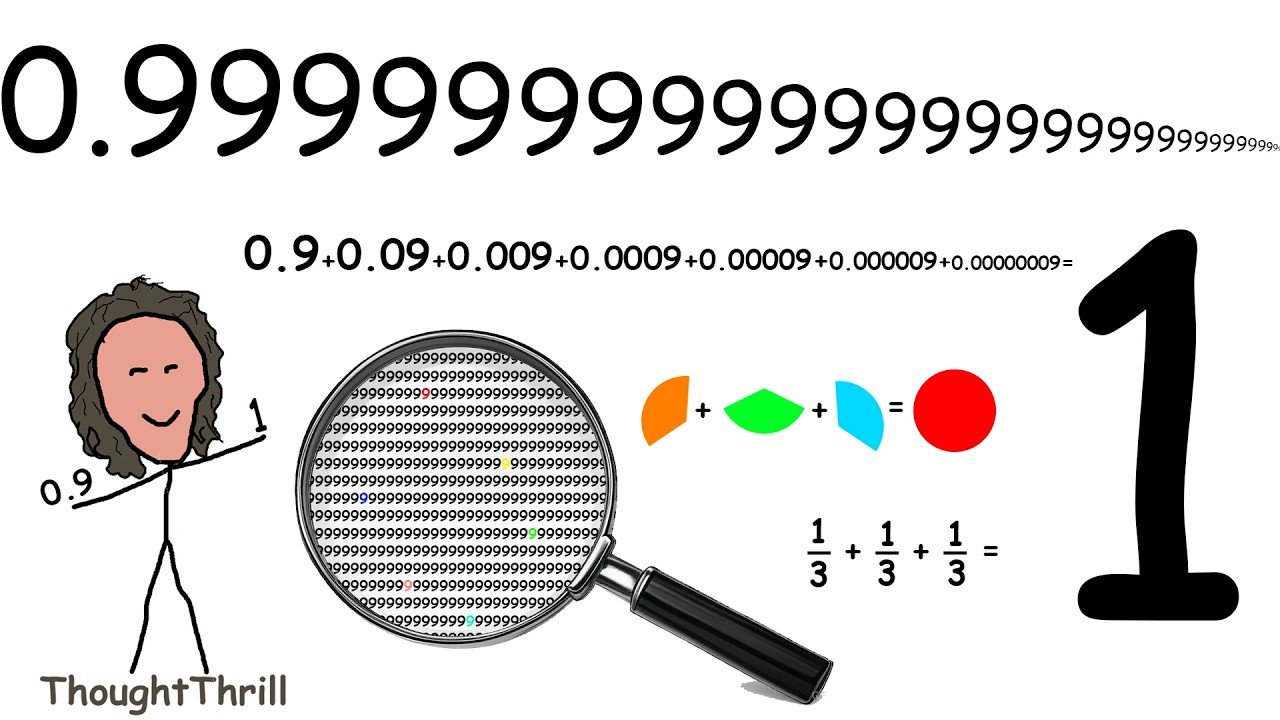
If we have 1/3 = 0.333… and we multiply both sides of the equation by 3, we see that 3/3 is equal to 0.999… Since 3/3 is 1, we find that 1 equals 0.999… The above is one of the simplest and most popular demonstrations that can be found regarding the claim that 0.999… equals 1. We will continue with more rigorous demonstrations.
Simple Algebraic Proof
Let’s set up the equation x = 0.999…, which we will call equation number one. Now consider multiplying the entire equation by 10 and thus obtaining equation number two: 10x = 9.999… Subtract the first equation from the second and you get 9x = 9. Dividing both sides by 9, we see that x = 1. Based on equation 1, since x = 0.999…, this means that 0.999… = 1.
Infinite Series Proof
Perhaps the most common definition of decimal expansions is in terms of infinite series. In particular, imagine a sequence where the nth term is a decimal point followed by n nines. Here each term has a subscript number called an index, which shows the position of the term in the sequence.
Now each term can be written as a sum of the values of the digits: s₁ = 0.9 = 9/10 = 9 × (1/10). Therefore, 0.999… is equal to an infinite sum:
0.999… = 9 × (1/10) + 9 × (1/10)² + 9 × (1/10)³ + …
Representing each term in the sequence using summation notation, it would be the sum from k = 1 to ∞ of 9 × (1/10)^k, which can be expressed starting from k = 0:
s = (9/10) × Σ(k=0 to ∞) (1/10)^k
Let’s resume: s = (9/10) × Σ(k=0 to ∞) (1/10)^k. Solving by means of the progression of a geometric series, we have this formula:
Σ(k=0 to ∞) r^k = 1/(1 − r), where |r| < 1
Clearly the absolute value of r is less than 1 because for our series it is 1/10. Then applying the convergence theorem of geometric series, we can calculate our final result:
s = (9/10) × Σ(k=0 to ∞) (1/10)^k = (9/10) × 1/(1 − 1/10)
Since 1 − 1/10 = 9/10, we have:
= (9/10) × (10/9) = 90/90 = 1
This implies that the infinite summation converges to 1, further proof that 0.999… is equal to 1.
Inequality and Limit Arguments
Taking our sequence, each term can be expressed as 1 minus some value, where this value is always a power of 10:
s₁ = 0.9 = 1 − 0.1 = 1 − 10⁻¹
So sₙ = 1 − 10⁻ⁿ.
Applying the concept of a limit, we have lim(n→∞) sₙ = L. We must determine whether the sequence is convergent or divergent. If it converges, we must demonstrate at what point this convergence occurs.
lim(n→∞) sₙ = lim(n→∞) (1 − 10⁻ⁿ)
Let’s evaluate the limit. We can start with a more informal demonstration. If we pretend for a moment that ∞ is just some really big number, we can rewrite the expression with that in mind:
= 1 − 10⁻∞ = 1 − 1/10∞
Multiplying ∞ copies of 10 together gives you ∞, so:
= 1 − 1/∞
Since 1 divided by a really big number is close to zero, 1/∞ is 0:
= 1 − 0 = 1
Put another way, the limit of a constant is the constant itself. On the other hand, any number will tend to zero if it is divided by a number tending to infinity:
lim(n→∞) (1 − 10⁻ⁿ) = 1 − 0 = 1
The limit being equal to 1 ensures that 0.999… is exactly equal to 1. This works because the limit of a sequence of numbers is defined as the value that the terms of a sequence approach as the index of the term goes to ∞. Essentially, it’s the value the sequence gets arbitrarily close to as you move further along in the sequence. In this case, one.
To make this argument fully rigorous, we must use the formal definition of the limit of a sequence of numbers. Since a limit is all about approaching a certain value, let’s call the limit value L and define a certain interval around it. Suppose this interval consists of any number within less than a certain non-zero distance of L. We’ll write this distance as the Greek letter ε (epsilon).
For instance, let’s say that the limit L is 1 and that the distance ε is 0.01. This means that our interval goes from 0.99 to 1.01. Note that this is an open interval, so it doesn’t include the endpoints. What we want is for this sequence to eventually end up in this interval and never leave again.
So let’s go through our sequence until we end up in the interval. The first few terms are 0.9 and 0.99. Now 0.99 is one of the endpoints, but it’s not included in the interval, so we’ll continue. Next is 0.999, which is in the interval. So is the next term, and the term after that. Indeed, every term after this is in the interval. The sequence never escapes.
That means for this interval, we can choose the third term to start from, and every term from then on will be in the interval. This is a good sign that our limit is one, but we’re not done with the proof yet. After all, starting with ε being 0.01 and using the same logic, the limit could just as well be a number like 1.1. We need to show that our logic still works no matter how small ε is, remembering that it has to be positive.
In other words, it’s like a game: you give me any positive value of ε you want, and I’ll tell you at what point the sequence enters the corresponding interval and never leaves again. We can call this point N. In the example we chose with ε = 0.01, we get N = 3.
Finally, to express the distance between two numbers, we can use the absolute difference, which is the absolute value of the difference. For instance, the distance between 3 and 5 is 2, since |3 − 5| = 2.
Now we can quote the formal definition of the limit of a sequence: L is the limit of a sequence aₙ if, for all real values of ε > 0, there is a natural number N so that if n ≥ N, then |aₙ − L| < ε.
For our sequence, let’s write a general equation where you can plug in a value of ε and receive a value of N in return. To start, notice the distance between the number one and each term in our sequence: 0.1, 0.01, and so on. These numbers are powers of 1/10. So if ε is equal to one of them, we can take the logarithm base 1/10 of ε to get a whole number corresponding to our position. However, this can result in non-whole values for other values of ε, so let’s fix that by applying the floor function, which rounds a value down to a whole number.
Unfortunately, the values we get from this expression are off by one, so we’ll add one to correct that. Finally, to avoid values of N less than one, we have to define its value piecewise: N is equal to this expression if ε is less than one, and N is equal to one otherwise. You can verify that this works by plugging in your own values of ε. This shows that the definition of the limit is satisfied, completing the proof.
Proof Method
The proof method consists of interpreting n as the number of nines that are present as digits in 0.999…ₙ. This allows us to write an equation relating each term of the sequence with the number one:
0.9 + 0.1 = 1
For example, if n = 2: 0.99 + 1/10² = 1.
Now if there exists a number x that is not greater than 1 and is not smaller than each 0.999…ₙ, then x is exactly equal to 1. We can express this using these inequalities:
x ≤ 1, and 0.999…ₙ ≤ x ≤ 1
For example, taking the first three terms, we have these inequalities:
0.9 ≤ x ≤ 1
Let’s multiply the whole inequality by −1. Since we are multiplying by a negative number, the inequality signs flip:
−0.999…ₙ ≥ −x ≥ −1
Let’s change the position of the terms of the inequality:
−1 ≤ −x ≤ −0.999…ₙ
Let’s add one to each term of the inequality:
0 ≤ 1 − x ≤ 1 − 0.999…ₙ
This is equivalent to saying that 0 ≤ 1 − x ≤ 1/10ⁿ, and this implies that the difference between 1 and x is less than or equal to the reciprocal of any integer power of 10, and indeed any positive integer.
Here we invoke the concept of the Archimedean property that is fulfilled by the rationals and the reals, which says that there is no rational that is larger than all integers. This implies that zero is the only non-negative number smaller than the reciprocal of any positive integer. In other words, the fact that 1 − x is a non-negative value that is less than the reciprocal of every positive integer tells us that the only way to obtain such a value is for that value to be zero. That is, 1 − x must equal 0, so x must equal 1.
Hyperreal Numbers
Last but not least, let’s talk about the demonstration using the concept of hyperreal numbers and how it can help us in solving the question of whether 0.999… equals 1.
Hyperreal numbers are an extension of the set of real numbers that allow us, among other things, to formalize some operations with infinitesimals, usually thought of as infinitely small numbers. The hyperreals also allow us to prove some classical results of real analysis, a field of math that studies real numbers, in a simpler way.
They are an algebraic structure consisting of numbers, operations on those numbers, and rules for performing those operations. They are non-Archimedean. In other words, they fail to satisfy the Archimedean property from before. They are also metrically incomplete, so a sequence of hyperreal numbers can converge to a limit outside of the hyperreal numbers. They are a field, so the usual arithmetic operations (addition, subtraction, multiplication, and division) behave nicely like in the real numbers. Finally, the hyperreal numbers contain the Archimedean and complete set identifiable with the real numbers.
In the hyperreal numbers, there are infinitesimal numbers that are infinitely close to 0 but are different from zero. For example, a positive infinitesimal number ε is a number greater than zero but less than every positive real number. Then what would be the reciprocal of ε? For any positive infinitesimal number, the reciprocal will be an infinite number.
It turns out that there are ways to rigorously define this hyperreal number system and to use these numbers in a field called non-standard analysis. Let’s look at the differences from earlier again. 0.9 = 1 − 0.1, so if what we subtract is an infinitely small amount, we have 0.999… = 1 − ε.
By constructing a number system that does not obey the Archimedean property, we can find the interpretation that 0.999… is somehow infinitesimally smaller than one. However, if we want to work with standard real numbers, then we must conclude that 0.999… is exactly equal to 1.
Specifically, the difference 1 − 0.999… must be less than any positive real number, so it must be an infinitesimal or zero. Since real numbers do not contain infinitesimals, it is assumed that the difference must be zero, and therefore the two expressions represent the same number. That is, 0.999… = 1.
Leave a Reply