
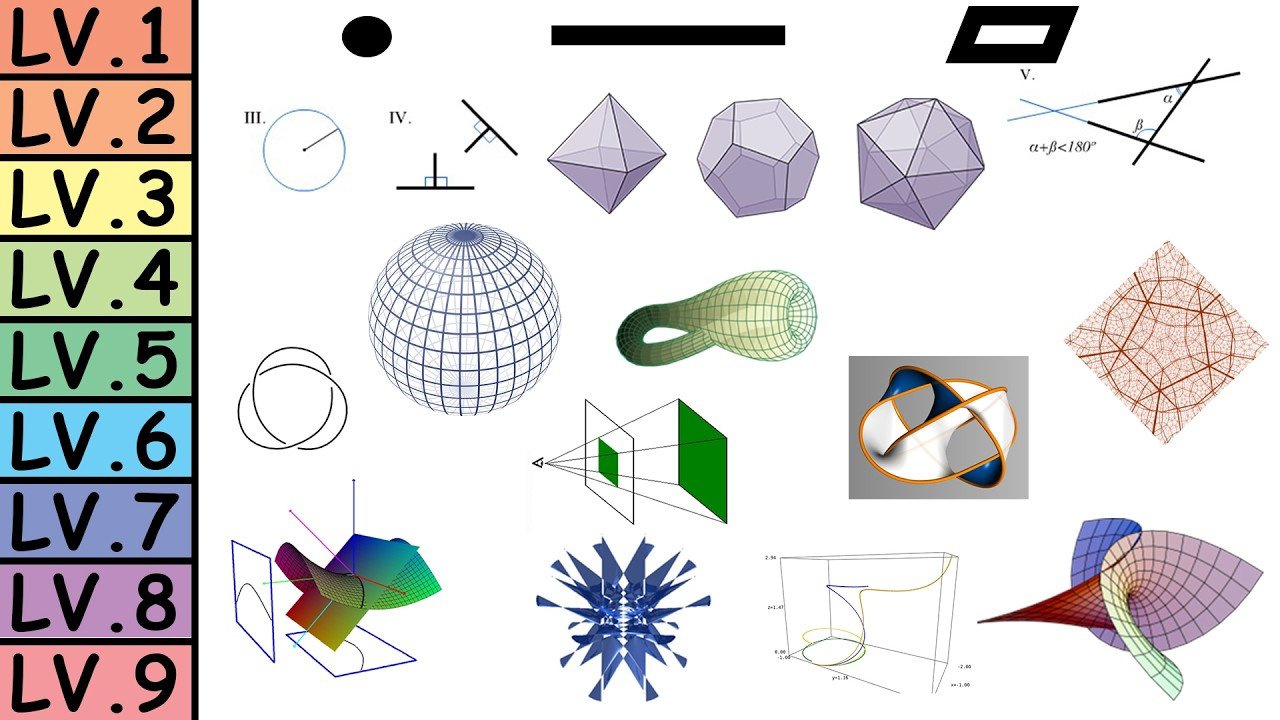
Level 1. Basic Geometry
The fundamental entities of geometry include the point, the line, and the plane. It is only possible to describe them in relation to other similar elements.
The point is an exact location in space with no size or volume. It is considered to exist in zero dimensions, having neither length, width, nor height. The straight line is a continuous succession of points extended in a single direction and, along with the point, exists in only one dimension. The plane is an object that has two dimensions and contains infinite points and straight lines.
Lines can be classified as parallel, perpendicular, or secant. The angle is the figure formed by two lines (called sides) which share a common endpoint. This point is called the vertex. Depending on their positions, angles are classified into consecutive angles, adjacent angles, and vertical angles. According to their measure, angles are classified as right, acute, obtuse, straight, and full.
The best-known figures of plane geometry are the triangle, hexagon, rectangle, rhombus, square, circle, trapezoid, and pentagon. The triangle can be described with three fundamental geometry theorems. The Pythagorean theorem: a² + b² = c². The law of sines: a/sin α = b/sin β = c/sin γ. And the law of cosines: c² = a² + b² − 2ab cos γ.
Level 2. Intermediate Geometry
Euclid’s five postulates refer to the treatise called the Elements, written by Euclid around 300 BC. The postulates are as follows. First, any two distinct points determine a straight line segment. Second, a straight line segment can be extended indefinitely in a straight line. Third, a circle can be drawn given any center and radius. Fourth, all right angles are equal to each other. Fifth, through a point outside a straight line, exactly one parallel straight line passes.
The circumference is the geometric locus of the points of a plane that are equidistant from another point called the center. This distance is known as the radius of the circumference. So what is the difference between a circle and a circumference? A circle is defined as the area or flat surface contained within a circumference. Some mathematical relationships: the area of a circle is A = πr², and the perimeter of the circumference is P = 2πr.
Level 3. Advanced Geometry
This level includes the study of geometric bodies. The five Platonic solids are convex polyhedra such that all their faces are regular polygons equal to each other, and in which all the solid angles are equal. Here are the reasons why there are only five such shapes and not more: for each of the five shapes, at least three faces meet at each vertex, and the internal angles that meet at a vertex sum to less than 360°.
They are identified as the tetrahedron (4 faces), the cube (6 faces), the octahedron (8 faces), the dodecahedron (12 faces), and the icosahedron (20 faces).
Round bodies are solid geometric figures that have at least one curved surface and are obtained by rotating a figure around an axis. Some examples of round bodies are the cylinder, the cone, and the sphere.
Level 4. Analytic Geometry
Analytic geometry, also known as Cartesian geometry, is the study of geometry using a coordinate system. Cartesian coordinates are coordinates used in Euclidean spaces which meet at a point of origin and form the coordinate plane.
In analytic geometry, the equation of a straight line in a plane can be expressed by the equation y − y₁ = m(x − x₁) + b, where x and y are variables in a Cartesian plane. In this expression, m is called the slope of the line and is related to the inclination that the line takes with respect to a pair of axes that define the plane, while b is the so-called independent term and is the value of the ordinate of the point at which the line cuts the vertical axis. The slope is defined as m = (y₂ − y₁)/(x₂ − x₁).
A geometric locus is defined as the set of all points in a plane or space that meets specific conditions, such as the conditions that form conic sections.
An important topic is the transformation of coordinates, specifically from rectangular coordinates to polar coordinates. The following relationships are used: r² = x² + y², y = r sin θ, x = r cos θ, and tan θ = y/x. In the polar plane, we can find plane curves like four-petal roses, cardioids, limaçons, lemniscates, and logarithmic spirals. If you ever want to create a heart shape, it’s good to know that you can graph one using polar coordinates.
Level 5. Non-Euclidean Geometry
Non-Euclidean geometry is a mathematical model that studies geometry on surfaces that are not flat and that is not based on all the postulates of Euclidean geometry. There is not a single system of non-Euclidean geometry but many. Three formulations of geometries can be distinguished.
Euclidean geometry satisfies the five postulates of Euclid and has zero curvature, meaning it is assumed to be a flat space. Hyperbolic geometry satisfies only the first four postulates of Euclid and has negative curvature. Elliptic geometry satisfies only the first four postulates of Euclid and has positive curvature.
A classical model of n-dimensional elliptic geometry is the n-sphere. Complementing the concept of finite geometry, we have a geometric system that has only a finite number of points. Euclidean geometry is not finite, since the Euclidean line contains infinitely many points. A finite geometry can contain any finite number of dimensions.
Level 6. Topological Geometry
Topological geometry studies geometric, topological, and algebraic problems that arise in the study of manifolds of dimensions less than five.
A 1-manifold is a topological space of dimension one. Examples include the number line and the circle. A surface is a two-dimensional manifold, some of which arise as graphs of functions of two variables. However, surfaces can also be defined abstractly without reference to any ambient space. For example, the Klein bottle is a surface that cannot be embedded in three-dimensional Euclidean space. An example of a non-orientable surface is the Möbius strip, which is also a ruled surface.
In low-dimensional topology, 3-manifolds are a field that studies three-dimensional topological manifolds. An example is the simplicial scheme of a hyperbolic 3-manifold. A 4-manifold is a four-dimensional topological manifold from which physical concepts such as spacetime and relativity are built. The tesseract, the four-dimensional analog of the cube, is an important example here.
Level 7. Projective Geometry
Projective geometry is the branch of mathematics that studies the properties of geometric figures that are preserved under projection onto another surface. Its practical applications are widely used in technical drawing, such as isometric views and projections used to better describe a figure from multiple perspectives.
Level 8. Differential Geometry
Differential geometry is the study of geometry using the tools of mathematical analysis and multilinear algebra. While geometric topology focuses solely on topological properties, differential geometry allows the application of results from multivariable calculus.
A ruled surface in geometry is generated by a straight line (called a generatrix) moving over one or more curves (called directrices). In differential geometry, Riemannian geometry is the study of differential manifolds with Riemannian metrics. Riemann surfaces can be thought of as deformed versions of the complex plane. For example, a Riemann surface appears when extending the domain of the function f(z) = √z.
A curve on a surface gives rise to the Frenet-Serret frame. Another important concept in differential geometry is the torsion tensor. Torsion is particularly useful in the study of the geometry of geodesic lines.
Level 9. Algebraic Geometry
Algebraic geometry is a branch of mathematics that, as its name suggests, combines abstract algebra (especially commutative algebra) with analytic geometry. Algebraic geometry occupies a central place in modern mathematics and has multiple conceptual connections with fields as diverse as complex analysis, topology, and number theory.
The best-known algebraic surfaces are surfaces of order two, or quadric surfaces. The order of an algebraic surface is the order of the polynomial defining it, which can be geometrically interpreted as the maximum number of points at which a line meets the surface. Algebraic surfaces range from degree 2 (quadrics) through increasingly complex surfaces up to degree 16 and beyond.
Further Reading
- Euclid’s Elements hosted by Clark University
- Platonic Solids on MathWorld
- Non-Euclidean Geometry on MathWorld
- Riemannian Geometry on MathWorld
- Algebraic Surface on MathWorld
Leave a Reply