
Completing the Square: Why It’s Actually About Squares
If you’ve ever taken an algebra class, you’ve probably been asked to solve for x. Before you get to quadratic equations, you usually start with linear equations, which are equations that can be put in the form ax + b = 0 for a ≠ 0. Once you know the process, these are simple, and some basic algebra gives a general formula.
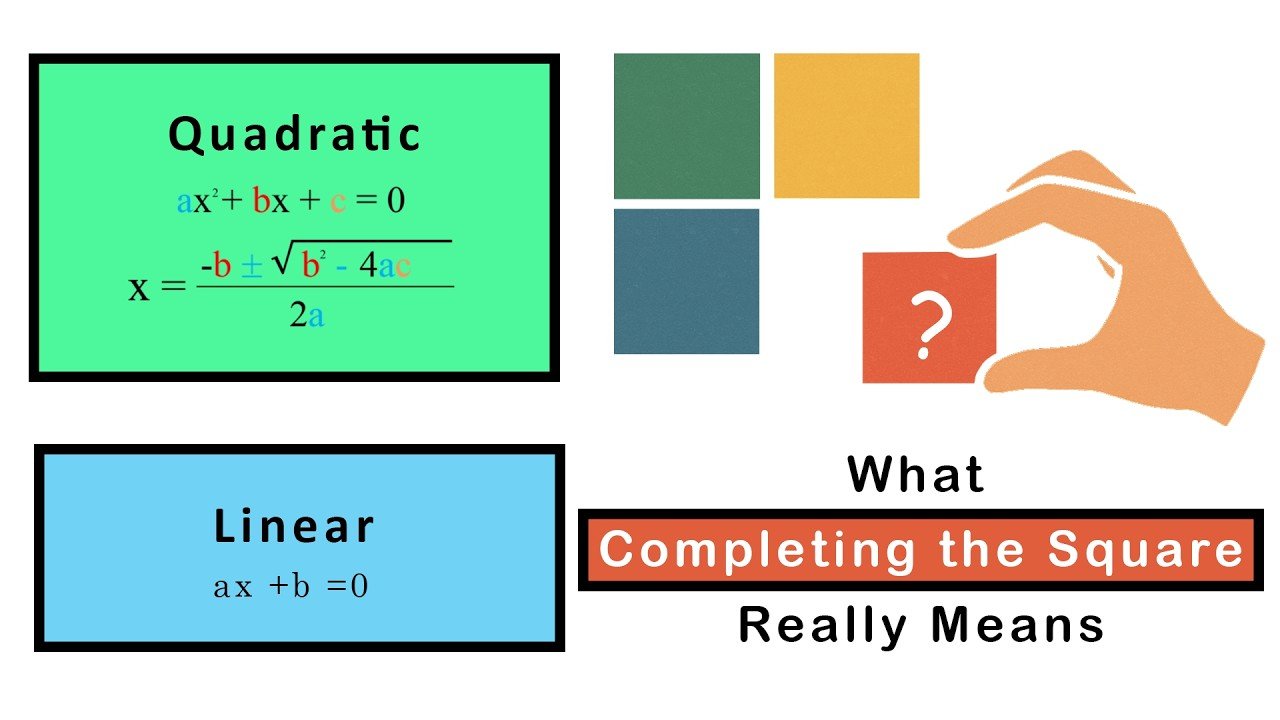
Meanwhile, a quadratic equation is of the form ax² + bx + c = 0, assuming that the value a isn’t equal to zero. The word quadratic comes from the Latin quadratus, meaning “made square,” in reference to the x². The expression ax² + bx + c is called a polynomial, meaning “many terms,” where the terms are the things being added together. In particular, a polynomial of this form is called a quadratic polynomial. And a quadratic equation is about finding the values of x where a quadratic polynomial is equal to zero: the roots or zeros of the polynomial.
Quadratic equations turn out to be far more annoying than linear equations. A variety of techniques have been developed to solve them, and here we will focus on one of them: completing the square. In particular, we will explore why the method is called completing the square, a detail which is often glossed over in courses.
Starting Simple
As is usual in math, let’s start with something slow and simple: x² − 9 = 0. First, we add 9 to both sides, giving us x² = 9. Now, what number times itself gives you 9?
To visualize this, one idea you might have is to draw a literal square with side lengths of x. This square must have an area of x², which we know is 9 in this case. From here, the solution that may be immediately obvious to you is x = 3. But x = −3 is also a possible solution because −3 × −3 = 9. These two solutions compose our solution set.
Admittedly, the square is kind of a lie here. It usually doesn’t make sense to have a negative length in math, but it’ll be important for completing the square later. So just remember not to think of x as a literal length.
Square Roots and Absolute Values
Now, this idea of “what number squared gives you this number” is often useful in math, and it is called the square root. Actually, a nonzero number has two square roots. However, we conventionally choose the non-negative square root called the principal square root, or just the square root for short. In general, it’s often important in math to get a single definite result from an operation.
You may have heard that you have to take the principal square root when a square root symbol is given to you, but you have to attach a plus or minus when you supply the square root yourself. Though this may seem rather confusing and arbitrary, there is another way to think about it.
First, consider the equation x² = 9 again and take the square root of both sides: √(x²) = √9. The right side is simply 3. We don’t need to worry about a plus or minus at the moment. On the left, you may think that the square root and the square fully cancel each other out. But this is not actually the case. In actuality, for a real number x, squaring it and then taking the square root will give you its absolute value: |x| = 3.
The absolute value of a real number, written with vertical bars, is just its distance from zero on the real number line. When taking the absolute value, a positive number stays positive, whereas a negative number becomes positive. There are two real numbers whose absolute value is 3: those being 3 and −3. So x = 3 and x = −3 are our solutions. Keep in mind that x has to be a real number for this reasoning to work.
A More Complicated Example
Unfortunately, not all quadratic equations can be as nice as the one we just solved. Let’s look at a more complicated example: x² + 4x − 21 = 0.
There are a variety of ways we can proceed from here. And if you’ve learned about quadratic equations before, you may know some of them. But right now, let’s use the following procedure. Add 21 to both sides, giving us x² + 4x = 21. With this step, we’ve isolated the constant term on the right-hand side.
Now let’s try to visualize this situation again. We can draw a square with a side length of x and an area of x², just like before. But now we also have the term 4x to deal with. Let’s draw a rectangle with a width of 4 and a height of x. Then we can cut the rectangle into two identical rectangles, each with a width of 2 and a height of x.
We can glue one of these rectangles to the right of the square representing x². Then we can rotate the other one by a quarter turn and glue it to the bottom of the square. This gives us an overall shape with an area of x² + 4x. Remember, this area has to be equal to 21.
Now this shape almost looks like a square. However, there is a little missing part in the bottom right corner. This missing part has a width of 2 and a height of 2, so it’s a smaller square with an area of 4. Adding in this missing part, the overall shape is finally one big square. This is called completing the square.
Solving by Completing the Square
So let’s figure out this big square’s area. Remember, before adding in the missing part with an area of 4, we had the equation x² + 4x = 21. Adding 4 to both sides gives us x² + 4x + 4 = 25.
On one hand, we know that the big square’s area is x² + 4x + 4. And on the other, we know that it’s 25. The square has a side length of x + 2, so we can turn this equation into (x + 2)² = 25.
Now we solve the equation similarly to before. Take the square root on both sides: √((x + 2)²) = √25. Everything here is a real number, including x + 2, so we can change the square root of a square into an absolute value: |x + 2| = 5.
Since there’s an absolute value, we have two possibilities to solve for. The first is that x + 2 = 5. Subtracting 2 from both sides gives us x = 3. Alternatively, x + 2 could be equal to −5. Again, we subtract 2 from both sides, giving us x = −7.
Remember, negative lengths don’t really make sense in geometry, but the square in completing the square shouldn’t be taken too literally.
Verification
Let’s bring back the original equation, x² + 4x − 21 = 0, and verify that both of our solutions work.
First, x = 3:
- 3² + 4(3) − 21 = 0
- 9 + 12 − 21 = 0
- 21 − 21 = 0
- 0 = 0 ✓
Now, x = −7:
- (−7)² + 4(−7) − 21 = 0
- 49 − 28 − 21 = 0
- 21 − 21 = 0
- 0 = 0 ✓
So our solutions are correct.
Leave a Reply