
What Is a Non-Newtonian Fluid?
A non-Newtonian fluid is one whose viscosity does not remain constant under different rates of deformation. Unlike Newtonian fluids such as water or air, where the relationship between shear stress and deformation rate is linear, in non-Newtonian fluids this relationship becomes nonlinear. Mathematically, this means that viscosity depends on the rate of deformation: μ is a function of the deformation rate du/dy, where μ is the apparent viscosity and du/dy is the deformation rate (or velocity gradient).
In a Newtonian fluid, the shear stress τ is defined as τ = μ(du/dy). These are called Newtonian fluids in honor of Isaac Newton, who was the first to formulate the mathematical relationship between shear stress and the rate of deformation in a fluid. In contrast, for a non-Newtonian fluid, this formula is no longer sufficient, and more complex models are required to describe its behavior.
Time-Independent Non-Newtonian Fluids
The classification of non-Newtonian fluids is based on the shear stress they undergo in relation to whether or not they are time-dependent. Among the time-independent non-Newtonian fluids are the following types.
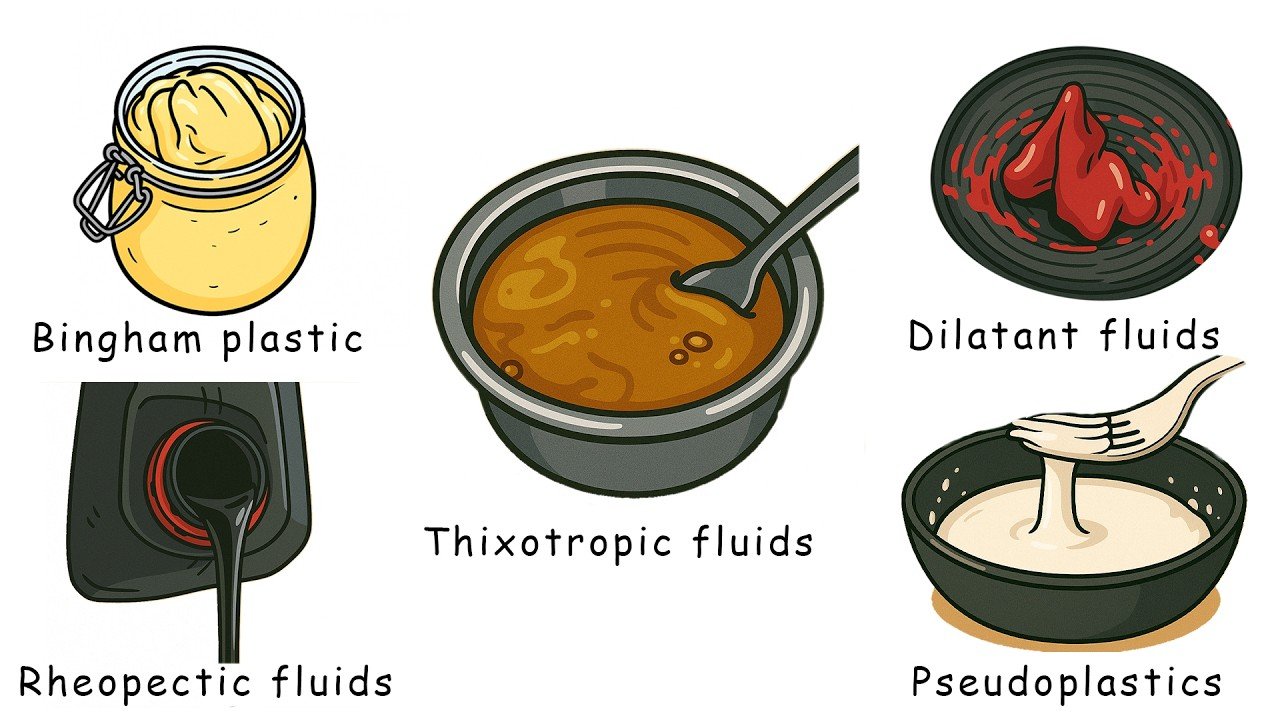
Bingham plastics are materials that do not flow until a minimum force, known as the yield stress, is applied. Once that threshold is exceeded, they behave like a viscous fluid. Toothpaste is a familiar example: it doesn’t come out of the tube until you squeeze it with a certain amount of force. Mayonnaise requires a certain initial force to start moving. Melted chocolate, especially if it contains solid particles in suspension, behaves similarly.
Pseudoplastic fluids (also called shear-thinning fluids) have a viscosity that decreases as the deformation rate increases, meaning that when stirred or forced more, they flow more easily. Ketchup is a classic example: when shaken or the bottle is tapped, it becomes more liquid. Blood is another, as its viscosity decreases when it flows faster through the arteries. Yogurt stays thick at rest but becomes more fluid when stirred or moved with a spoon.
Dilatant fluids (also called shear-thickening fluids) have a viscosity that increases as the deformation rate increases. They become harder or more resistant when force is applied quickly. The water and cornstarch mixture known as oobleck is a classic example. If struck, it hardens. If left still, it flows slowly like a liquid. It acts like a solid when pressure is applied, but like a liquid when it is not.
Time-Dependent Non-Newtonian Fluids
Rheopectic fluids increase their viscosity over time when a constant deformation is maintained. Some lubricants or industrial paints that thicken while being continuously mixed fall into this category.
Thixotropic fluids decrease their viscosity over time under constant deformation. When agitation stops, they regain their original consistency. Wall paint is a good example: it becomes more liquid when stirred but thickens again at rest. Clay or bentonite mud used in oil drilling becomes fluid with constant agitation but thickens when left still, which is useful for keeping particles suspended.
The Mathematical Challenge
These differences between Newtonian and non-Newtonian fluids are not just physical curiosities. They represent significant mathematical challenges, as they require modifications to the traditional equations of fluid dynamics and the development of models that accurately describe their nonlinear properties.
To mathematically describe the behavior of non-Newtonian fluids, one begins with the Navier-Stokes equations, which are fundamental in fluid mechanics. These equations express the conservation of momentum, and for an incompressible Newtonian fluid, the viscous term μ∇²u is linear. However, in non-Newtonian fluids, this viscous term is no longer linear. Instead, a formulation is required that relates stress to deformation through more complex functions. This is where various rheological models come into play.
Rheological Models
The power law model is one of the most commonly used models for pseudoplastic and dilatant fluids. It defines the shear stress τ in terms of a consistency index K and a flow behavior index n. If n < 1, the fluid is pseudoplastic (shear-thinning). If n > 1, it is dilatant (shear-thickening).
The Bingham model describes fluids that require a minimum stress before they begin to flow. It includes a yield stress τ₀ and a plastic viscosity η. This model is useful for pastes and dense suspensions.
The Herschel-Bulkley model is a generalization of the previous two. It allows for the adjustment of both the yield stress and the nonlinear behavior, making it especially versatile for complex rheological simulations.
To accurately analyze these fluids, tensors are used. The stress tensor represents how internal forces are transmitted within the fluid, while the strain rate tensor describes how velocity changes in space. The interaction between these tensors is what enables the construction of precise mathematical models that simulate how these materials flow under different conditions.
Real-World Applications and Open Problems
The mathematical understanding of non-Newtonian fluids has led to remarkable advances in various fields of science and engineering. Their unique behaviors are essential in real-world problems, ranging from medicine to the development of new materials.
Despite the progress in studying non-Newtonian fluids, many aspects remain unexplored territory for applied mathematics. One of the main challenges is the computational complexity involved in solving the equations that describe them. Unlike linear models, these require simulations with multiple time and space scales, which demand advanced numerical techniques and enormous processing power.
In addition, many current models rely on parameters that must be adjusted experimentally. This limits their predictive capability in contexts where conditions change dynamically. There is a growing need to develop adaptive models that integrate machine learning or real-time updates of their constitutive equations. Computational fluid dynamics software can visualize maps of velocity, pressure, and local viscosity, and optimize industrial processes related to the transport, mixing, or application of these fluids. It also allows customization of fluid behavior through user-defined functions, enabling detailed analysis without the need for costly physical experiments.
Solving these problems involves not only advances in pure mathematics but also interdisciplinary collaboration with physics, biology, and computing. The future of non-Newtonian fluid studies lies at the intersection of these mathematical frontiers.
Further Reading
- Navier-Stokes Equations on MathWorld
- Non-Newtonian Fluid on Wikipedia
- Herschel-Bulkley Fluid on Wikipedia
- Bingham Plastic on Wikipedia
- Rheology on Wikipedia
Leave a Reply