
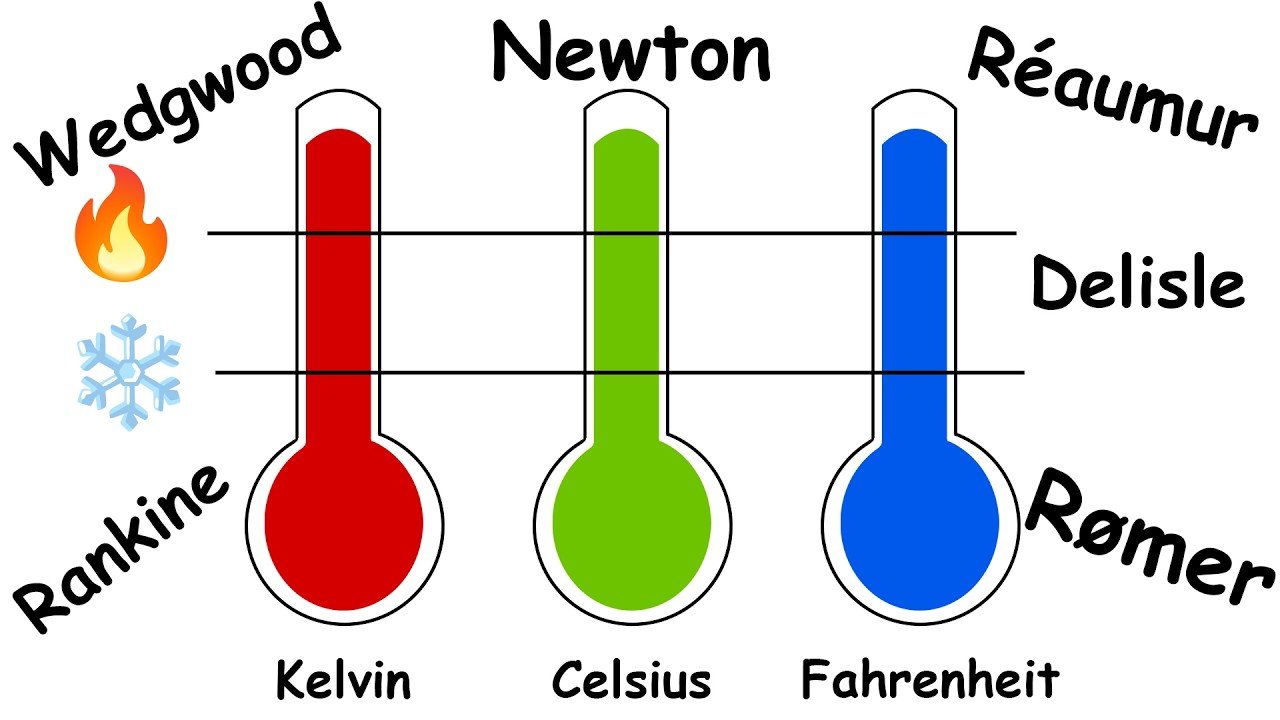
Celsius
In its simplest definition, a temperature scale uses numbers to classify how hot or cold something is. The Celsius scale is the most commonly used scale of temperature around the world, with units of degrees Celsius. At one atmosphere of pressure, 0°C is the temperature at which water freezes and 100°C is the temperature where it boils.
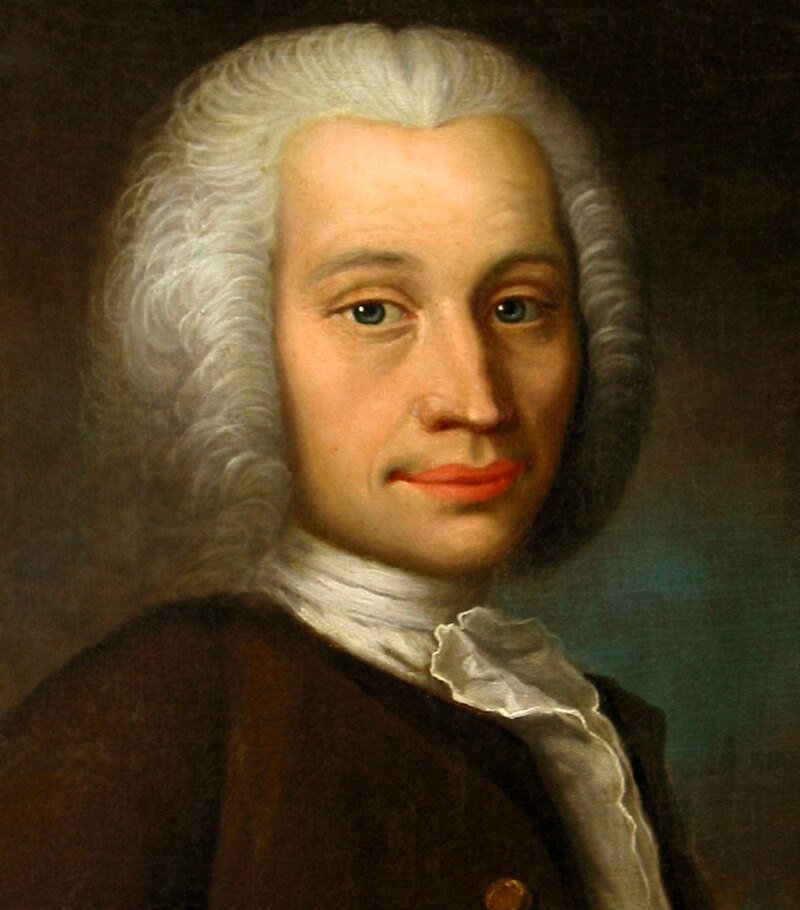
The history of the Celsius scale begins all the way back in 1742 with Swedish physicist and astronomer Anders Celsius. Though he invented the scale that would eventually become Celsius as we know it, it involved a choice that would seem bizarre to us today: zero was boiling and 100 was freezing. So higher numbers represented colder temperatures. Since temperature is a kind of energy measurement, this would mean that higher numbers counterintuitively correspond to lower energy.
However, Celsius himself actually knew this. He lived in Sweden, where it gets exceptionally cold, so he chose this orientation to avoid dealing with negative numbers too much. Additionally, his choice was based on the earlier Delisle scale, which follows a similar orientation.
Celsius’s water-based approach resulted in a revolution in temperature scale standardization. His work was highly respected among the scientific community, though pretty much everyone came to the decision of making one change: flip 0 and 100. And with that, the modern Celsius scale was invented.
There is still one remaining convention to discuss: the name of the scale. The standard name was “centigrade” beginning in the 1800s. However, this could also mean 1/100th of a gradian, where the gradian is a unit of angle measurement. Due to this ambiguity, “Celsius” was adopted for the scale in honor of Anders Celsius, even though he technically didn’t invent it in its modern form. This is the standard name in scientific communities today, though “centigrade” persists in some more colloquial contexts.
Fahrenheit
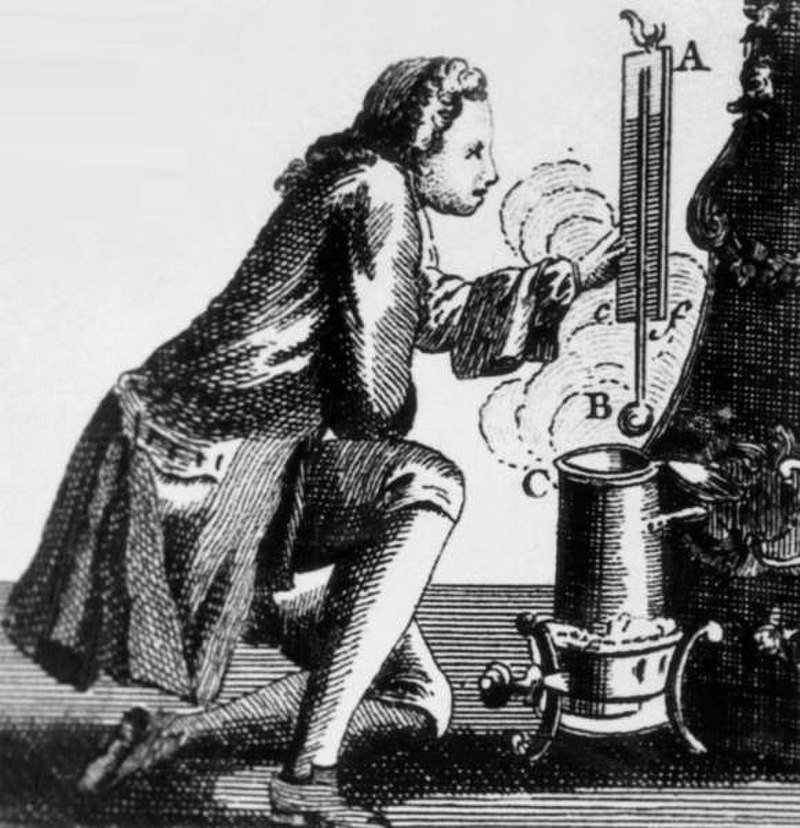
The Fahrenheit scale, with units of degrees Fahrenheit, is likely familiar to those living in the United States of America as well as places with heavy US influence. Its story begins in 1724, 18 years before that of Celsius, with Polish-Lithuanian physicist and inventor Daniel Gabriel Fahrenheit.
It is believed that the Fahrenheit scale was initially defined using two fixed points at 0 and 90. Zero was chosen as the stable temperature of a brine made of ice, water, and ammonium chloride. 90 was based on an estimate of average human body temperature. The scale was based on earlier work by Danish astronomer Ole Christensen Rømer, inventor of the Rømer scale.
A later adjustment put 32 as water’s freezing point and 96 as human body temperature, leaving 64° between them. Daniel Fahrenheit chose a power of two so that degrees could be marked just by repeatedly splitting intervals in half. However, soon after, Celsius’s work meant that using water to measure temperature was the hot new thing. So the Fahrenheit scale underwent one final major revision. 32 and 212 became the freezing and boiling points of water, respectively. This puts the brine’s stable temperature at about −4° and the average human body temperature at about 98.6°, a modest difference from Daniel Fahrenheit’s original vision.
Though Fahrenheit was in popular use among English-speaking countries for a while, it largely fell out of favor throughout the 20th century as Celsius took over, except in the US. Fahrenheit and Celsius each have their supporters. One might claim that Fahrenheit’s 0 to 100 range is a close representation for the temperature range where humans live, and that rounding in Fahrenheit is more useful. Another might point out that Celsius’s 0 to 100 range was designed to work nicely with water, which humans find themselves using extremely frequently.
Kelvin
The Kelvin scale is the temperature scale used in the International System of Units (SI). To understand the Kelvin scale, let’s start really thinking about what temperature actually is. It begins with a concept called kinetic energy, which is the energy of an object that comes from its motion. This is determined by the amount of work required to accelerate an object to a given speed. More mass means more kinetic energy because heavier objects need more work to be moved. Similarly, more speed means more kinetic energy because you need more work to make it go faster.
Temperature is simply a measure of the average kinetic energy of the particles in a material. These particles are jiggling around at the atomic level, and temperature just tells us how much they jiggle. So what if there’s no jiggling at all? That would mean the material has the lowest possible temperature, which has a special name: absolute zero, or −273.15°C. This is where zero is on the Kelvin scale, making it an absolute temperature scale. This is the least arbitrary possible choice for zero in a temperature scale.
A kelvin has the same magnitude as a degree Celsius. A change by one kelvin equates to a change by 1°C. A quick note on terminology: the Kelvin scale as defined in the SI does not use “degrees.” The units are kelvins, not “degrees Kelvin.” As for capitalization, the K is uppercase for the scale but lowercase for the unit.
The history of the Kelvin scale begins in 1848 with British physicist and engineer William Thomson, 1st Baron Kelvin. At this time, Kelvin calculated absolute zero as being about −273°C, which we know is accurate today. This was accompanied by a proposal for an absolute Celsius scale, the predecessor of the modern Kelvin scale. However, the initial system was flawed and had to be refined in 1854. Then the 10th General Conference on Weights and Measures redefined it in 1954. The unit name changed from “degrees absolute Celsius” to “degrees Kelvin,” then to just “kelvin” between 1967 and 1968.
The story concludes with the 2019 SI revision, which centered on redefining units based on universal constants. The kelvin in particular was redefined in terms of the Boltzmann constant, and that definition stands today. All other temperature scales are now defined in terms of the Kelvin scale, so 0°C and 100°C aren’t exactly the freezing and boiling points of water anymore.
The Obscure Temperature Scales
Rankine. The unit is the degree Rankine, written °R or °Ra. It’s Fahrenheit but with 0° Rankine set at absolute zero. This was proposed in 1859 by Scottish mathematician and physicist William John Macquorn Rankine. Some write the units as “rankine” instead, similar to “kelvin.” This one is not used much.
Rømer. This is the Fahrenheit forerunner, invented by Ole Christensen Rømer in 1702, with units written °Rø. It was defined so that 7.5° and 60° are water’s freezing and boiling points, respectively. Historians hypothesize that 0° was based on the brine temperature. One version of Fahrenheit took Rømer and multiplied everything by four to eliminate fractions.
Delisle. This is the Celsius forerunner, invented by French cartographer and astronomer Joseph-Nicolas Delisle in 1732, with units written °D. As with the original Celsius, higher numbers are colder. This scale was used in Russia for a while.
Newton. Invented by Sir Isaac Newton in 1701. Newton was a brilliant mathematician and physicist, but he was not a good temperature scale inventor. His scale describes many different reference points, many of which are completely subjective, such as “the greatest heat of a bath which one can endure for some time when the hand is dipped in and is kept still.” The objective parts taken together make for a completely inconsistent and incoherent system. However, this scale was likely only intended for personal use, so we can’t judge it too harshly.
Réaumur. Based on a 1730 scale by French entomologist René Antoine Ferchault de Réaumur, 0° and 80° are the melting and boiling points of water. This one was widespread throughout Europe up to the 19th century.
Wedgwood. An 18th-century scale by English potter and abolitionist Josiah Wedgwood, intended to be used for metals. 0° Wedgwood was 580°F (about 304°C), and step sizes were meant to be 72°F. Unfortunately, in creating this system, Wedgwood overshot the melting points of copper, silver, and gold each by at least 1,400°C. A later correction revealed that the starting point was about 300°C too high and the steps nearly twice as big as they should be, but the element melting points were overshot even then.
Further Reading
- Kelvin on Wikipedia
- Celsius on Wikipedia
- Fahrenheit on Wikipedia
- Rankine Scale on Wikipedia
- Rømer Scale on Wikipedia
- Boltzmann Constant on Wikipedia
Leave a Reply