
Five Circle Problems That Are Way Harder Than They Look
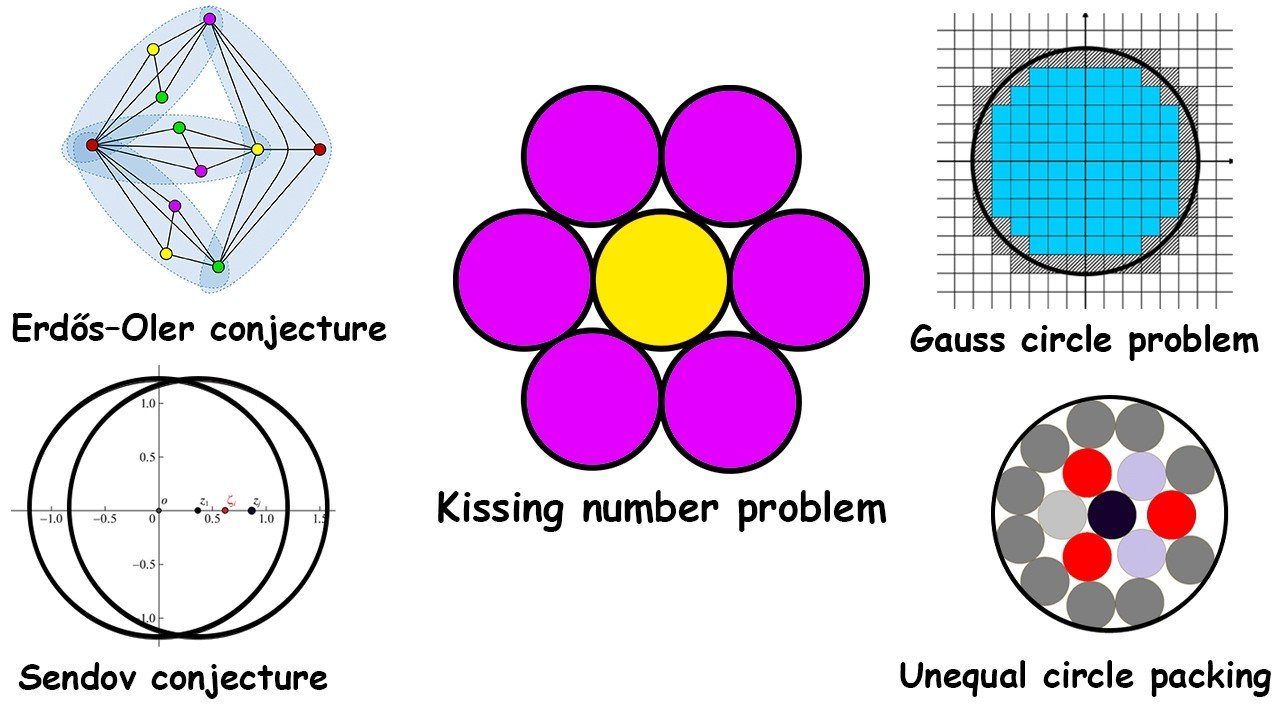
The Erdős-Oler Conjecture
A unit circle is a circle whose radius (the distance from the center to the edge) is 1. An equilateral triangle is a triangle where all the side lengths are the same. Suppose you have a certain number n of unit circles, where n is at least 1, and you want to pack them into an equilateral triangle with no overlap. For each n, what is the smallest possible triangle side length s? This is an example of a packing problem, and packing problems are notorious for producing a lot of unsolved examples.
We can work out some specific cases. Starting with n = 1, the side length of our triangle is 2√3, about 3.464. Then n = 2 gives a side length of 2 + 2√3, about 5.464. Interestingly enough, n = 3 actually gives the same side length of 2 + 2√3 again. Altogether, solutions are known all the way up to n = 12, and for all triangular numbers.
A triangular number is a number obtained by taking the sum 1 + 2 + 3 + … up to n, where n is a non-negative integer. If n = 0, then the result is equivalent to adding together no numbers (known as the empty sum), which is zero. The first few triangular numbers are 0, 1, 3, 6, and 10. If you have a triangular number of objects, they can be packed together into the shape of an equilateral triangle. This method can be used to obtain a circle packing in an equilateral triangle for all triangular numbers n.
The Erdős-Oler conjecture, named after Hungarian mathematician Paul Erdős and Canadian mathematician Norman Oler (where “conjecture” is an educated guess), states: if you have a triangular number n of unit circles, then the optimal bounding triangle for n and n − 1 is the same. In other words, given an optimal packing of n circles in an equilateral triangle, you can always remove a circle and still have the packing be optimal. This conjecture seems to make intuitive sense, but it has not been proven.
The Gauss Circle Problem
A point in space can be described by a coordinate list. In two dimensions we can use the coordinate pair (x, y). Now suppose that all of the coordinates you have are integers. If you plot all possible points you can reach under this restriction in a given Euclidean space, the result is called a lattice, composed of lattice points. In 2D, using a Cartesian coordinate system, you can draw a lattice by filling in all the points where the integer-valued grid lines intersect.
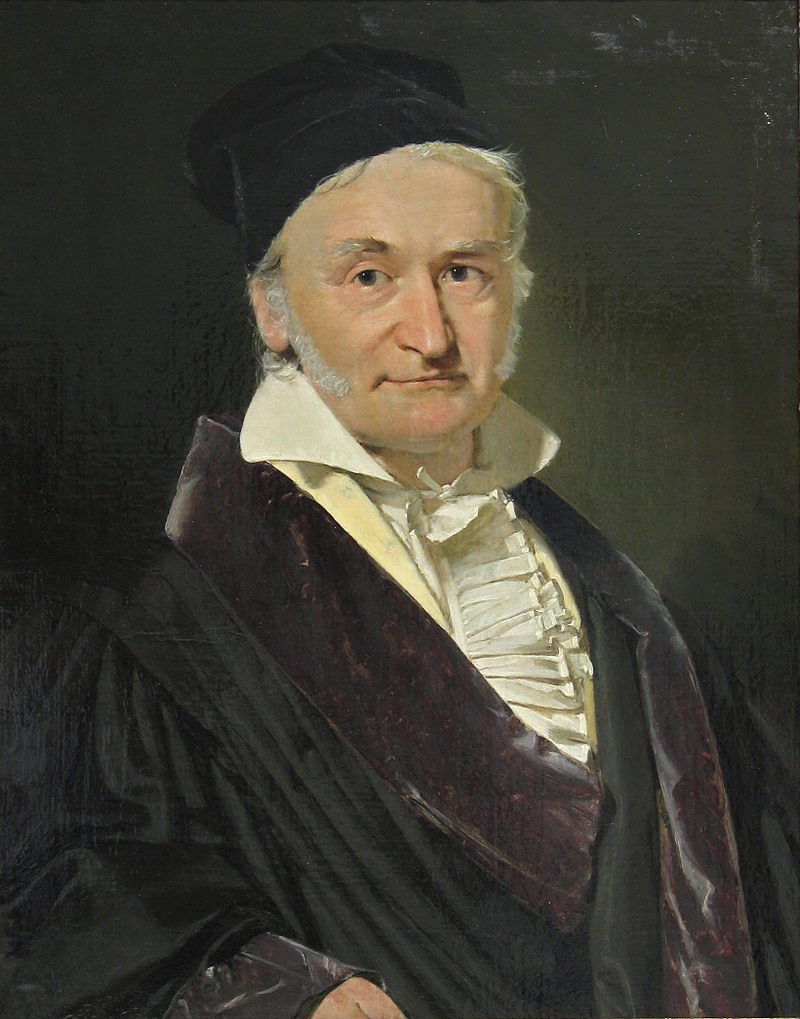
Now imagine you have a circle of radius r centered at the origin in 2D. This circle will enclose a certain number of lattice points depending on its radius. The Gauss circle problem asks how many lattice points are enclosed for a given radius. This problem is named after German mathematician, astronomer, geodesist, and physicist Carl Friedrich Gauss, who was the first person to make progress on a solution.
For a given radius r, let’s call the number of enclosed lattice points N(r). This number can be approximated by the area enclosed by the circle, which is given by A = πr². For instance, a radius of 5 yields an enclosed area of about 78.54, whereas the number of enclosed lattice points is 81. In other words, N(5) = 81.
This approximation gets better and better for larger values of r. We can express this approximation by adding an error term, an expression added on in order to account for the difference between an approximation and the true value. Here the equation is N(r) = πr² + E(r). Therefore the problem now takes the form of finding an upper bound for E(r), where progress continues to this day. Similar problems can be asked of shapes other than circles, such as conic sections or spheres in three-dimensional space.
The Kissing Number Problem
Suppose you have a unit circle and you want to have a bunch of other unit circles touch it without any overlap between the interiors. How many can you fit? This number is known as the kissing number. The problem is a special case of a problem known as the kissing number problem, which remains unsolved in general. However, in the two-dimensional case, the answer is 6.
We can also consider the problem in higher and lower dimensions. The generalization of a circle is the set of points in a given space that is a certain distance (the radius) away from a given center point. In one-dimensional space, this is simply a pair of points, each of them a distance of 1 from a point in the middle. The kissing number in one dimension is 2.
Meanwhile, in three dimensions, we have spheres of radius 1, known as unit spheres. The kissing number in dimension 3 is 12. For a while it was unknown whether this was the case. English polymath Isaac Newton and Scottish mathematician and astronomer David Gregory famously disagreed on the subject in the late 1600s. Newton thought the answer was 12, whereas Gregory thought it was 13. Indeed, it may appear as if a 13th sphere can fit, given that there appears to be a lot of extra space in a configuration for 12 kissing spheres. A convincing proof would not arrive until 1953, over 200 years after Newton’s death, but Newton was finally crowned the winner of the debate.
After three dimensions, we can keep going into higher dimensions. The kissing number in four dimensions is 24. However, the unsolved dimensions begin with dimension 5, where a lower bound of 40 and an upper bound of 44 are known but no exact solution is apparent. Dimensions 6 and 7 are also unsolved. But dimension 8 has a solution of 240. The next known solution comes in dimension 24, with a whopping 196,560. No solutions are known beyond this point.
Unequal Circle Packing

Previously we examined the case of packing circles of only one given size. (Technically, if the interior region is included, it is called a disc.) However, problems exist in the form of packings of non-congruent discs as well. If a packing system permits discs of two different sizes, then it is known as a binary system. The question then becomes: what is the optimal packing density in a binary system?
Let’s start with the ratio between the radius of the smaller disc and the radius of the larger disc. Certain values of this ratio allow for a compact packing, wherein if two discs are touching, then they also mutually touch two other discs. In all, there are nine such ratios allowing for a compact packing. All nine of these allow for a denser packing than the standard uniform packing, which involves just a single disc size. Additionally, some non-compact packings involve a higher packing density as well.
However, for packing densities in binary systems with size ratios of less than about 0.742, only upper bounds are known, not exact solutions.
Sendov’s Conjecture
Suppose you take the graph of a polynomial function in the real numbers. The roots of a polynomial are the points where the polynomial value becomes zero. For instance, if you have f(x) = x³ − 3x, its roots are x = 0 and x = ±√3.
Meanwhile, a point where the function flattens out is known as a critical point. For instance, if you have f(x) = x³ − 3x, the function flattens out at x = −1 and x = 1. From a calculus perspective, this is because the derivative of the function at that point, representing the function’s rate of change, is zero. Since the function’s value can be thought of as stationary there, such a point is called a stationary point.
We can extend this idea to complex numbers, though it’s harder to use graphs to visualize it. The derivative of a complex function is defined similarly, and where it becomes zero, we call those critical points.
A unit disc is the region enclosed by a unit circle. The unit disc is called closed if it includes its bounding circle, and open otherwise. In the complex plane, the closed unit disc centered at the origin is the set of complex numbers z satisfying |z| ≤ 1, where the absolute value of a complex number is its distance from zero.
Now imagine a polynomial function in the complex numbers of degree n ≥ 2. Suppose that all of its roots are contained within the unit disc centered at the origin. Sendov’s conjecture, named after Bulgarian mathematician, diplomat, and politician Blagovest Sendov, states that each root must be a distance of no more than 1 from at least one critical point of the function.
A few things are known about this conjecture. The Gauss-Lucas theorem guarantees that if the function’s roots are inside the unit disc, then the critical points must also be. As for proofs of the conjecture itself, mathematicians Brown and Xiang published a 1999 proof for n ≤ 8, whereas Terence Tao published a proof for sufficiently large n in 2020, essentially meaning that starting at a certain positive integer, the conjecture is true for all values of n greater than or equal to it, whatever that integer happens to be.
Further Reading
- Kissing Number on MathWorld
- Gauss Circle Problem on MathWorld
- Sendov’s Conjecture on Wikipedia
- Terence Tao, “Sendov’s conjecture for sufficiently high degree polynomials” on arXiv (2020)
- Circle Packing in an Equilateral Triangle on Wikipedia
Leave a Reply