The Biggest Numbers in Mathematics
Googol
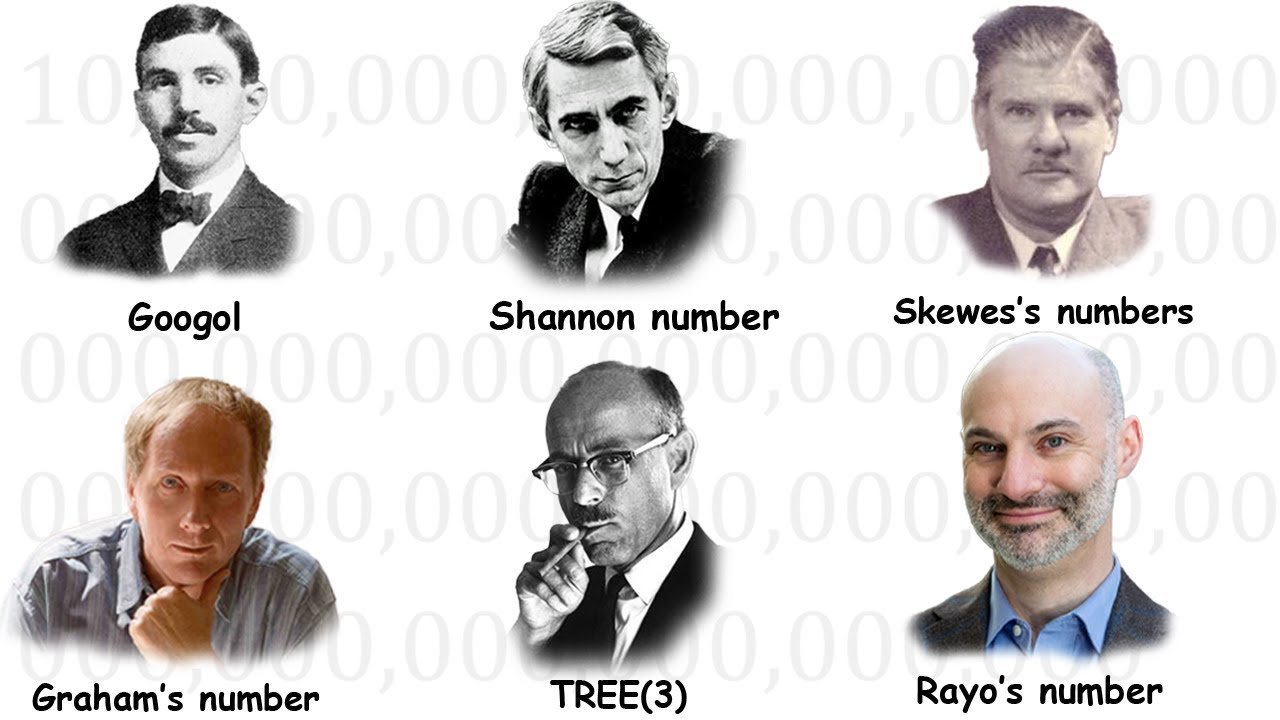
A googol is 10¹⁰⁰. Written out, this is a 1 followed by 100 zeros. It is also known as ten duotrigintillion. The word “googol” was originally invented by Milton Sirotta in 1920 when he was only 9 years old, possibly drawing inspiration from a comic character named Barney Google. Sirotta was the nephew of the American mathematician Edward Kasner, who brought the number to public attention in Mathematics and the Imagination, a book he published in 1940.
There is nothing mathematically special about this number, but it can be used in comparisons with other very large numbers. For example, it is much greater than the number of protons in the observable universe, known as the Eddington number, currently estimated to be around 10⁸⁰. If you had 100,000 copies of the observable universe and packed them all completely full of grains of sand, the number of grains would be about a googol. It is also roughly the number of years a galaxy-mass black hole would take to decay from Hawking radiation.
The Shannon Number
The Shannon number, 10¹²⁰, is a large number that arose in the early days of computer chess. The calculation is simple. In chess, a “move” consists of each player taking their turn once consecutively. Shannon estimated that there were about 10³ possibilities per move, and that a game consisted of each player making 40 moves (alternatively, 80 plies, where a ply is one player making one move). Thus the total number of possibilities overall is about (10³)⁴⁰ = 10¹²⁰.
This estimate was meant as a lower bound, so all of the estimates are conservative. The point of the Shannon number was to demonstrate that brute-force algorithms would be highly impractical for solving chess. This number was given in Shannon’s 1950 paper “Programming a Computer for Playing Chess,” the first ever paper written about computer chess.
The actual number of possible games after n moves can be calculated for small enough n. White has 20 possible starting moves, so the number of possible games after White’s first move is 20. Then Black has 20 possible starting moves, and 20 × 20 makes 400. The calculation gets more complicated from here, as the number of possible moves begins to depend on how the game was previously played, but the numbers get very large very fast. After only Black’s fifth move, there are about 69 trillion possible games.
Since most of these games would be total nonsense, some have also asked what the number of reasonable chess games would be. The calculation is very similar to that of the Shannon number, but instead it is assumed that each player has about three reasonable moves per ply. Assuming an 80-ply game, this yields 3⁸⁰ sensible chess games, about 1.48 × 10³⁸.
Skewes’ Numbers
To understand Skewes’ numbers, we must start with two functions: the prime-counting function and the logarithmic integral function.
The prime-counting function, denoted by π (not the number), takes in a real number and tells you how many prime numbers are less than or equal to that number. For instance, π(7) = 4, since there are four prime numbers less than or equal to 7: 2, 3, 5, and 7 itself. It is an important function in the field of number theory, which studies integers and arithmetic functions.
The logarithmic integral function is defined by an integral: Li(x) = ∫₂ˣ 1/ln(t) dt. The integrand has no elementary antiderivative, so this expression can’t be simplified. The prime number theorem tells us that this function is a very good approximation for the prime-counting function.
However, for relatively small natural numbers x, Li(x) is always slightly greater than π(x). It may appear that this would go on forever, but this is not actually true. π(x) does eventually outpace Li(x) for natural numbers x. However, the value of x required to do so is absolutely massive.
The first person to take serious consideration of this scenario was British mathematician John Edensor Littlewood. In a 1914 paper, he proved that π(x) alternates between being less than and greater than Li(x) infinitely many times, contrary to all available numerical data at the time. His paper did not provide any explicit statements on the size of this number.
The first person to make progress in this area was South African mathematician Stanley Skewes. His proof involved the Riemann hypothesis, which conjectures that the Riemann zeta function’s zeros exist only at the negative even integers and complex numbers with real part 1/2. Skewes proved that if the Riemann hypothesis is true, then a number x for which π(x) ≥ Li(x) must be less than e^(e^(e^79)). Here e is Euler’s number, the base of natural logarithms, about 2.718.
This number is in the size range of 10^(10^(10^34)). If this number were written out, 34 would be the number of zeros in the number of zeros in the number of zeros after the digit 1.
Graham’s Number
Graham’s number is a number originating from a problem about graphs in Ramsey theory, specifically about coloring a complete graph of the vertices of a hypercube in n-dimensional space.
Graham’s number can be described as follows. Exponentiation is repeated multiplication. For instance, 3³ = 3 × 3 × 3. Using Knuth’s up-arrow notation, exponentiation can be denoted by an up arrow. Similarly, tetration is repeated exponentiation, denoted by two up arrows. 3↑↑3 = 3^(3³). Exponents are evaluated top to bottom, so this expression evaluates to 3^27 = 7,625,597,484,987.
Pentation, using three arrows, is repeated tetration. 3↑↑↑3 = 3↑↑(3↑↑3). Adding another arrow simply iterates the previous operation in the sequence. Now, 3↑↑3 is about 7.6 trillion as previously discussed, so we get 3↑↑(7.6 trillion), which corresponds to a power tower containing 7.6 trillion 3s. Already, this number is too large for any physical analogy with the observable universe. Its digits cannot be fully written down in the observable universe, even with digits the size of a Planck volume. The digits in its number of digits also cannot be written down, and this continues for a number of times much greater than the number of Planck volumes in the observable universe.
Now consider 3↑↑↑↑3, which is even larger than 3↑↑↑3. Let’s define a sequence of numbers G₁, G₂, and so on. 3↑↑↑↑3 will be G₁. The number G₁ represents the number of arrows between the threes in the next element, G₂. This in turn represents the number of arrows between the threes in the next element, G₃. This is done again and again until finally we reach G₆₄. This is Graham’s number, named after American mathematician Ronald Graham.
TREE(3)
In graph theory, a graph consists of vertices that are connected to each other by edges. Graphs can be directed, meaning each edge has a sense of going in a particular direction (where each edge can be thought of as an arrow pointing in one direction), or undirected, meaning direction doesn’t matter. A path is a sequence of edges, possibly just a single edge, leading from one vertex to another. A tree is a graph where every pair of two vertices is connected by exactly one path. A forest is a graph consisting of a collection of trees that aren’t connected to each other.
A rooted tree is a single tree with a single vertex designated as the root, called r. There is also the concept of ancestry: if the path from r to some vertex w passes through some other vertex v, then v is an ancestor of w. A common ancestor is an ancestor shared by two vertices. One tree T₁ is contained in another tree T₂ if the vertices of T₁ can be matched with same-colored vertices in T₂, and the nearest common ancestor of each vertex is preserved.
Now imagine playing a game with three colors of nodes: black, green, and red. Using these nodes, you have to construct a forest of trees, where each tree is a graph consisting of nodes connected by edges. The first tree must have one node. The second tree must have anywhere from one to two nodes. The third tree must have one to three nodes. And so on. And you can’t make a tree that contains a previous tree in the sequence. The largest number of trees you can possibly make is TREE(3). In general, TREE(n) asks how many trees you can make with n vertex colors.
As it happens, TREE(3) is an absolutely massive number. To compare with our earlier G sequence, an approximation for the lower bound of TREE(3) would require iterating far beyond G₆₄.
Rayo’s Number
Rayo’s number, named after Mexican philosophy professor Agustín Rayo, arose in a 2007 MIT big number duel. It relates to the topic of first-order set theory, which is the commonly used standard when it comes to axiomatic formalization of math.
In any given language of first-order set theory, a number may be named by a certain expression. Let’s say we limit ourselves to using at most a googol symbols from such a language, where any number expressible under this restriction is called “Rayo-nameable.” There’s no special significance to a googol; it’s just what Rayo felt like choosing.
Now, Rayo’s number is the smallest number that is bigger than any finite Rayo-nameable number. That’s the basic explanation, though the formal definition of Rayo’s number involves a formula using second-order logic, which is an extension of first-order logic.
Rayo’s number has been claimed to be the largest named number, though what numbers exactly qualify for that title is debatable. In any case, the number was good enough for Rayo, who won the big number duel decisively.
Leave a Reply