
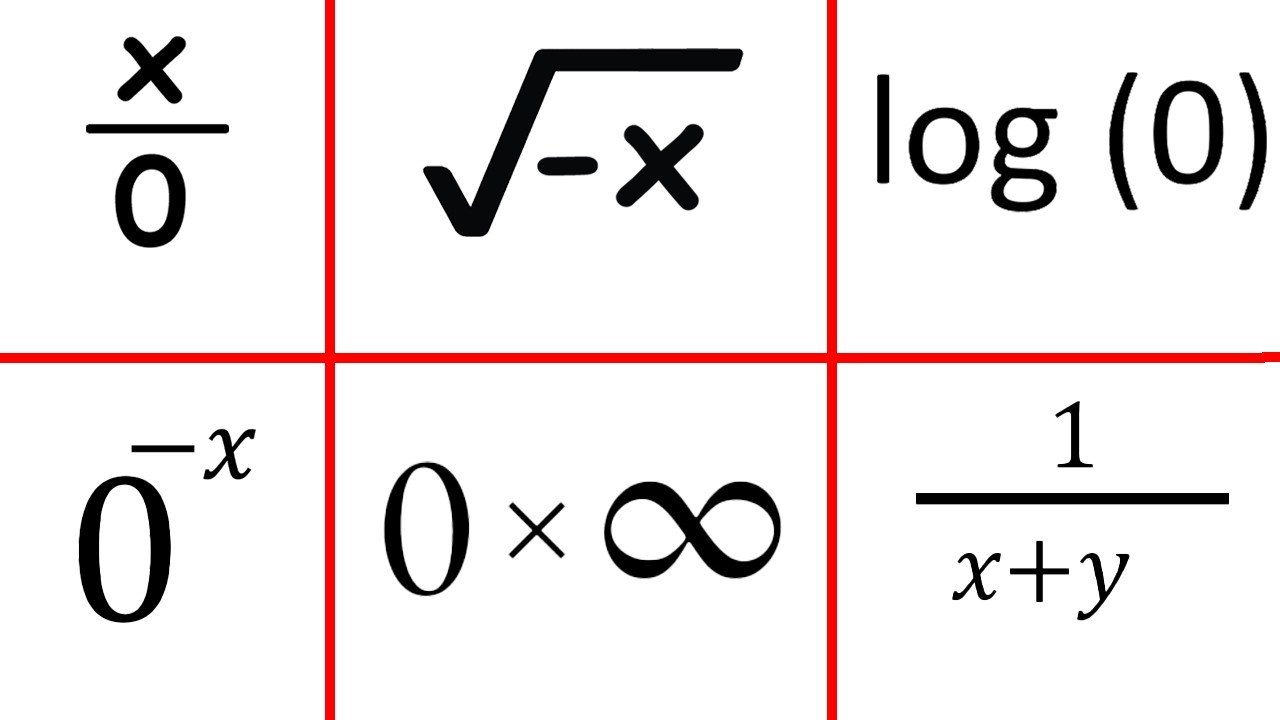
Ever wondered why you cannot take the logarithm of zero? We are diving into every forbidden math operation that just does not play by the rules.
Division by Zero
Division by zero is an operation for which you cannot find an answer, so it is disallowed. The word division means splitting up a number into equal parts or groups so it is shared equally among everyone, whereas the value of zero as a number is nothing. Another reason is that zero has no multiplicative inverse. In division, A/B means A × B⁻¹, and since 0⁻¹ does not exist, division by zero is undefined.
Logarithm of Zero
A logarithm is defined as the inverse operation of exponentiation. For example, log base a of x = y means aʸ = x. A logarithm tells you what exponent you need to produce a certain number. Since there is no number that can be raised to any power to get zero, it is impossible to find the log of zero.
Negative Output of Absolute Value
The modulus, or absolute value, of x is defined as follows: |x| = x if x ≥ 0, and |x| = −x if x < 0. By definition, the modulus of a number is always non-negative because it represents the magnitude or distance of a number from the origin on the number line. Since distance can never be negative, neither can the modulus.
Zero to a Negative Exponent
If we have a number with a negative exponent, we take the reciprocal of that number to make the exponent positive. In the case of zero, exponentiation is defined as repeated multiplication of the number, and zero remains zero no matter how many times you multiply it. We are left with something divided by zero, and that is not allowed.
Multiplying Infinity by Zero
∞ is not a number. It is a concept used to describe something that has no end or limit, but it is not a numeric value. If we allow multiplication of ∞ by zero, the result will be undefined or inconsistent, and it will also violate some usual properties and laws of mathematics, such as the distributive property.
Adding Scalars and Vectors
Scalars are quantities which only have magnitude, but vectors have both magnitude and direction. Scalars are added by simple arithmetic operations, but the addition of vectors requires geometric transformation, so the two cannot be added together.
Determinant of a Non-Square Matrix
A determinant is a scalar value that can be computed from the elements of a square matrix. Non-square matrices have an unequal number of rows and columns, and their columns and rows are not linearly independent. The determinant represents a scaling factor of area or volume in linear transformations, which only applies to square matrices.
Inverse of a Non-Invertible Matrix
The inverse of a non-invertible (singular) matrix does not exist because its determinant is zero. The formula for the inverse involves dividing by the determinant, so if the determinant of A is 0, it involves division by zero, which is not allowed. A non-invertible matrix has linearly dependent rows or columns. If matrix A has an inverse, multiplying it by that inverse produces the identity matrix (A × A⁻¹ = I). A non-invertible matrix has no matrix that can be multiplied by it to produce an identity matrix.
Logarithm of a Negative Number
A logarithm is defined as the inverse operation of exponentiation. The base of a logarithm is always a positive number. There is no real number that can be raised to a power to give a negative number, so it is impossible to find the log of a negative number in the real number system.
Adding Scalars and Matrices
Scalars are just numbers, while matrices are arrays of numbers with specific rows and columns. Matrices can only be added with other matrices of the same order. Scalars have no dimension, while matrices do.
Derivatives of Non-Smooth Functions
Derivatives require a function that is continuous and smooth. Derivatives are slopes of tangent lines, and tangent lines cannot be drawn for non-smooth functions that may have corners or jumps in their graphs. Also, if the graph of a function has a vertical tangent, it is non-differentiable at that point.
Eigenvalues of a Non-Square Matrix
Eigenvalues are defined as scalar solutions to the equation Ax = λx. A non-square matrix has an unequal number of rows and columns, and its rows or columns are linearly dependent. The eigenvalue equation requires the matrix to map a vector to a scaled version of itself, which is only well-defined for square matrices.
Squaring a Non-Square Matrix
The square of a matrix A is found by multiplying it by itself. Matrix multiplication requires compatible dimensions: specifically, the number of columns of the first matrix must equal the number of rows of the second matrix. In a non-square or rectangular matrix, the number of rows and columns are not the same, so when we try to multiply it by itself, it does not satisfy the condition for matrix multiplication.
Common Math Mistakes
Keep in mind that all of the operations discussed above are not allowed in standard mathematics. Some can be extended or generalized in advanced mathematics, but these extensions require careful definitions and interpretations.
Order of Operations
While using BODMAS or PEMDAS, it is a common misconception that division precedes multiplication and that addition precedes subtraction. The fact is that division and multiplication are of equal importance, and addition and subtraction are of equal importance as well. They are solved from left to right.
PEMDAS stands for: P (parentheses), E (exponents), M or D (multiplication or division), and A or S (addition or subtraction).
Here is an example: 2³ − 8 / 4 × 2 + 7. First we solve the exponent. Since we are working from left to right, division gets preference over the multiplication that follows. Then we do multiplication. Working left to right again, subtraction gets preference over addition. Finally, we complete the addition.
Incorrect Cancellation
Sometimes students cancel out terms without keeping in mind the rules of cancellation. You cannot simply cancel individual terms across a fraction. You must factorize first and then cancel common factors.
Similarly, you cannot cancel squares with a square root if the squares are being added or subtracted under the root. It can only be cancelled if we have the square of the entire expression, not individual squares.
Exponent Mistakes
When expanding exponents, remember to use Pascal’s triangle or the binomial theorem. For example, (a + b)² is not a² + b², but rather a² + 2ab + b².
Parentheses Matter
Not using parentheses can completely change the result. For example, −4² = −16 because the square applies only to the 4 and the minus remains unaffected. However, (−4)² = (−4) × (−4) = 16.
Combining Like Terms
Like terms are those which have the same variable and exponent. In algebra, like terms can be added, but unlike terms cannot be combined. For example, 2x + 3 cannot be simplified to 5x because 2x is a variable term and 3 is a constant. But 2x + 3x + 5 = 5x + 5. Similarly, if the variable is the same but the exponents are different, they cannot be combined. For example, in x³ + 3x² + 5x + 7, there are four different terms and none of them can be combined.
Splitting Fractions
Splitting means breaking down a fraction into two or more fractions. If we have 1/(x + y), we cannot split it as 1/x + 1/y. You cannot split the denominator like this. However, if we have more than one term in the numerator, like (2x + 3)/(x + y), it can be split as 2x/(x + y) + 3/(x + y). The numerator is split while the denominator remains the same in both fractions.
Leave a Reply