
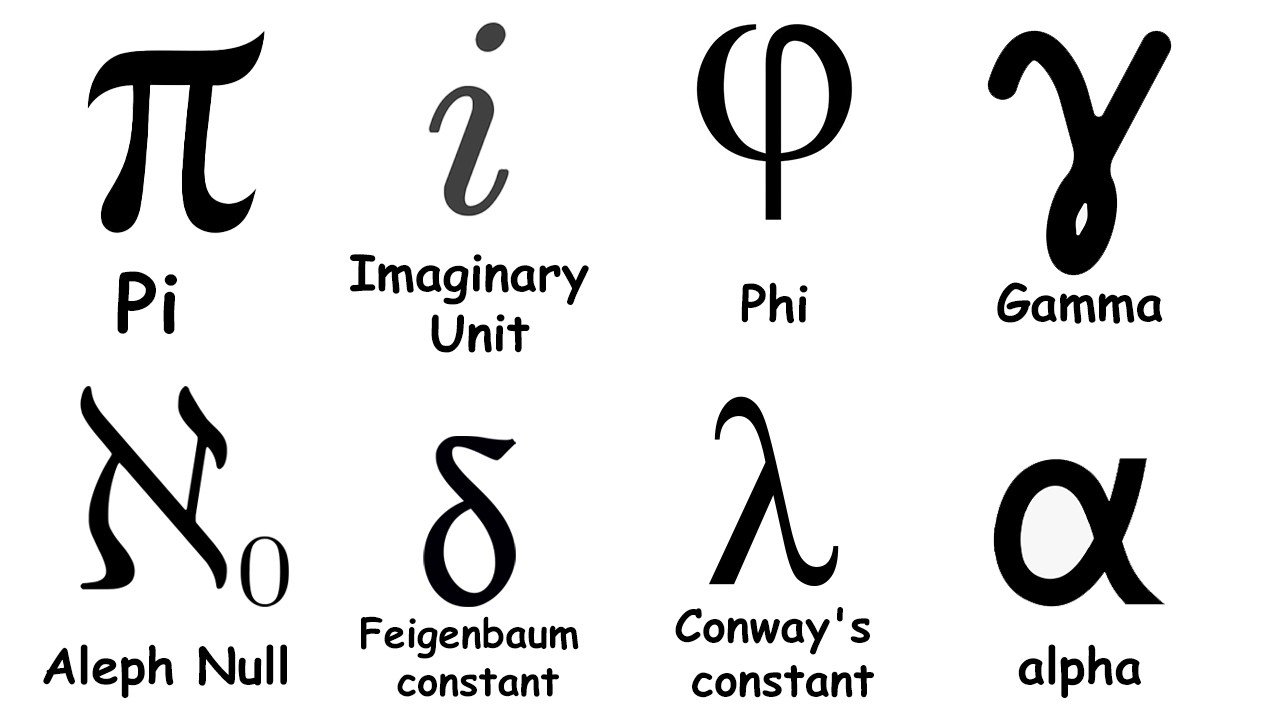
Pi (π)
Pi is a fundamental mathematical constant that represents the ratio of a circle’s circumference to its diameter. It was first calculated by the ancient Greek mathematician Archimedes of Syracuse, who was also a physicist, engineer, inventor, and astronomer. The Greek letter π is the first letter of the Greek word perimetros, meaning circumference.
π ≈ 3.14159…
Pi is used extensively in mathematics, physics, engineering, and many other scientific fields to calculate the properties of circles, spheres, and other circular or spherical objects. It is an irrational number, meaning its decimal representation never ends or repeats.
Euler’s Number (e)
The mathematical constant e is the base of the natural logarithm, a fundamental logarithmic function. It is also known as Euler’s number, named after the mathematician Leonhard Euler, who extensively studied this constant.
e ≈ 2.71828…
The constant e is used in many areas of mathematics and science, including calculus, complex numbers, and population growth models. It represents the rate of continuous growth and is the unique base for which the derivative of the exponential function equals the function itself.
The Imaginary Unit (i)
The imaginary unit, denoted by the symbol i, is a mathematical constant representing √(−1). The concept of the imaginary unit was developed over time by various mathematicians as a way to represent and work with square roots of negative numbers. It is a foundation of complex number theory, which is essential for many areas of mathematics, physics, and engineering, such as electrical engineering and quantum mechanics.
Complex numbers that include the imaginary unit i are written in the form a + bi, where a is the real part and b is the imaginary part.
Pythagoras’s Constant (√2)
√2 is a fundamental mathematical constant also known as Pythagoras’s constant. It represents the length of the diagonal of a square with side length one.
√2 ≈ 1.41421…
This special number was first studied in depth by the ancient Greek mathematician Pythagoras and his followers. √2 is an irrational number, meaning its decimal representation never ends or repeats. Despite its seemingly simple definition, √2 has profound implications in various fields including geometry, trigonometry, and physics. This constant appears in many important mathematical theorems and formulas, such as the Pythagorean theorem.
Theodorus’s Constant (√3)
Theodorus’s constant refers to √3, which was studied by the ancient Greek mathematician Theodorus of Cyrene. Theodorus proved that the square roots of numbers that are not perfect squares, such as √3, are irrational numbers.
√3 ≈ 1.73205…
Its decimal representation extends infinitely without repeating. In 2013, √3 had been computed to at least 10 billion decimal places. √3 is used extensively in mathematics, geometry, and physics. For example, it appears in the formula for the volume of a regular tetrahedron.
The Golden Ratio (φ)
The golden ratio, represented by the Greek letter φ (phi), is approximately equal to 1.618 and is defined as a ratio where the ratio of the whole to the larger part is equal to the ratio of the larger part to the smaller part. In other words, if you have a line segment divided into two parts, the golden ratio describes the perfect proportion where the longer part is to the shorter part as the whole line is to the longer part.
φ ≈ 1.61803…
This unique ratio has been observed in many natural phenomena, from the spiral patterns of seashells to the branching of trees. It is also widely used in art, architecture, and design, as the golden ratio is often considered to be an aesthetically pleasing proportion. The golden ratio is an irrational number, meaning its decimal representation goes on forever without repeating, and it is closely related to the Fibonacci sequence.
The Euler-Mascheroni Constant (γ)

The Euler-Mascheroni constant is approximately equal to 0.5772, and this constant appears in various areas of mathematics, especially in number theory and analysis. It is defined as the limiting difference between the harmonic series and the natural logarithm. The Euler-Mascheroni constant is not known to be rational or irrational, and its exact nature remains an open question in mathematics.
γ ≈ 0.57721…
The First Feigenbaum Constant (δ)
The first Feigenbaum constant, denoted by the Greek letter δ, has an approximate value of 4.669. This constant was discovered by the mathematician Mitchell Feigenbaum in the late 1970s. It is a fundamental quantity that describes the universal behavior of certain types of nonlinear systems, such as the logistic map, as they transition from stable periodic behavior to chaotic unpredictable behavior. It helps us understand the universal patterns and behaviors that emerge in complex nonlinear systems. It is a key concept in the study of chaos theory, which is the study of how small changes in initial conditions can lead to dramatically different outcomes over time.
The Second Feigenbaum Constant (α)
The second Feigenbaum constant has a value of approximately 2.502. This constant describes a ratio between the width of a tine (or branch) and the width of one of its two sub-branches closest to the fold in the bifurcation diagram of certain nonlinear dynamical systems.
α ≈ 2.50290…
Like the first Feigenbaum constant, the second constant is a universal quantity that describes the behavior of a wide class of nonlinear systems as they transition to chaos. While the first Feigenbaum constant describes the rate of period doubling, the second constant describes the geometric scaling of the bifurcation intervals. Together, these two constants provide a quantitative description of the universal route to chaos observed in many nonlinear dynamical systems.
Apéry’s Constant (ζ(3))
Apéry’s constant is the value of the Riemann zeta function evaluated at the argument 3.
ζ(3) ≈ 1.20205…
The Riemann zeta function, denoted ζ(s), is a function of a complex variable s that generalizes the harmonic series. When s = 3, the series converges to Apéry’s constant. It is a special value of the Riemann zeta function, which is a fundamental function in number theory and has deep connections to the distribution of prime numbers.
Apéry’s constant is an irrational number, meaning it cannot be expressed as a ratio of two integers. This was proven by the French mathematician Roger Apéry in 1979. The exact value of ζ(3) is not known in closed form, but it can be approximated using various series expansions and numerical methods.
Conway’s Constant (λ)
Conway’s constant is a mathematical constant that arises in the study of the look-and-say sequence, a mathematical sequence discovered by the renowned mathematician John Conway. The look-and-say sequence is generated by repeatedly describing the previous term in the sequence. For example, the sequence starts with the term 1, and each subsequent term is obtained by reading the previous term aloud. The first few terms of the sequence are 1, 11, 21, 1211, 111221, and so on.
λ ≈ 1.30357…
The constant λ is the exponential growth rate of the length of the terms in the sequence as it progresses. It is an irrational number, meaning it cannot be expressed as a ratio of two integers. It has connections to other areas of mathematics, such as the theory of dynamical systems and the study of certain types of fractals.
Khinchin’s Constant (K)
Khinchin’s constant, denoted K, was proven by the Russian mathematician Alexander Khinchin in 1934. The definition of Khinchin’s constant is as follows: let x be a continued fraction expansion where a₀ is an integer and a₁, a₂, a₃, … are positive integers. Khinchin proved that for almost all real numbers x (with respect to Lebesgue measure), the geometric mean of the partial denominators a₁, a₂, a₃, …, aₙ converges to a constant K as n → ∞.
K ≈ 2.68545…
Khinchin’s constant is an irrational number, but it is not known whether it is transcendental. While K is known to exist for almost all real numbers, it has not been rigorously proven for any specific real numbers, including π, e, and Khinchin’s constant itself.
The Glaisher-Kinkelin Constant (A)
The Glaisher-Kinkelin constant is a real number approximately equal to 1.28243. It is named after the mathematicians James Glaisher and Adolf Kinkelin, who independently studied and calculated this constant in the late 19th century.
A ≈ 1.28242…
The Glaisher-Kinkelin constant appears in various mathematical and physical formulas, often in connection with the gamma function. It is closely related to the asymptotic behavior of the gamma function, which is a fundamental function in mathematics with applications in probability, statistics, and physics. The exact value of the constant is not known, but it can be approximated to high precision using computational tools.
Zero (0)
Zero is a fundamental concept in mathematics that represents the absence of quantity or magnitude. It is one of the most important and widely used constants in various branches of mathematics and science. It is the additive identity, meaning that when added to any number, it leaves the number unchanged. For example:
5 + 0 = 5
0 + (−3) = −3
Zero is an integral part of number systems such as integers, rational numbers, real numbers, and complex numbers. In algebra, zero is used in equations, inequalities, and various algebraic operations. In calculus, zero is used in limits, derivatives, and integrals, often as a reference point for comparison. In geometry, zero represents the origin of a coordinate system or the absence of length, area, or volume. In physics, zero represents the absence of a physical quantity such as temperature, energy, or potential.
Aleph-Null (ℵ₀)
Aleph-null is a cardinal number in set theory that represents the cardinality, or size, of the set of natural numbers {1, 2, 3, …}. It is the first transfinite cardinal number and is used to describe the size of infinite sets. Aleph-null is closed under addition, multiplication, and exponentiation. For example:
ℵ₀ + ℵ₀ = ℵ₀
ℵ₀ × ℵ₀ = ℵ₀
ℵ₀^ℵ₀ = ℵ₀
Aleph-null can also be used to compare the sizes of infinite sets. The set of rational numbers has the same cardinality as the set of natural numbers (ℵ₀), while the set of real numbers has a larger cardinality of 2^ℵ₀. Aleph-null is used in Cantor’s diagonal argument, which proves that the set of real numbers has a larger cardinality than the set of natural numbers.
Catalan’s Constant (G)

Catalan’s constant is a well-known mathematical constant defined by the following infinite series:
G = 1/1² − 1/3² + 1/5² − 1/7² + … ≈ 0.91596…
It is named after the Belgian mathematician Eugène Charles Catalan, who first gave an equivalent series and expressions in terms of integrals for this constant. Catalan’s constant commonly appears in estimates of combinatorial functions and in certain classes of sums and definite integrals. It is not known whether Catalan’s constant is a rational or irrational number, which is an open problem in mathematics.
Over the years, the number of known digits of Catalan’s constant has increased dramatically, from 16 digits to 1,832 to over 1 trillion digits as of 2022. Efficient algorithms and formulas, such as those discovered by Ramanujan and Broadhurst, have enabled the rapid computation of Catalan’s constant to high precision. Catalan’s constant has applications in various areas of mathematics, including number theory, combinatorics, and mathematical physics.
Further reading:
- NIST Digital Library of Mathematical Functions, a comprehensive reference for mathematical constants and special functions (NIST DLMF)
- Wolfram MathWorld entries on mathematical constants (MathWorld)
- Steven Finch’s Mathematical Constants is the definitive reference for this topic (Cambridge University Press)
Leave a Reply