
A Timeline of History’s Greatest Mathematicians
Ancient Mathematicians
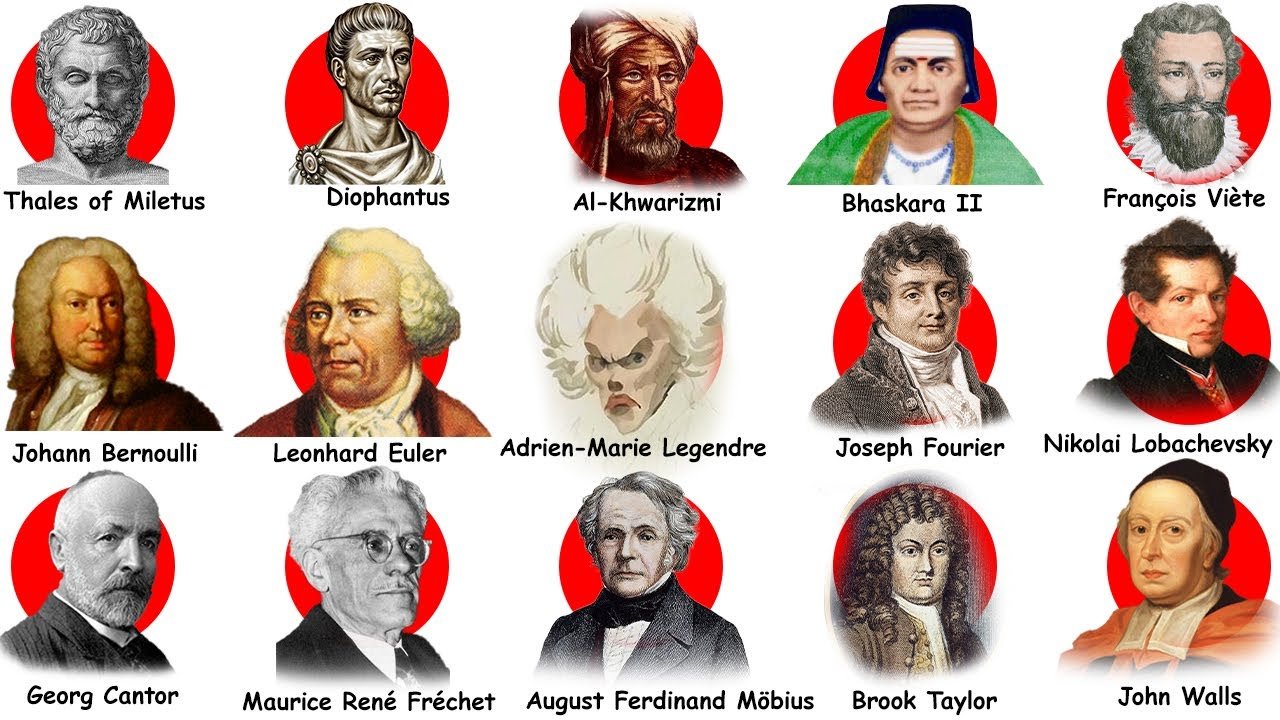
Thales of Miletus is a foundational figure in Greek mathematics and philosophy, credited with early developments in geometry, including Thales’s theorem. He is also renowned for predicting a solar eclipse. Thales hailed from Miletus, Ionia, now in modern-day Turkey.
Anaximander, an early Greek philosopher and mathematician from Miletus, Ionia, contributed to concepts of ∞ and geometric shapes. He is also known for creating one of the earliest maps of the world.
Eratosthenes, from Cyrene (now in modern-day Libya), is best known for the Sieve of Eratosthenes, a method for finding prime numbers. He calculated the Earth’s circumference and the tilt of its axis and made significant contributions to geography and chronology.
Diophantus, an influential mathematician from Alexandria, Egypt, is often called the father of algebra. His Arithmetica series dealt with solving algebraic equations and number theory, laying the groundwork for future developments in mathematics.
Hypatia is one of the first female mathematicians, hailing from Alexandria, Egypt. Hypatia taught and wrote about mathematics, astronomy, and philosophy and is associated with a commentary on Diophantus’s Arithmetica.
Indian and Central Asian Mathematicians
Aryabhata is an Indian mathematician and astronomer from Kusumapura (likely Patna, India). He authored the Aryabhatiya, which includes work on the approximation of pi, the place value system, and trigonometry.
Brahmagupta, from Bhinmal (modern-day Rajasthan, India), made major contributions to number theory and algebra. His Brahmasphutasiddhanta introduced rules for arithmetic operations, including the use of zero.
Al-Khwarizmi is a mathematician from Khwarezm (modern-day Uzbekistan). Al-Khwarizmi is considered a founding figure in algebra. His works introduced algebra and algorithms, and he played a significant role in introducing Hindu-Arabic numerals to the Western world.
Omar Khayyam, a Persian mathematician, poet, and astronomer from Nishapur, Persia (now Iran), made significant advancements in algebra and contributed to the development of the Persian calendar.
Bhaskara II, an Indian mathematician and astronomer from Bijapur, India, authored Siddhanta Shiromani. He made significant contributions to calculus, algebra, and spherical trigonometry.
Renaissance and Early Modern Mathematicians
John Napier, from Edinburgh, Scotland, is best known for inventing logarithms. His work, including Napier’s bones (a calculating tool), greatly facilitated calculations and advanced mathematical practice.
François Viète, a pioneer of new algebra from Fontenay-le-Comte, France, introduced the use of letters to represent unknowns in equations, significantly advancing algebraic notation.
Marin Mersenne, from Oizé, France, is known for Mersenne primes. His work in number theory, particularly on Mersenne primes, influenced the study of prime numbers.
Bonaventura Cavalieri, an Italian mathematician from Milan, is known for Cavalieri’s principle. His work in geometry, particularly the method of indivisibles, prefigured integral calculus.
John Wallis, from Ashford, England, made significant contributions to infinitesimal calculus. He introduced the ∞ symbol and advanced algebra and calculus.
James Gregory, a Scottish mathematician from Drumoak, made early contributions to calculus. He developed the first proof of the fundamental theorem of calculus and the Gregory series for arctangent.
The Bernoulli Era and 18th Century
Jacob Bernoulli, from Basel, Switzerland, was a founding figure in the calculus of variations. His contributions to probability theory and the study of infinite series were significant.
Johann Bernoulli, also from Basel, Switzerland, made contributions to calculus, extending differential equations. He taught the principles of calculus to many prominent students, including Euler.
Brook Taylor, an English mathematician from Edmonton, is known for the Taylor series. His work in mathematical analysis, particularly the Taylor series expansion, was groundbreaking.
Abraham de Moivre, from Vitry-le-François, France, is known for de Moivre’s formula in complex numbers. He made significant contributions to probability theory and analytic geometry.
Leonhard Euler, from Basel, Switzerland, made prolific contributions across all areas of mathematics. He pioneered graph theory, topology, and introduced much of modern mathematical notation, including e, i, and π.
Joseph-Louis Lagrange, from Turin, Italy, made significant contributions to number theory, mechanics, and algebra. His work in analytical mechanics, known as Lagrangian mechanics, is particularly noteworthy.
19th Century Mathematicians
Pierre-Simon Laplace, from Beaumont-en-Auge, France, is known for the Laplace transform. His work in celestial mechanics, statistics, and probability theory was foundational for future developments in these fields.
Adrien-Marie Legendre, a French mathematician from Paris, is known for Legendre polynomials. He contributed to number theory, abstract algebra, and statistics, laying groundwork for later developments in elliptic functions.
Joseph Fourier, from Auxerre, France, is best known for the Fourier series. His work on heat transfer and vibrations led to the development of Fourier analysis, crucial in both theoretical and applied mathematics.
Siméon Denis Poisson, a French mathematician, is renowned for his contributions to probability theory and mathematical physics, particularly for the Poisson distribution and Poisson’s equation. He made significant advancements in the study of electricity and magnetism. Poisson was born in Pithiviers, France.
August Ferdinand Möbius, a German mathematician and theoretical astronomer, is best known for his discovery of the Möbius strip, a non-orientable surface. His work in projective geometry and topology was foundational. Möbius was born in Schulpforta, Germany.
Nikolai Lobachevsky, a Russian mathematician, is celebrated as one of the founders of non-Euclidean geometry. His work on hyperbolic geometry paved the way for new developments in the field. Lobachevsky was born in Nizhny Novgorod, Russia.
János Bolyai, a Hungarian mathematician, independently developed non-Euclidean geometry alongside Lobachevsky. His work, published as an appendix to his father’s book, revolutionized the understanding of space and geometry. Bolyai was born in Kolozsvár, Hungary (now Cluj-Napoca, Romania).
Joseph Liouville, a French mathematician, made significant contributions to number theory, complex analysis, and differential equations. He is known for Liouville’s theorem and his work on transcendental numbers. Liouville was born in Saint-Omer, France.
Pafnuty Chebyshev, a Russian mathematician, is known for his work in number theory, probability, and approximation theory. Chebyshev polynomials and the Chebyshev inequality are named after him. Chebyshev was born in Okatovo, Russia.
Georg Cantor, a German mathematician, is best known for creating set theory and introducing the concept of different sizes of ∞. His work laid the groundwork for modern mathematical analysis. Cantor was born in St. Petersburg, Russia.
Early 20th Century Mathematicians
Henri Lebesgue, a French mathematician, is celebrated for the Lebesgue integral, which revolutionized the field of integration and measure theory. His work laid the foundation for modern real analysis. Lebesgue was born in Beauvais, France.
Maurice René Fréchet, a French mathematician, made pioneering contributions to topology and functional analysis. He introduced the concept of metric spaces and worked extensively on abstract spaces. Fréchet was born in Maligny, France.
Jacques Hadamard, a French mathematician, is known for his work in number theory, complex function theory, and partial differential equations. The Hadamard matrix and the Hadamard transform are named in his honor. Hadamard was born in Versailles, France.
Andrey Markov, a Russian mathematician, is best known for developing the theory of Markov chains, which are used extensively in statistics and various applications of stochastic processes. Markov was born in Ryazan, Russia.
L.E.J. Brouwer, a Dutch mathematician, is a key figure in the development of topology and the founder of intuitionism, a philosophy of mathematics that emphasizes the constructive aspects of mathematical objects. Brouwer was born in Overschie, Netherlands.
John Edensor Littlewood, a British mathematician, is known for his extensive collaboration with G.H. Hardy, contributing to analytic number theory and complex analysis. His work also extended to inequalities and approximation theory. Littlewood was born in Rochester, England.
Norbert Wiener, an American mathematician, is celebrated as the founder of cybernetics, the study of control and communication in animals and machines. He made significant contributions to stochastic processes and noise theory. Wiener was born in Columbia, Missouri, USA.
Hermann Weyl, a German mathematician and theoretical physicist, made fundamental contributions to various fields including group theory, quantum mechanics, and general relativity. Weyl was born in Elmshorn, Germany.
Mid to Late 20th Century Mathematicians
Oscar Zariski, a Russian-born American mathematician, was a leading figure in algebraic geometry. His work on the resolution of singularities and Zariski topology significantly advanced the field. Zariski was born in Kobrin, Russia (now in Belarus).
Richard Courant, a German-American mathematician, made notable contributions to applied mathematics, particularly in the field of partial differential equations and numerical analysis. He co-authored the influential book Methods of Mathematical Physics. Courant was born in Lublinitz, Germany (now Lubliniec, Poland).
Lars Ahlfors, a Finnish mathematician, is known for his work in complex analysis. He was one of the first two recipients of the Fields Medal. Ahlfors’s contributions include the theory of Riemann surfaces. He was born in Helsinki, Finland.
Raoul Bott, a Hungarian-American mathematician, made significant contributions to topology and differential geometry. Bott periodicity is a central concept in homotopy theory. Bott was born in Budapest, Hungary.
Michael Atiyah, a British-Lebanese mathematician, made groundbreaking contributions to topology and geometry, including the Atiyah-Singer index theorem. He was a leading figure in the development of modern mathematical physics. Atiyah was born in London, England.
Robert Langlands, a Canadian mathematician, is best known for the Langlands program, a set of far-reaching conjectures connecting number theory and representation theory. His work has profoundly influenced modern mathematics. Langlands was born in New Westminster, British Columbia, Canada.
Pierre Deligne, a Belgian mathematician, made significant contributions to algebraic geometry, number theory, and the theory of automorphic forms. He is best known for proving the Weil conjectures. Deligne was born in Brussels, Belgium.
Vaughan Jones, a New Zealand mathematician, is renowned for his discovery of the Jones polynomial in knot theory, which has applications in various areas of mathematics and physics. He was a leading figure in the field of von Neumann algebras. Jones was born in Gisborne, New Zealand.
Leave a Reply