
Every Complex Geometry Shape Explained
Geometry is not just about simple shapes. Some of the most fascinating objects in mathematics are staggeringly complex, emerging from surprisingly simple rules. Here is a tour through some of the most remarkable ones.
Sierpinski Triangle
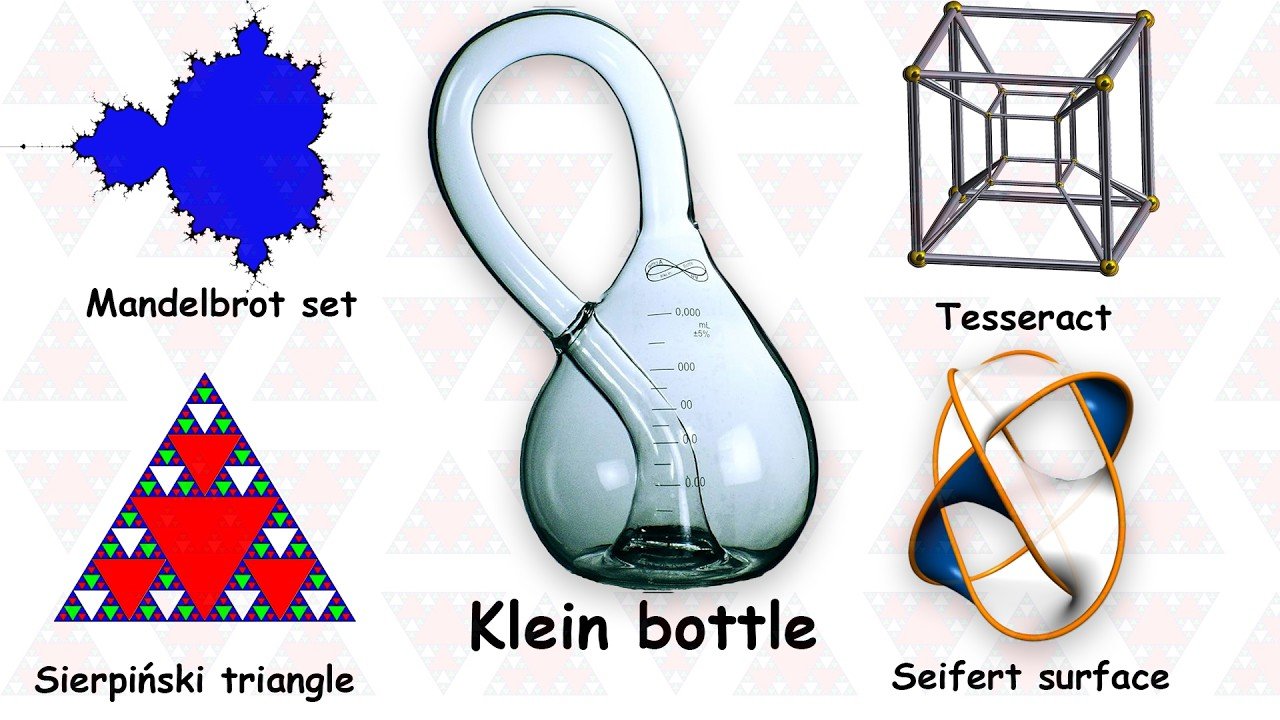
Take three identical equilateral triangles and join them at the vertices so they form another equilateral triangle in the middle. Then shrink this shape down by a factor of 1/2, take three identical copies, and join them the same way. Repeat this process indefinitely and the shape you approach is called the Sierpinski triangle, named after Polish mathematician Waclaw Sierpinski.
The Sierpinski triangle is an example of a fractal, which is a shape with infinite detail. No matter how far you zoom in, it never smooths out. This particular fractal is self-similar, meaning it is composed of three smaller copies of itself.
The study of fractals also introduces the idea of fractal dimension. A line segment is one-dimensional, a square is two-dimensional, and a cube is three-dimensional. If you scale up the dimensions of each by a factor of 2, the line segment’s length scales by 2¹ = 2, the square’s area scales by 2² = 4, and the cube’s volume scales by 2³ = 8. In each case the exponent equals the dimensionality of the object.
If you scale up the Sierpinski triangle by a factor of 2, it becomes three times as large. Its dimensionality D can be found by solving 2^D = 3. Taking the base-2 logarithm of both sides gives D = log₂(3), which is approximately 1.585. In this sense the Sierpinski triangle is roughly 1.585-dimensional. This is called its Hausdorff dimension, named after German mathematician Felix Hausdorff.
Tesseract
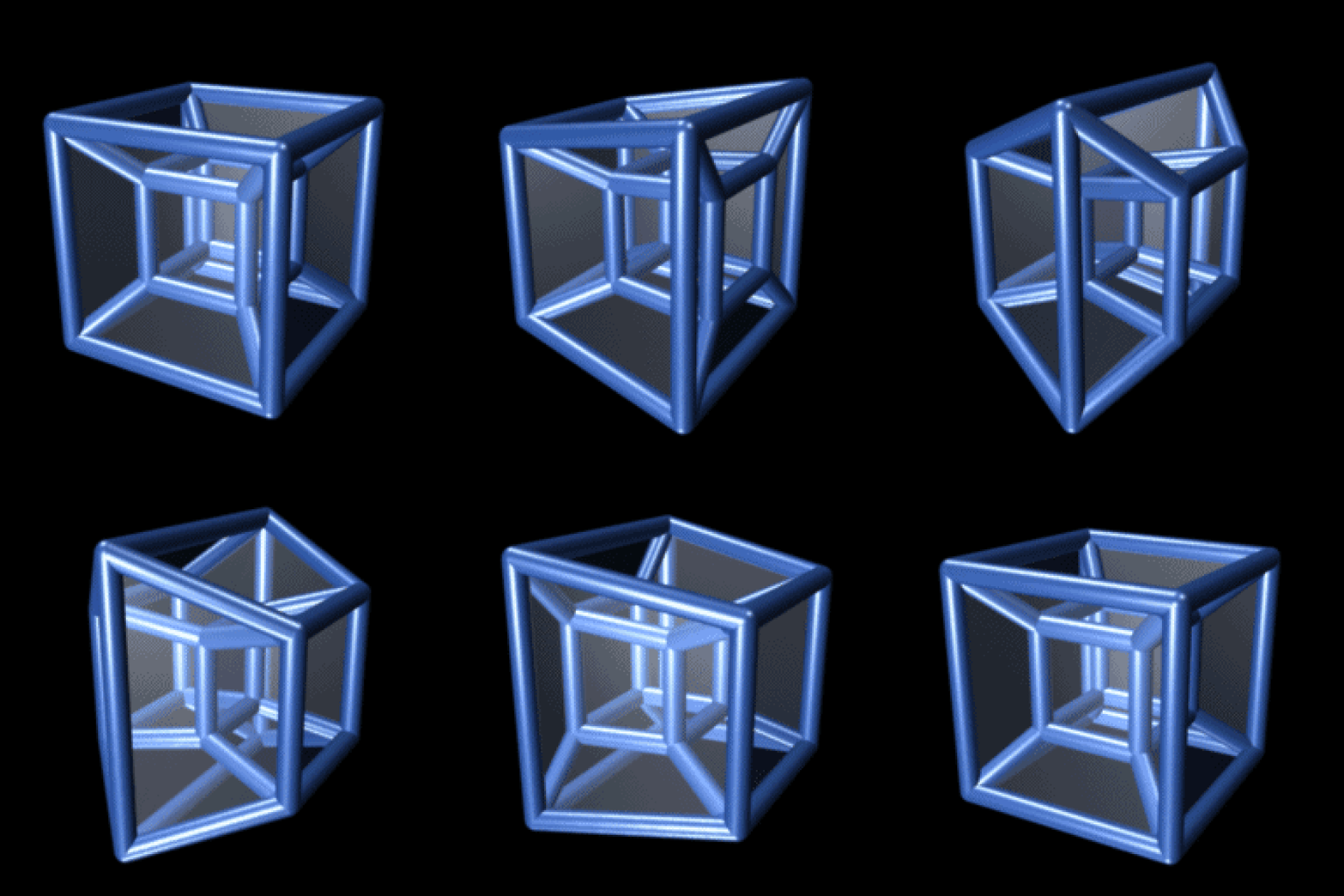
The tesseract is the four-dimensional analog of the cube. A line segment is formed by connecting two points, a square by connecting four line segments, and a cube by connecting six squares. A tesseract is formed by connecting eight cubes, which are called its facets. For each dimension n, the analog of the cube is called the n-dimensional hypercube.
Visualizing four-dimensional shapes in a three-dimensional world is difficult, but one option is to look at a 3D projection. Just as a 2D projection of a 3D object can be thought of as its shadow, the 3D projection of a 4D object works the same way, one dimension down.
Just as a cube has a volume and a surface area, a tesseract has a 4D hypervolume and a surface volume. The pattern is straightforward: a line segment of side length s has length s, a square has area s², and a cube has volume s³. Accordingly, a tesseract has hypervolume s⁴. The surface area of a cube is found by adding the areas of its six square facets, giving 6s². Likewise, the surface volume of a tesseract is found by adding the volumes of its eight cubic facets, giving 8s³.
Klein Bottle
To understand the Klein bottle, it helps to start with the Mobius strip, named after German mathematician August Ferdinand Mobius. Take a paper strip, give one end a half twist, and attach the ends together. The result is a surface with only one side.
The Mobius strip is a non-orientable surface, meaning that clockwise and counterclockwise rotation cannot be consistently distinguished within it. If you imagine traveling along the length of the strip and returning to your starting point, you would find yourself upside down. For a 3D object traveling on top of the strip that means flipped orientation, but for a 2D creature actually living within the strip, the journey would turn you into your own mirror image. Any rotation that once appeared clockwise would now appear counterclockwise, so no consistent orientation can be defined.
The Klein bottle, named after German mathematician Felix Christian Klein, is another non-orientable surface. Unlike the Mobius strip, it has no boundary: there are no points where the surface abruptly ends. Although visualizations in 3D space make it appear to intersect itself, it does not actually do so in four dimensions. In 4D space it can be constructed by taking two Mobius strips and gluing their edges together. As Austrian-Canadian mathematician Leo Moser put it in verse: “A mathematician named Klein thought the Mobius band was divine. Said he: If you glue the edges of two, you’ll get a weird bottle like mine.”
Mandelbrot Set
The Mandelbrot set, named after French-American mathematician Benoit Mandelbrot, arises from the study of complex numbers. Pick a number c in the complex plane. Define a function f_c(z) = z² + c. Starting at z = 0, evaluate f_c(0), then plug the result back in, then repeat indefinitely.
For some choices of c the resulting sequence stays bounded in absolute value. For others it diverges toward infinity. For example, with c = 1: f(0) = 1, f(1) = 2, f(2) = 5, f(5) = 26, and the sequence clearly diverges. With c = -1: the sequence cycles 0, -1, 0, -1, … and stays bounded. The Mandelbrot set is the set of all values of c that produce a bounded sequence.
The Mandelbrot set is entirely contained within the disk of radius 2 centered at the origin, and its boundary has Hausdorff dimension 2. When drawn in the complex plane it forms an infinitely intricate shape, making it a fractal. Zooming in reveals self-similar structures at certain points along with a variety of other patterns. The Mandelbrot set is frequently cited as an example of mathematical beauty: a deeply complex shape arising from a simple definition.
Weierstrass Function
In calculus, a function is differentiable at a point if zooming into its graph at that point causes it to look more and more like a straight line. That line is called the tangent line, and its slope is the derivative. For a function to be differentiable at a point it must be continuous there and it cannot bend sharply. The absolute value function, for instance, is not differentiable at zero because no matter how far you zoom in, the sharp corner never straightens out.
It is easy to imagine a continuous function that fails to be differentiable at a finite number of points. It is much harder to imagine one that is infinitely jagged everywhere with no smooth sections at all. For a long time, mathematicians assumed no such function could exist.
The Weierstrass function is continuous everywhere and differentiable nowhere. It was discovered by German mathematician Karl Weierstrass and first published in 1872. Weierstrass defined it using an infinite sum called a Fourier series, with parameters a and b subject to three conditions: a must be strictly between 0 and 1, b must be a positive odd integer, and the product ab must be greater than 1 + (3/2)π. Any values of a and b satisfying these rules produce the same essential behavior.
The graph of the Weierstrass function is a self-similar fractal curve. Its existence invalidated several proofs that had assumed continuous functions were differentiable almost everywhere, which led to it being denounced by some mathematicians at the time. The mathematical community eventually accepted that counterintuitive facts can simply be true, and the Weierstrass function is now widely recognized.
Seifert Surface
Take a long piece of rope and arrange it however you like, then glue the two ends together. The resulting object is called a knot. If you can stretch and deform one knot into another without any self-intersections, the two knots are considered the same. A combination of one or more knots, whether separable or not, is called a link. Knots and links are central objects in the mathematical field of knot theory.
The simplest knot is the unknot, which is just a plain loop of rope. The next simplest is the trefoil knot, formed by connecting the ends of an overhand knot. For links, the unlink is any finite collection of circles with no connections between them. The Hopf link, named after German mathematician Heinz Hopf, consists of two circles linked together. The Borromean rings, named after the aristocratic Borromeo family, are three linked circles that fall apart completely if any one of them is removed.
A Seifert surface, named after German mathematician Herbert Seifert, is an orientable surface whose boundary is a given knot or link. The simplest example is a disk, whose boundary is a circle, which is just the unknot. Because orientability is required, the Mobius strip does not qualify as a Seifert surface even though its boundary is also an unknot. A Seifert surface formed by the Hopf link may resemble a Mobius strip visually, but it is topologically equivalent to an annulus, the flat region between two concentric circles, and is therefore orientable. A Seifert surface formed by the Borromean rings produces a more elaborate structure still.
Leave a Reply