
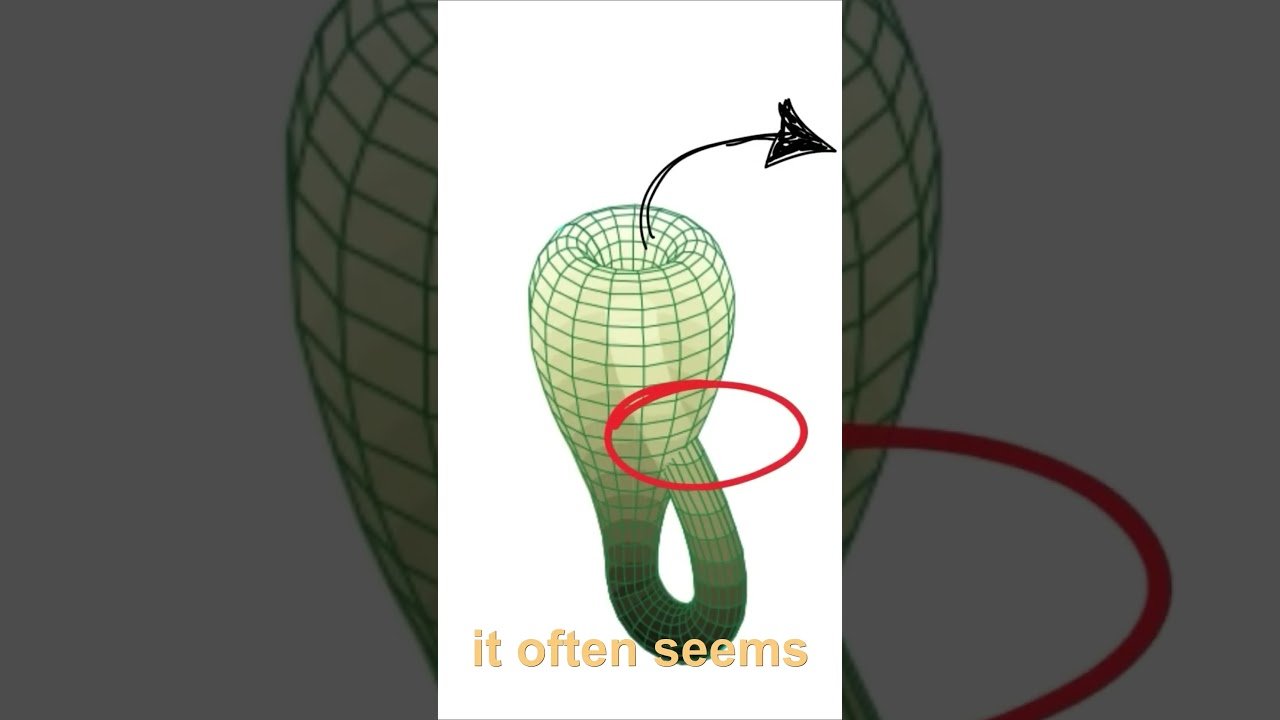
The Klein Bottle: A Surface with No Inside or Outside
The Klein bottle, named after German mathematician Felix Christian Klein, is another example of a non-orientable surface. However, unlike the Möbius strip, it has no boundary, meaning there are no points where the surface abruptly stops.
Constructing a Klein Bottle
The Klein bottle does not intersect itself, though it often appears to in visualizations due to the limitations of 3D space. In 4D space, it is easily constructed from the Möbius strip. Just take two copies of the Möbius strip and glue their edges together.
Or in the words of Austrian-Canadian mathematician Leo Moser:
“A mathematician named Klein Thought the Möbius band was divine. Said he, ‘If you glue The edges of two, You’ll get a weird bottle like mine.’”
The Klein bottle is a closed surface with no distinct inside or outside. If you were an ant walking along its surface, you could reach any point without ever crossing an edge, because there is no edge to cross. In 3D representations, the bottle appears to pass through itself, but this is an artifact of squeezing a 4D object into 3D space, similar to how a 2D drawing of a cube shows edges crossing even though they do not actually intersect.
Further reading:
- Klein’s original work is discussed in John Stillwell’s Classical Topology and Combinatorial Group Theory (Springer)
- For an accessible introduction to non-orientable surfaces, see the MathWorld entry on the Klein bottle (Wolfram MathWorld)
- David Richeson’s Euler’s Gem: The Polyhedron Formula and the Birth of Topology covers the broader history of surfaces like the Klein bottle (Princeton University Press)
Leave a Reply