

Ulam’s Packing Conjecture: Why Spheres Are the Worst Packers
Ulam’s packing conjecture concerns the packing of identical shapes in three-dimensional space. Imagine taking a bunch of identical convex solids and using them to fill a space, packing them as tightly as possible with no overlap.
Packing Density
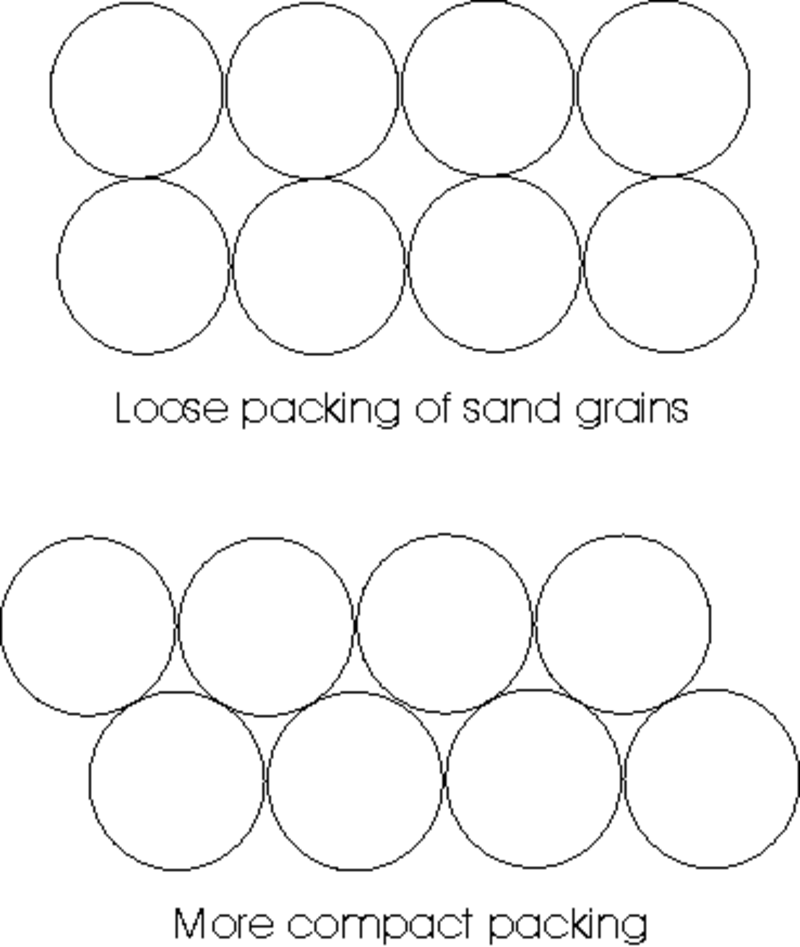
The packing density is the proportion of the space that is occupied by the solids. If the solids are packed as tightly as they can be, their density is called the optimal packing density. Of course, we cannot take the volume of infinitely many solids and divide it by the volume of the infinite space they occupy. Instead, we consider the proportion of occupied volume in a very large space, then take the limit as that volume approaches ∞.
The Conjecture
Ulam’s packing conjecture states that the ball has the smallest optimal packing density of any convex solid. In other words, if you want to fill up a space with a bunch of identical solids, then balls are the least efficient way to do it.
Why Is This So Hard to Prove?
The conjecture is attributed to Stanisław Ulam, one of the most versatile mathematicians of the 20th century. It sounds intuitive since spheres leave curved gaps between them no matter how they are arranged, while flat-faced shapes like cubes can tile space perfectly with zero wasted room. The optimal packing density of spheres is approximately 74.05%, a result known as the Kepler conjecture, which was proven by Thomas Hales in 1998. Despite this, Ulam’s conjecture remains unproven. The difficulty lies in the sheer diversity of convex shapes. To prove the conjecture, one would need to show that every possible convex solid, no matter how irregular, packs more efficiently than a sphere. While it has been verified for many specific shapes, a general proof covering all convex solids has eluded mathematicians.
Leave a Reply