
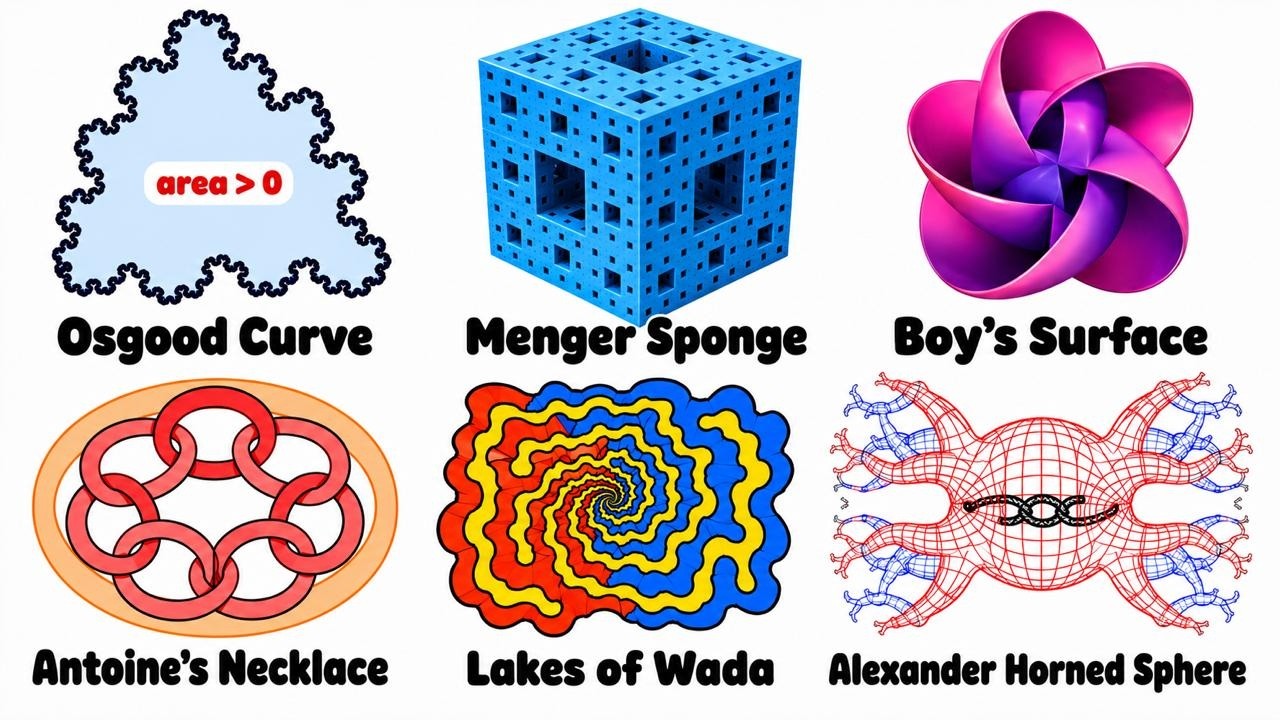
Some mathematical objects seem to break the rules of geometry. A curve that has area, a sponge with no volume but endless surface, a one-sided surface that fits in space, and a cloud of dust that can snag a rope: each is rigorously defined and fully consistent. This article tours six of them and explains why they are so surprising.
The Osgood Curve
Lay a string on a table and join its ends without letting it cross itself. The result is a Jordan curve, which is a plane curve with no multiple points that matches a circle by a one-to-one continuous correspondence [1]. Intuition says such a line, being one-dimensional, should have no area. Here the area means that of the curve as a set of points, not the area it encloses [1]. Jordan had shown that curves with finite length always have zero area, but the general question was apparently still open [1].
In 1903 William Osgood constructed a Jordan curve of positive area. His construction subdivides a square using progressively narrower canals and dykes, ultimately producing a non-self-intersecting curve whose points have positive area [1]. A Koch snowflake, by contrast, has infinite length but zero area as a set of points. The video's description of adding shrinking bumps is a loose analogy rather than Osgood's actual construction. A curve can remain topologically a single non-crossing loop without having zero area.
The Menger Sponge
Divide a cube into 3 × 3 × 3 = 27 smaller cubes and remove 7: the center cube and the six face centers [2]. Repeat on each of the 20 remaining cubes, then on the resulting 400, then 8,000, and so on. After n steps there are 20ⁿ cubes of edge 1/3ⁿ [2].
Vₙ = (20/27)ⁿ → 0
Each stage keeps only 20/27 of the volume, so the volume drops to zero, while the surface area grows without bound [2]. The sponge's fractal dimension d satisfies 3ᵈ = 20 [2]. For more examples of non-integer dimensions, see fractal dimensions.
d = log 20 / log 3 ≈ 2.727
This lies between the dimension of a surface and that of a solid, but one caveat matters: its topological dimension is 1. In fact, Menger showed in 1926 that every compact metric space of covering dimension 1 embeds in the sponge [2].
Boy's Surface
Glue each point of a sphere to its opposite point and you get the real projective plane, a closed surface with only one side. It cannot be placed in three-dimensional space without passing through itself, but it can be immersed, meaning mapped smoothly with self-intersections allowed. Hilbert had tasked his student Werner Boy with showing this was impossible; in 1901 Boy instead constructed such an immersion [3][4]. Unlike the Roman surface and the cross-cap, Boy's surface has no singular points other than its self-intersections [4]. It meets itself at a single triple point [3], and Boy found models with threefold rotational symmetry [5]. Another familiar example of a closed, one-sided surface is the Klein bottle.
Antoine's Necklace
A Cantor set is what remains when you repeatedly remove middle thirds from a segment: an uncountable cloud of points with no intervals. Antoine's necklace, discovered by Louis Antoine in 1921, is a Cantor set in space whose complement is not simply connected, which makes it wild; the standard middle-thirds version is tame [6][7]. It is built as the intersection of chains of linked solid tori, where each torus is circled by a chain of smaller ones, forever [6]. It therefore shows that Cantor sets, though all topologically alike, need not sit in space in equivalent ways [7]. A loop of rope threaded through the tangles cannot be pulled free, even though the set is only dust.
The Lakes of Wada
Start with an island and three disjoint lakes. Extend canals from each lake, never letting them touch and never cutting off dry land, so that the remaining land lies ever closer to every lake. The process was constructed by Yoneyama in 1917, who credited the idea to Takeo Wada [8]. The video's schedule of 1, 1/2, 1/3, … is illustrative: the general requirement is that the maximal distance from remaining land to water tends to zero [9]. In the limit every boundary point of the three lakes belongs to all three at once [10]. Two regions sharing a whole boundary is ordinary, as with the inside and outside of a circle. The surprise is three regions sharing one boundary. Kuratowski showed that such a boundary must be an indecomposable continuum [11].
The Alexander Horned Sphere
In the plane, the Schoenflies theorem says a simple closed curve splits the plane into two nice regions. The natural three-dimensional analogue fails. Alexander's 1924 horned sphere is a 2-sphere in three-dimensional space whose exterior is not simply connected [6]. The solid it bounds is homeomorphic to a closed ball, and its boundary is a genuine sphere, yet the exterior of that solid is not simply connected [12]. It grows two horns that nearly clasp each other, then splits each tip into smaller interlocking horns, forever. The result is perfectly ordinary from the inside and along its surface, yet a loop of rope in the surrounding space can be trapped by the interlocking horns. The 2D theorem would suggest otherwise, and this is exactly why the example refutes the 3D version [13]. Other unusual surfaces are explored in complex geometry shapes.
Sources
- A Jordan Curve of Positive Area Author(s): William F. Osgood
- Menger Sponge
- Boy's Surface
- Boy%27s surface
- Werner Boy
- Embeddings in manifolds, by Robert J. Daverman and Gerard A. …
- Antoine%27s necklace
- On Lakes of Wada
- Eremenko's conjecture, wandering Lakes of Wada, and maverick points
- ON LAKES OF WADA PEKKA PANKKA AND JANG-MEI WU
- The saddle-straddle method to test for Wada basins
- Alexander's Horned Sphere — from Wolfram MathWorld
- Alexander horned sphere
Leave a Reply