
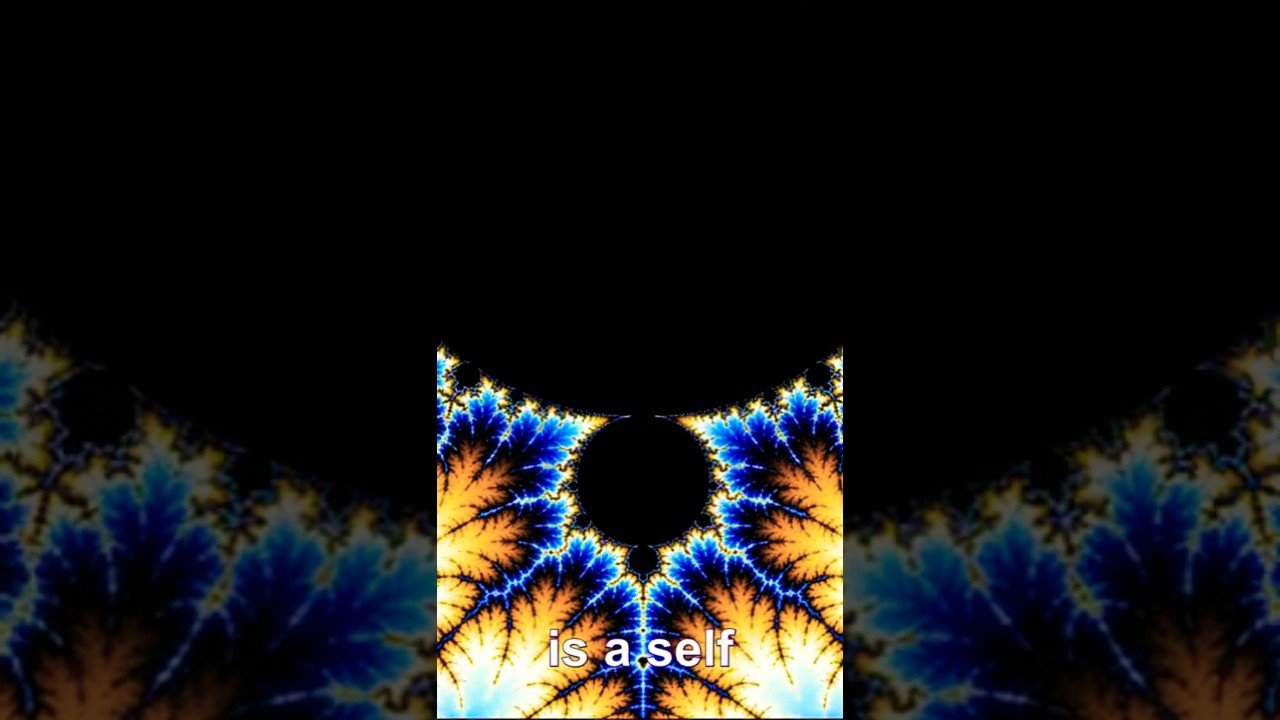
The Mandelbrot set, named after French-American mathematician Benoît B. Mandelbrot, arises in the study of complex numbers.
How It Works
We begin by picking some number c in the complex plane. Using c, we define a function: take a number, multiply it by itself, add c, and feed the result back in. Starting from zero, we repeat this process and watch what happens. If the sequence of outputs stays bounded (does not fly off to ∞), then c is in the Mandelbrot set. If it escapes to ∞, it is not.
A Fractal of Extraordinary Detail
Drawing the Mandelbrot set in the complex plane produces a very intricate shape. Infinitely intricate, in fact, making it a fractal. Zooming in reveals self-similarity at certain points, along with a variety of other patterns: spirals, branching filaments, and miniature copies of the whole set embedded throughout the boundary.
Due to its intricacy, the Mandelbrot set has been cited as an example of mathematical beauty, particularly how complex patterns can arise from simple definitions.
The function that generates it, f(z) = z² + c, is about as simple as a complex function can get. Yet the boundary of the Mandelbrot set is so complicated that it has a fractal dimension of 2, meaning the boundary is as complex as a two-dimensional surface despite being a one-dimensional curve. The set also connects to Julia sets: for each point c in the complex plane, there is a corresponding Julia set, and whether c lies inside or outside the Mandelbrot set determines whether that Julia set is connected or fragmented.
Further reading:
- Benoît Mandelbrot’s The Fractal Geometry of Nature (W.H. Freeman)
- MathWorld entry on the Mandelbrot set (Wolfram MathWorld)
- Robert Devaney’s An Introduction to Chaotic Dynamical Systems covers the mathematical foundations (Westview Press)
Leave a Reply