
Surveying and Geometry
Today, the remains of various Roman cities and settlements lie scattered across three major continents and stand as a testament to the power this civilization once possessed. From the city walls of Chester in England to the streets of Tarragona in Spain and eastward to ancient sites in Italy, these distinct places all harbor visible remains of their Roman past.
But these marvelous systems were not the creation of impromptu construction. Instead, they were meticulously planned out by specialized workers on the dime of the empire. This was all thanks to their expertise and development in the field of surveying, which not only required a considerable understanding of mathematics but also geometry.
Surveying was essential to the growing Roman Empire and played a crucial role in land management, urban planning, and its extensive infrastructure projects. While it would be wrong to suggest the Romans discovered surveying, they did develop their own sophisticated methods for land division. Roman surveyors, known as gromatici or agrimensores, primarily used Euclidean geometry, which provided them with the mathematical principles needed to make precise measurements. They were highly skilled and used several specialized tools, instruments, and techniques to implement geometric principles in the field. This enabled them to divide up vast pieces of rectangular land and plan the courses for roads and aqueducts.
The Centuriation System
One of the primary applications of geometry was in the establishment of the centuriation system. This allowed the surveyors to divide the land into a rectangular or square grid to facilitate colonization, taxation, and resource management.
To start the process, a surveyor would generally identify a central viewpoint known as the umbilicus. From here, they would proceed to establish two perpendicular axes: the Decumanus Maximus, which ran east to west, and the Cardo Maximus, aligning north to south, marking the two main roads of the settlement or the primary axes of the grid.
The intersection of the Cardo and Decumanus often served as the location for the city’s forum, the central public space for markets, religious ceremonies, and civic activities. The ends typically aligned with the city gates. These main streets also connected to the larger Roman road network that extended throughout the empire.
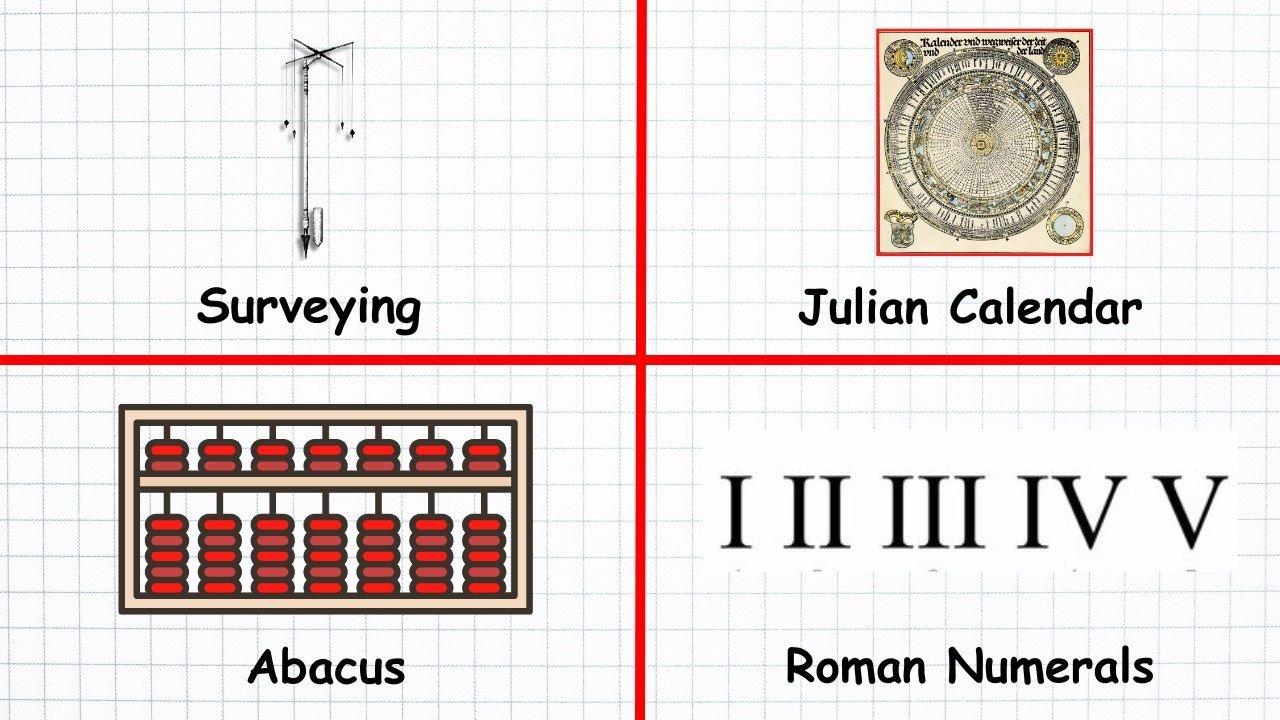
To ensure the principal axes were straight, the surveyor would make use of several instruments. The most important of all was the groma. This unique yet simple device consisted of a vertical staff with a horizontal crosspiece from which four plumb bobs were suspended at right angles. By properly aligning the plumb lines, Roman surveyors could establish straight lines and accurate right angles, both of which were essential to laying out the two main roads of a Roman city or encampment.
Once the main axes were established, surveyors then had the painstaking task of creating secondary roads called limites quintarii. These were laid out at regular intervals of 100 actus, or around 3.5 km apart. This essentially divided the settlement or grid into large square areas.
The Romans’ expertise in geometry and mathematics is further highlighted in the basic unit of the centuriation known as the centuria. This was used to further subdivide the grid into areas of 20 actus, equivalent to around 710 m². These centuriae were then divided into 100 heredia. Finally, each heredium was divided into two iugera, a unit of land that a pair of oxen could plow in one day.
The Roman surveyors utilized this meticulous and precise system of geometry to divide large plots of land into organized sections, facilitating not only the creation of settlements but also other infrastructure projects like roads and aqueducts. This practical and efficient approach allowed them to execute large-scale engineering projects with remarkable accuracy for the era. The remains of their geometric ingenuity can still be witnessed across the landscape of former Roman territories today, particularly in places like Italy.
Roman Numerals
Another equally fascinating development was their own numerical system, still recognizable even in our modern era on various clock faces and monuments. The origin of this unique system actually predates the formation of the Roman Empire itself and takes us back to the days of the Etruscan civilization that once thrived in central Italy.
The Romans adopted the earlier Etruscan system and created unique symbols of their own which represented specific values. The symbol I represents 1, V represents 5, X represents 10, L represents 50, C represents 100, D represents 500, and M represents 1,000. The numerals were primarily used for counting, trade, and basic arithmetic during the height of the Roman Empire, right up until they were replaced in Europe around the 15th century by the Hindu-Arabic numeral system.
Roman numerals typically worked on an additive principle in which the numbers were arranged from largest to smallest. For example, LXXVII = 50 + 20 + 5 + 2, amounting to 77. However, the standard Roman numeral system could only represent numbers up to 3,999, or MMMCMXCIX. This is because a symbol could not be repeated more than three times in a row. To get around this, larger numbers were represented using various methods, such as placing a vinculum (a horizontal line) over a numeral to multiply it by 1,000. For example, V with a vinculum represents 5,000.
Roman numerals weren’t solely used for addition. It’s also possible to subtract numbers from one another. This was done by placing a smaller value to the left of a larger one, indicating that the smaller number is to be subtracted from the larger. For example, IV equals 4, as we subtract the I (1) from the V (5).
While Roman numerals were widely considered one of the oldest legacies of Roman mathematics, the system was not well suited for complex arithmetic operations. One of the major limitations was the absence of a symbol for zero. While Latin writers of the medieval period expressed the concept of nothing using the term nulla, the lack of a symbol for zero made complex mathematical operations, particularly multiplication and division, incredibly challenging.
The Roman Abacus
The limitations of Roman numerals ultimately led to the emergence of the Roman abacus. This allowed citizens of the Roman Empire to overcome the constraints of their numerical system. The development of a portable abacus aided merchants, military surveyors, and tax collectors in their daily work.
This small device worked on a base-10 format reminiscent of earlier abacuses used by the Greeks and Babylonians. The Roman abacus typically consisted of a rectangular frame, often made of wood or metal, with horizontal grooves or wires. The grooves were arranged into columns, each representing a different place value, ranging from units to tens and hundreds. Small calculi, or pebbles, were placed into the grooves and could be moved up and down, allowing the user to add and subtract values easily. This simple yet valuable tool made some aspects of daily life easier, especially for recordkeeping and basic calculations.
The Julian Calendar
One final mathematical development the Roman Empire could be best known for is its contribution to timekeeping, most notably through the Julian calendar. In the 1st century BC, under the advice of the astronomer Sosigenes, Julius Caesar decided to create and implement a new calendar for the empire based on the solar year.
Before this, European societies including Rome used lunisolar calendars based on the cycles of the moon and seasons. But this required periodic intercalary months to keep the calendar aligned with the solar year. Even before Caesar, various scholars of the ancient world, including Herodotus, spoke of the inefficiency of this system. According to the Greek writer, the Egyptians had a more accurate solar calendar, and this would inspire Caesar to implement his new system around 45 BC.
He went on to introduce a solar calendar made up of 365 days with a leap year every four years. Caesar’s great-nephew, Augustus, later fixed a minor error in the leap year schedule and adjusted the lengths of some months. This mathematical approach to timekeeping demonstrated the Roman emphasis on practical application and order. From Augustus’ correction onward, the Julian calendar would serve as the standard calendar for the Western world for over 16 centuries.
Rome’s Mathematical Legacy
As we look back at the various mathematical developments made by the Romans, it’s clear they were not a hotbed of abstract mathematical theory. Their contributions had a practical impact on the empire’s evolution. From the enduring Roman numerals and the portable abacus to their sophisticated surveying techniques and the foundational Julian calendar, Roman mathematical developments were instrumental in building and sustaining one of history’s greatest civilizations.
Further Reading
- Roman Surveying on Wikipedia
- Groma (Surveying) on Wikipedia
- Centuriation on Wikipedia
- Roman Abacus on Wikipedia
- Julian Calendar on Wikipedia
Leave a Reply