Every Geometry Paradox Explained
Geometry is not always as straightforward as it seems. Some of its most surprising results look like errors at first glance but hold up completely under scrutiny. Here is a tour through some of the strangest and most mind-bending geometry paradoxes.
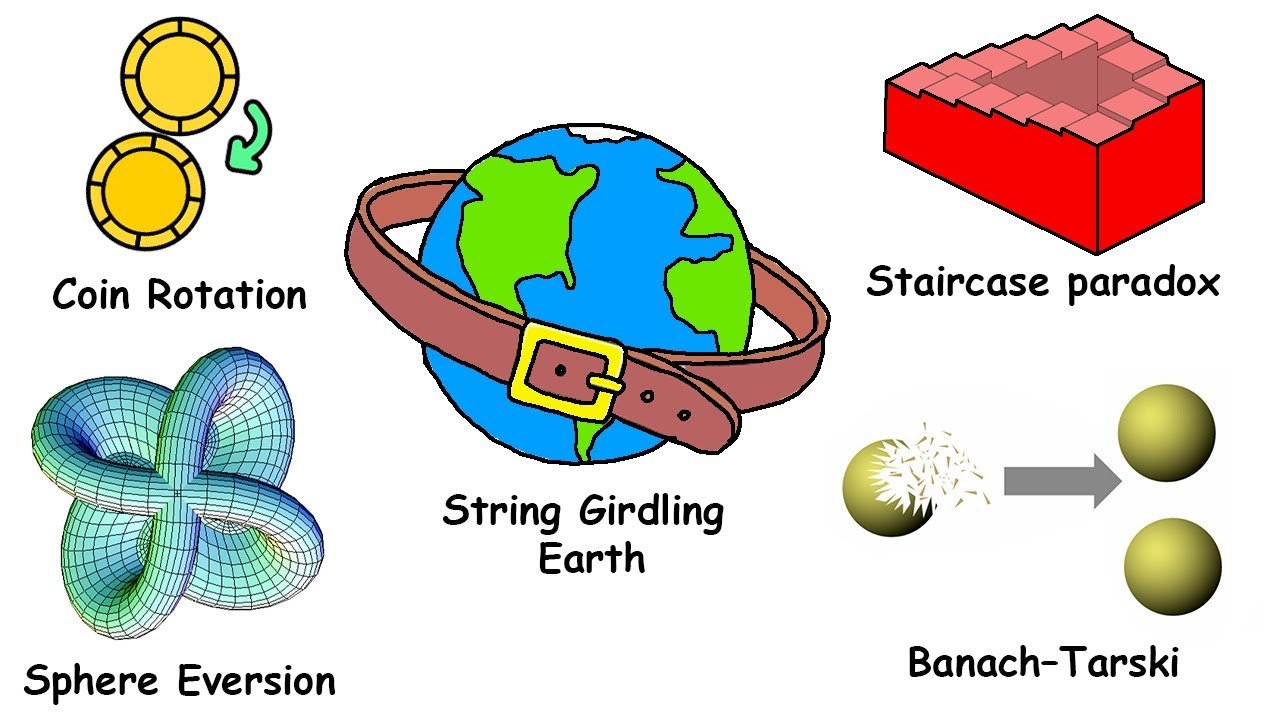
String Girdling Earth

Imagine Earth as a perfect sphere. Stretch a piece of string along the entire equator so that it loops back on itself and hugs the ground perfectly. Now lift the entire string so that it sits exactly 1 meter off the ground, adding extra string as needed to keep it a closed loop. How much extra string is required?
Most people guess several kilometers. The actual answer is about 6.28 meters.
Here is why. The key relationship is that a circle’s circumference equals tau (τ) times its radius, where tau is approximately 6.28. That means the circumference is directly proportional to the radius. Increasing the radius by any fixed amount increases the circumference by tau times that amount, regardless of what the original radius was. Lifting the string by 1 meter increases the radius of the circle it forms by 1 meter, so the circumference increases by exactly tau meters, around 6.28. The size of Earth does not enter into it at all.
Algebraically: if the original circumference is τr, and the new circumference is τ(r + 1), the difference is simply τ.
Coin Rotation Paradox
Take two identical coins A and B. Hold coin A in place and roll coin B around it without any slipping for one complete trip around. How many full rotations does coin B make?
The intuitive answer is one. The actual answer is two.
To see why, first consider rolling coin B along a flat surface. Assume each coin has a radius of 1 cm. As coin B rolls, its center travels a distance equal to the coin’s circumference, which is tau centimeters. The coin completes exactly one full rotation.
Now roll coin B around coin A. As coin B completes one full trip, its center traces a circle whose radius is the sum of both coins’ radii, which is 2 cm. The circumference of that path is therefore 2 tau centimeters, twice as far as in the flat-surface case. Since coin B travels twice as far while rolling without slipping, it must rotate twice as much, making two full turns.
Another way to see it: the rotation of coin B comes from two separate effects. Sliding coin B around coin A while keeping a fixed contact point accounts for one turn. Rolling coin B across the equivalent flattened length of coin A accounts for another turn. Combined, that gives two turns total.
This problem is subtle enough that the SAT included a multiple choice question about it in May 1982 where every single answer option was wrong. Three students wrote in to flag the error, and the tests were regraded.
Staircase Paradox
Given a square with side length 1, the Pythagorean theorem tells us the diagonal has length √2, approximately 1.414. But consider approximating that diagonal with a staircase pattern, alternating between horizontal and vertical steps. The total length of all horizontal portions is 1 and the total length of all vertical portions is 1, so the staircase has length 2.
Now make the steps smaller and smaller. Each staircase is still exactly 2 units long, and the staircases visually approach the diagonal as the steps shrink. Since the limit of the staircases appears to be the diagonal, and each staircase has length 2, it seems to follow that the diagonal has length 2. But the diagonal has length √2, not 2. What went wrong?
The problem is the direction of travel. Along the actual diagonal, your direction of travel stays constant. Along any staircase path, your direction flips between straight up and straight right with every step. No matter how small the steps get, that alternation never goes away. The staircases get geometrically closer to the diagonal, but the direction of travel along them never gets any closer to the direction of travel along the diagonal.
The length of the limit of a sequence of curves is not necessarily equal to the limit of their lengths. This turns out to be a subtle point in how arc length is formally defined. A valid way to approximate the arc length of a curve is to connect points along the curve with straight line segments, where all the vertices lie on the curve itself. The staircase construction violates this: its corners do not lie on the diagonal. The staircase paradox is ultimately a reminder to be precise when constructing mathematical definitions.
Sphere Eversion
Imagine a sphere made of a stretchy, flexible sheet material. The material can pass through itself freely, but you cannot tear it, poke holes in it, or create any crease or sharp bend. The goal is to turn the sphere inside out, a process called sphere eversion.
One natural approach is to push the two hemispheres through each other. This creates a crease along the equator, which is not allowed. Other approaches run into similar problems. The task turns out to be genuinely difficult to solve in practice.
Counterintuitively, sphere eversion is possible. This was first proven by American mathematician Stephen Smale in 1957. Practical methods were later developed by several mathematicians, including Arnold Shapiro and Bernard Morin, the latter of whom was blind. The best-known method is called Thurston’s corrugations, developed by American mathematician William Thurston. It involves dividing the sphere into guide strips, making the regions between them bulge into corrugations, pushing the caps through each other while rotating them a half turn in opposite directions, and then pulling the strips through the sphere’s center. This method was illustrated in the 1994 educational video “Outside In,” produced at the Geometry Center at the University of Minnesota.
Banach-Tarski Paradox
Can you split a solid object into pieces and reassemble those exact pieces into two identical copies of the original? In the physical world, no. In mathematics, under a specific set of rules, yes.
The Banach-Tarski paradox, proven by Polish mathematician Stefan Banach and Polish-American mathematician Alfred Tarski, states that a ball can be decomposed into at least five pieces that can then be rotated and repositioned to form two balls identical to the original. More broadly, any two reasonable solids can be decomposed and rearranged into each other. Because of one famous illustration of this, the result is sometimes called the pea and the sun paradox: a pea could theoretically be decomposed and reassembled into something the size of the sun.
This theorem depends critically on which axioms you accept. In particular it relies on the axiom of choice, which states that given any collection of sets, there is a way to select one element from each. This cannot be proven from the other standard axioms of mathematics, so it must be assumed separately.
The proof works by decomposing the ball into a collection of infinitely scattered point sets that have no well-defined volume. Simple rigid transformations then allow these pieces to be reassembled into two complete balls. The argument is dense and not easy to follow intuitively, but the conclusion is mathematically airtight given the axiom of choice.
Leave a Reply