
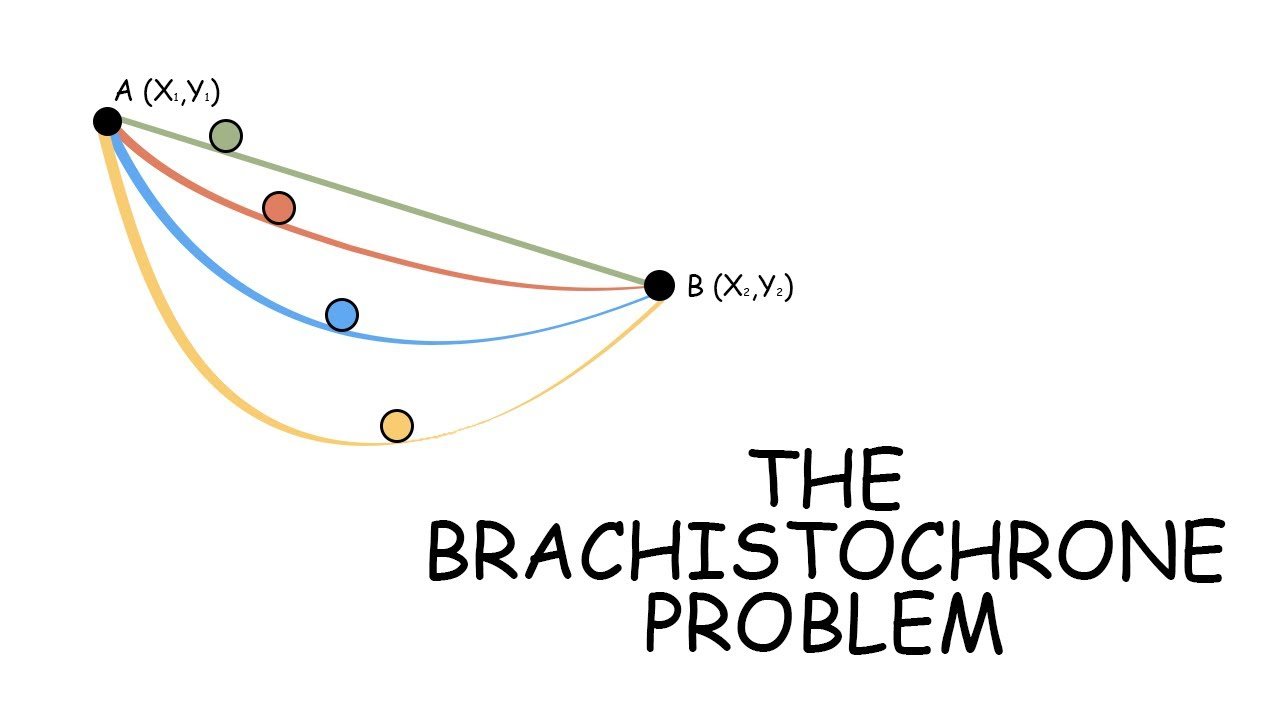
What Is the Brachistochrone?
One of the most fascinating problems in the history of mathematics is the brachistochrone problem, posed in the 17th century. It seeks to answer a seemingly simple question: what is the fastest path between two points in a gravitational field? This problem marked the birth of the calculus of variations and revolutionized both physics and mathematics.
The word “brachistochrone” comes from Greek and is composed of two parts. “Brachistos” meaning shortest or fastest, and “chronos” meaning time. Therefore, brachistochrone literally means “curve of shortest time” or “fastest curve.”
Suppose we drop a particle from point A to point B, frictionless and under the sole influence of gravity. The most intuitive option would be a straight path. However, experience tells us that objects in free fall accelerate as they descend. This means that if the particle follows a curve that allows it to gain speed quickly at the start, it could reach its destination more quickly. The goal is to find a curve that minimizes travel time in a gravitational field.
This challenge attracted the attention of the most influential mathematicians of the time, giving rise to the calculus of variations, a branch of mathematics dedicated to finding functions that optimize certain values. The search for this optimal curve and the intellectual competition among great mathematicians marked a milestone in the history of mathematical analysis.
The Challenge
In 1696, the Swiss mathematician Johann Bernoulli, a member of the illustrious Bernoulli family (a dynasty of scientists and mathematicians who left a profound mark on the history of science), publicly posed the brachistochrone problem as a challenge to Europe’s greatest mathematicians. He was convinced that solving it required an innovative approach and wanted to test the ingenuity of his contemporaries. Although it seemed like a geometric problem, the solution required mathematical tools that were still developing.
Mathematicians such as Isaac Newton, Jacob Bernoulli, Gottfried Leibniz, and Guillaume de l’Hôpital accepted the challenge. The rivalry between Newton and Leibniz, exacerbated by the dispute over the invention of calculus, added tension to the competition.
Newton solved the problem in a single night and submitted his solution anonymously. Upon seeing it, Bernoulli exclaimed the famous phrase: “I recognize the lion by its claws.” Jacob Bernoulli also found a solution and proposed an alternative derivation. It was discovered that the optimal curve was neither a straight line nor a parabola, but a cycloid, the curve generated by a point on the rim of a rolling wheel.
The Calculus of Variations
The brachistochrone problem could not be solved with the traditional mathematical tools of differential calculus. Its solution required a new branch of mathematics, the calculus of variations, whose goal is to find functions that optimize certain quantities. The calculus of variations studies how a functional changes when small variations are made in the form of the input function. Unlike standard calculus, which works with derivatives of functions, in the calculus of variations an optimal function is sought from an infinite set of possible solutions.
A key concept in this problem is the Euler-Lagrange equation, which establishes a necessary condition for a function to minimize or maximize an integral value. It is expressed as:
d/dx (∂f/∂y′) − ∂f/∂y = 0
where f is a function of x, y, and y′. Here y is the function to be optimized, and y′ represents its derivative.
Euler and Lagrange were not directly involved in the original solution to the brachistochrone problem, as it had been posed in 1696 by Johann Bernoulli. However, Leonhard Euler and Joseph-Louis Lagrange were key figures in the subsequent development of the calculus of variations, which became a central tool for addressing similar problems.
Deriving the Solution
The brachistochrone problem is also related to the principle of least action, a fundamental idea in physics. This principle states that physical systems evolve along paths that minimize a quantity called action.
To find the optimal curve, it is necessary to formulate a differential equation that describes its shape. The time it takes for a particle to move from A to B under the action of gravity is given by the integral t = ∫ ds/v, where ds is a differential element of the curve and v is the velocity of the particle.
A differential element of arc length in Cartesian coordinates is given by ds = √(dx² + dy²) = √(1 + y′²) dx. Substituting this into the time equation gives t = ∫ √(1 + y′²)/v dx.
The velocity v of the particle is given by the conservation of mechanical energy. Since potential energy is converted into kinetic energy as the particle descends, we have mgy = (1/2)mv², which gives v = √(2gy).
Rewriting the equation of time: t = ∫ √((1 + y′²)/(2gy)) dx. This is the objective function that we seek to minimize. To find the function y(x) that minimizes an integral of the form I = ∫ f(x, y, y′) dx, we apply the Euler-Lagrange equation.
For this case, f = √((1 + y′²)/(2gy)). Since f does not depend on x explicitly, there is a property in the calculus of variations that allows the problem to be simplified: f − y′ · (∂f/∂y′) = C, where C is a constant.
The Cycloid
Solving this differential equation reveals that the curve that minimizes the descent time is not a straight line or a parabola, but a cycloid. This result is surprising and demonstrates how nature follows optimization principles that can be described using advanced mathematics.
The parametric equations of a cycloid with radius r are:
x = r(θ − sin θ)
y = r(1 − cos θ)
where θ is the parameter representing the angle of rotation of the circle generating the cycloid. This curve ensures that the particle always descends in such a way that it quickly reaches the highest possible speed and at the same time uses its momentum to reach the endpoint in the shortest time.
The cycloid is a plane curve that has applications in physics, optics, engineering, and architecture. The brachistochrone problem remains a benchmark in applied mathematics, demonstrating how a simple question led to advances in multiple disciplines.
Further Reading
- Brachistochrone Problem on MathWorld
- Cycloid on MathWorld
- Euler-Lagrange Equation on MathWorld
- Calculus of Variations on Wikipedia
Leave a Reply