
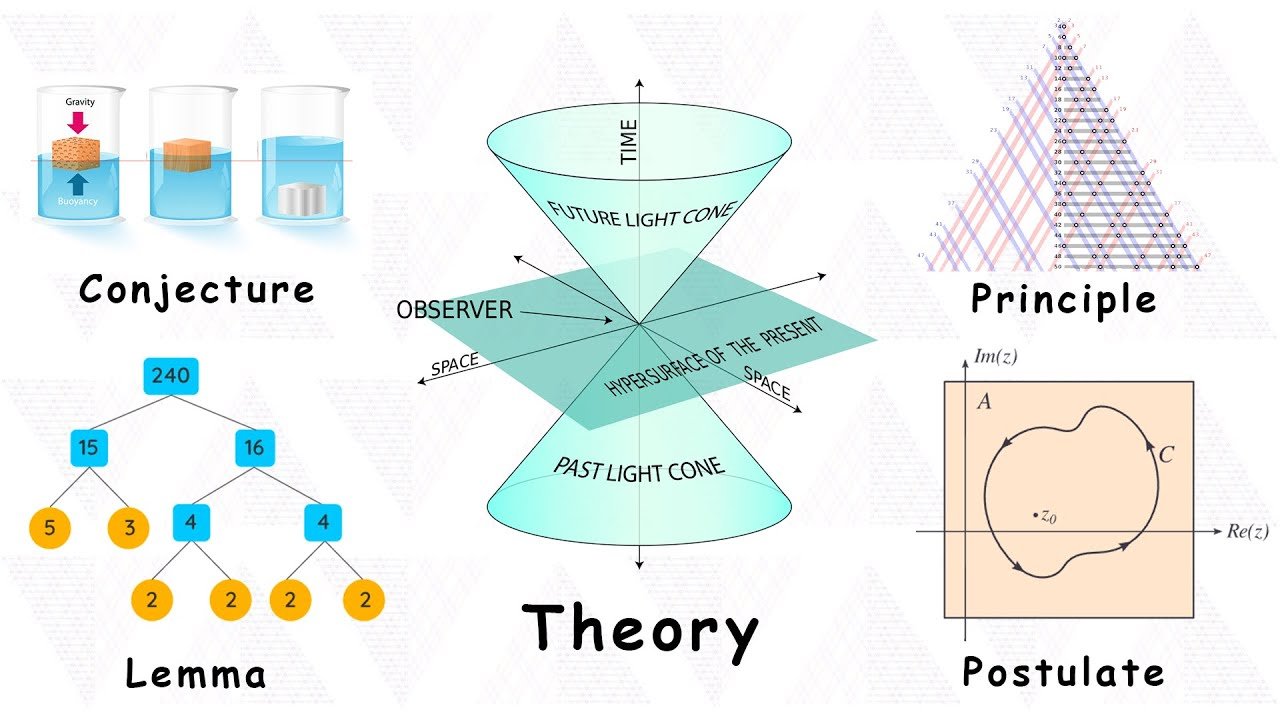
Terminological precision in mathematics is not a mere formality but has profound consequences for the logical structure and understanding of mathematical theories. In the mathematical and scientific field, the concepts of principles and laws play a fundamental role in the formulation of knowledge. Although both terms are often used interchangeably in everyday language, in the academic context, they have key differences that determine their nature and application.
Principles vs Laws
A principle is a fundamental notion that serves as a basis for the development of theories, proofs, or models. Principles generally do not require formal proof. They are accepted because of their logical coherence or agreement with observable reality. In many cases, these are presented as starting points for a discipline or a specific area of knowledge.
On the other hand, a law is a rule that describes a constant relationship within a given system. Unlike principles, laws are usually derived empirically or by logical deduction and are characterized by their validity within a specific set of conditions. In the field of natural sciences such as physics, laws are usually formulated from experimental observations, while in mathematics, they may arise as results of axioms and postulates.
The main difference between the two concepts lies in their origin and the way in which they are validated. While a principle may be a statement accepted for its usefulness and internal coherence, a law must be supported by mathematical proofs or verifiable empirical evidence.
Archimedes’ Principle
An iconic example of a principle is Archimedes’ principle, formulated by the Greek mathematician Archimedes of Syracuse in the 3rd century BC. This principle states that a body immersed in a fluid experiences an upward thrust equal to the weight of the volume of fluid displaced. Mathematically, it can be expressed as:
F_B = ρgV
where F_B = buoyancy force, ρ = fluid density, g = gravitational acceleration, and V = volume of fluid displaced. The principle does not require experimental demonstration in terms of advanced differential equations, but is logically deduced from the behavior of fluids.
Newton’s Laws
In contrast, Newton’s laws, formulated by Isaac Newton in the 17th century, are paradigmatic examples of mathematical laws applied to physics. These laws describe the relationship between force and the motion of bodies. Newton’s second law is expressed mathematically as:
F = ma
where F = applied force, m = mass of the object, and a = acceleration produced. Unlike Archimedes’ principle, these laws are verified by rigorous experimentation and form the basis of classical mechanics.
The validity of a principle is maintained as long as it remains a useful tool for explaining phenomena or constructing mathematical models. On the other hand, a law can be modified or replaced if new empirical evidence or theoretical developments demonstrate its inaccuracy or its limited applicability.
In summary, while principles provide conceptual and heuristic foundations for a discipline, laws establish quantifiable relationships verifiable by experimentation or logical deduction.
Conjectures vs Theories
In the field of mathematics and science in general, the terms conjecture and theory have different meanings, although these are often confused. Both concepts are related to the process of generating and validating knowledge, but they differ in their degree of certainty and acceptance within the scientific community.
A conjecture is a mathematical statement whose truth has not yet been proven, but which is considered plausible due to empirical evidence, observed patterns, or partial proofs. In other words, a conjecture is an unproven hypothesis within the field of mathematics. Some conjectures may remain unresolved for centuries, defying generations of mathematicians.
On the other side, a theory is a structured set of propositions that have been rigorously proven from axioms and definitions. A theory provides a conceptual framework within which new statements, theorems, and applications can be developed. Generally speaking, a theory is a consolidated system of mathematical knowledge that has undergone a rigorous validation process.
The key difference between the two concepts is that a conjecture has not been formally proven, while a theory is supported by a logical structure and rigorous demonstrations.
Goldbach’s Conjecture
One of the most famous examples of a conjecture is the Goldbach conjecture, proposed in 1742 by the Prussian mathematician Christian Goldbach. This conjecture states that every even number greater than 2 can be expressed as the sum of two prime numbers. For example, 4 = 2 + 2, 6 = 3 + 3. Although it has been verified for extremely large numbers using computers, there is still no mathematical proof validating the conjecture for all even numbers. Its status remains one of the most important open problems in number theory.
Theory of Relativity
For its part, a well-established theory is the theory of relativity, formulated by Albert Einstein in the 20th century. Unlike a conjecture, this theory has been supported by multiple mathematical demonstrations and experimental verifications. The theory of relativity is divided into two parts.
Special relativity describes how the laws of physics are the same for all inertial observers and establishes the famous equation E = mc². General relativity extends these principles to gravitation, describing it as the curvature of spacetime in the presence of mass. This theory has been confirmed by multiple observations such as the bending of starlight during a solar eclipse, the expansion of the universe, and the existence of gravitational waves.
It may take centuries for a conjecture to be validated, and in some cases, it may never be solved. Once a conjecture is proven, it becomes a theorem, as was the case with Fermat’s conjecture, which remained unsolved for over 350 years until Andrew Wiles presented his proof in 1994.
On the contrary, a mathematical theory is built from axioms and enriched by theorems derived from them. Its validity does not depend on experimentation, but on logical rigor.
In conclusion, while a conjecture is a statement pending demonstration, a theory is a structured framework of mathematically demonstrated knowledge.
Axioms vs Postulates
Axioms and postulates are fundamental statements that are accepted as true without proof. Although they are often used interchangeably, there are subtle differences between them.
An axiom is a general proposition that is considered self-evident within a logical system. It is used as a starting point for constructing mathematical theories. In many cases, axioms are abstract and can be applied in different branches of mathematics.
On the other hand, a postulate is a statement that is accepted without proof within a specific context. Unlike axioms, which can be applied in different fields, postulates are usually restricted to a particular theory or system. For example, the Zermelo-Fraenkel axioms in set theory form the basis of modern mathematics, while Euclid’s postulates are fundamental in Euclidean geometry but not in other geometries.
Euclid’s Axioms
Traditional geometry is based on five key axioms introduced by Euclid in his seminal work, The Elements. Of these, the fifth axiom is the most famous. It states that through any point not lying on a given straight line, there exists exactly one line that can be drawn parallel to the original.
For centuries, mathematicians tried to prove this postulate from the other four without success. Finally, in the 19th century, non-Euclidean geometries were developed by modifying this postulate. These non-Euclidean geometries, such as Riemann’s and Lobachevsky’s, have been fundamental in modern physics and in the theory of relativity.
Axioms and postulates are the foundation of all mathematics. Without them, it would not be possible to prove theorems or build coherent mathematical structures. In addition, they allow for the existence of multiple mathematical systems that can be applied in different contexts. The development of new axiomatic systems has led to fundamental advances in logic, computing, and physics, demonstrating that the choice of axioms is key in the construction of mathematical knowledge.
Theorems, Lemmas, and Corollaries
Mathematics is built on a logical system of proofs and deductions. In this context, theorems, lemmas, and corollaries play a fundamental role in the organization of knowledge and in the construction of new mathematical theories.
Theorems
A theorem is a mathematical statement that has been rigorously proven from previously proven axioms, postulates, or other theorems. The proof of a theorem is a logical process in which each step follows undeniably from established premises. Theorems can be of different types depending on their level of generality and impact within a mathematical theory. Some theorems are fundamental within a discipline and serve as a basis for many other proofs.
One of the best-known theorems in mathematics is the Pythagorean theorem, which states that in a right triangle, the sum of the squares of the legs is equal to the square of the hypotenuse:
a² + b² = c²
This theorem has been demonstrated in many ways throughout history, including algebraic, geometric, and even combinatorial methods. Its importance is such that it is used in various branches of mathematics, physics, and engineering.
Lemmas
A lemma is a mathematical result whose main function is to serve as a tool in the demonstration of a more important theorem. Although lemmas by themselves may seem secondary, they are often fundamental in the development of new theories.
For example, Euclid’s lemma states that if a prime number p divides the product of two integers a × b, then necessarily p divides either a or b. Although this lemma seems simple, it is key to proving a much deeper property called the fundamental theorem of arithmetic, which states that every integer greater than 1 can be factored as a unique product of prime numbers, except for the order of the factors.
Corollaries
A corollary is a mathematical result that follows directly from an already proven theorem. In other words, a corollary does not require an independent proof, but is a natural consequence of the previous result.
Cauchy’s theorem in group theory states that if a finite group G has order divisible by a prime number p, then G contains a subgroup of order p. An immediate corollary of this theorem is that any finite group whose order is a power of a prime number p contains a subgroup of every lower power of p.
The use of theorems, lemmas, and corollaries allows mathematical knowledge to be structured in an orderly manner. Without lemmas, many proofs would be unnecessarily long and complicated. Without corollaries, many useful applications of the proven theorems would be lost. The distinction between these concepts not only has theoretical value but also facilitates communication within the mathematical community and the teaching of the discipline.
Thanks to this hierarchy, it is possible to develop new mathematical theories in an efficient and understandable way. Thanks to this logical structure, mathematics continues to evolve in a systematic way, allowing the advancement of science, technology, and engineering in the modern world.
Leave a Reply