
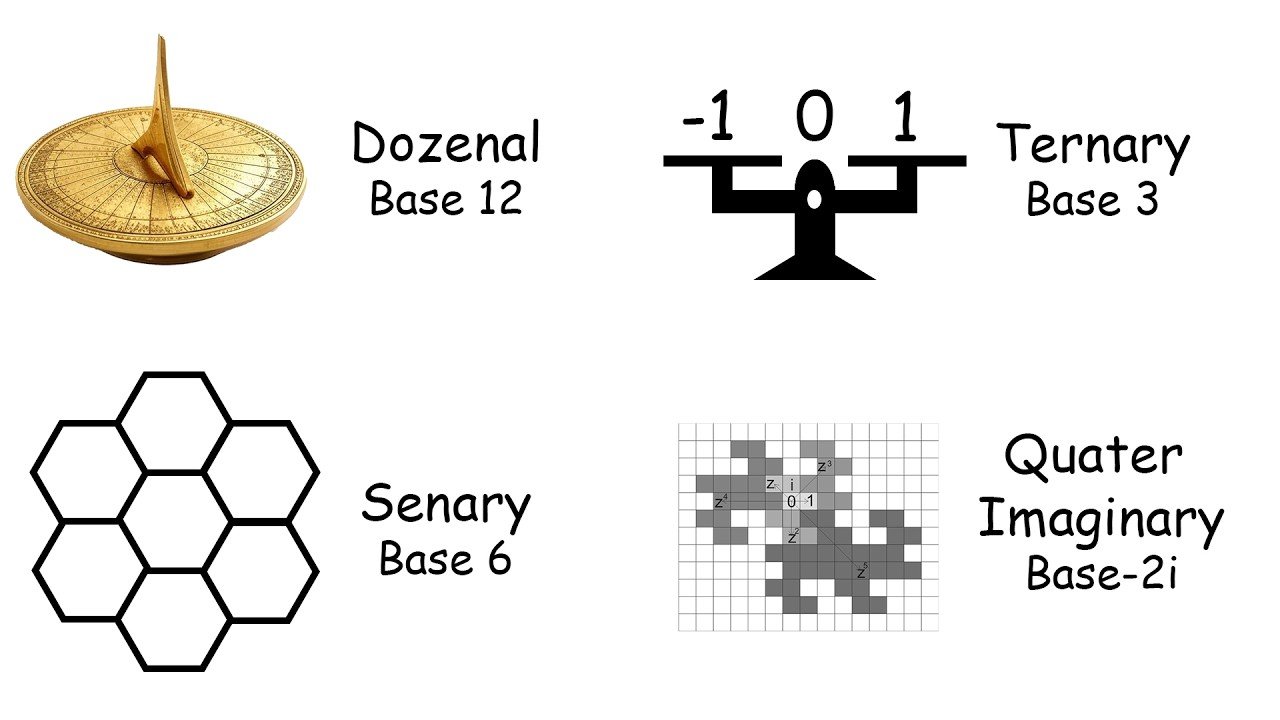
Base 10 may seem like a natural choice for humans based on our number of fingers, but it has its inconveniences. One major detail is that 1/3, which is one of the simplest fractions, can’t be represented without a repeating decimal. This extends to any fraction which is 1 divided by a positive multiple of three. Shockingly enough, positive multiples of three constitute 1/3 of natural numbers, so you will end up dealing with many such fractions in practice. Depending on who you ask, this might be considered a problem.
Dozenal (Base 12)
One way to fix this is by using a base with a factor of three. Indeed, if there’s any number that you want to be able to divide by without having to deal with a repeating representation, you can use a base with that number as a factor.
One choice you might consider is 12. It has a lot of factors, namely 1, 2, 3, 4, 6, and 12. For example, in base 12, 1/3 is just 0.4. This has made base 12 a popular choice for an alternate number base. It is often referred to by the name dozenal, since a dozen is 12. Indeed, base 12 refers to 12 as a dozen, 12 × 12 as a gross, and 12 × 12 × 12 as a great gross, though these terms were in use long before base 12.
In order for base 12 to work, we must introduce two new digits. Of course, the simplest solution is simply to borrow from the alphabet. We’re already familiar with using A and B for 10 and 11 respectively. However, other options are possible as well, like T and E. 10 is sometimes even represented by X in reference to Roman numerals.
Naturally, the digits of base 12 are harder to memorize than those of base 10, as there are more of them. The same is true of its single-digit multiplication table, which has 44 more entries than that of base 10. This is important because performing long multiplication in any base requires memorizing its multiplication table. However, having more digit types means that fewer digits are necessary to write numbers when they get big, which is a trade-off that applies to any base.
Despite base 12’s popularity, there are several other contenders for an alternative base for human use. We will examine one of them shortly.
Senary (Base 6)
As previously mentioned, base 12 has a few shortcomings. As previously unmentioned, one of those shortcomings is its awkward representation of 1/5, which is 0.2497 repeating. 1/7 and 1/10 fare similarly poorly. Perhaps we can find another base that overcomes these problems. What if we choose base 6?
This base is known by various names, including senary, heximal, and sextal. We can write out the base 6 representation of the previously mentioned fractions. In terms of digit count, these are a significant improvement from the base 12 counterparts. In fact, every fraction from 1/2 to 1/10 in base 6 can be represented with three digits or fewer. Unfortunately, 1/11 is pretty bad, but this may be a sacrifice you are willing to make.
As for the single-digit times table for base 6, it is very compact. Excluding trivial multiplications by 0 and 1, and cases where the same two numbers are multiplied in a different order, there are only 10 entries to memorize.
Base 6 also has the benefit of being nice for counting if you happen to have two hands with five fingers each, which most people do. The right hand can represent the digit in the ones place, and the left hand can represent the digit in the sixes place. For example, if you have three fingers up on the right hand and four on the left hand, that equates to four sixes plus three ones, or 27 in decimal. This allows you to represent any number from 0 to 35.
Unfortunately, this does not apply if you do not have two hands with five fingers each. A more versatile system is to have each finger represent a digit in base 2 instead, which works if you have one or more available fingers.
Of course, there is much more to say about which base would be optimal for human use. Base 12 and base 6 are only two of the proposed bases. Some have even put forth an argument for base 2. For now, we will leave this topic behind and venture into the deep dark woods of mathematics. Many number systems have been designed with certain properties more bizarre than the ones we’re used to, so let’s take a look at a few.
Balanced Ternary
Ternary is simply base 3, but we’re not talking about the standard type today. Instead, we will focus on balanced ternary: −1, 0, and 1. These are sometimes referred to as trits. To avoid confusion, we denote −1 with the letter T. However, note that other conventions exist, like −1 being a minus sign and 1 being a plus sign.
Immediately it is apparent how this base stands out from the rest with the inclusion of a negative digit. The question is, what can we do with this base? For starters, we are able to represent every single integer with just these three digits without requiring the use of a negative sign. For example, −5 can be represented as shown.
Indeed, if a number has a fractional part, this can also be represented in balanced ternary with the use of a radix point, the generalized version of a decimal point, allowing representations to extend infinitely. Balanced ternary is capable of representing any real number. Note that representations are not necessarily unique. For instance, 1/2 can either be 0.111… or 1.TTT…
We can count the first few positive integers in balanced ternary as follows: 1, 1T, 10, 11, 1TT. Meanwhile, the negative counterparts are T, T1, T0, TT, T11. As you can see, they have the same representations except that the Ts and ones are swapped. This, of course, makes sense, as each digit is simply the negation of the other.
After counting, let’s move on to single-digit addition. Most of the additions are as you would expect. Anything plus 0 is itself, and T and 1 annihilate to 0 when added together. Aside from that, 1 + 1 is 1T (or 2 in decimal), and T + T is T1 (or −2).
Using these rules, we can perform long addition in balanced ternary just like in any other base, going column by column and carrying any extra digits. Subtraction can be done by simply taking the subtrahend, negating it by swapping Ts and ones, and then performing an addition.
Due to the simplicity and convenient properties of balanced ternary, it has found use in the world of computers alongside the more familiar binary. Instead of just true or false, the values may be used to represent true, unsure, or false. This system was used in some early Soviet computers. More recently, proposals for usage in neural networks have been made. Binary still dominates in nearly all respects, but we can’t discount its ternary cousin.
Quater-Imaginary Base
We’ve seen number systems that can represent integers, allowing for fractional parts, possibly infinitely long ones. These systems can even represent all real numbers. All you need is a single string of digits and a sign. But what if we want to go beyond the real numbers?
For example, there are the imaginary numbers. We start with the imaginary unit, defined by the equation i² = −1, which no real number satisfies. An imaginary number can be obtained by multiplying a real number b by i, giving you bi. Adding this to a real number a, you get a + bi, which is called a complex number.
This is essentially a two-dimensional number, having a real part and an imaginary part, which can be represented in a 2D space called the complex plane. For example, the number −1 + 2i can be placed at the Cartesian coordinates (−1, 2).
Due to the two-component nature of the complex numbers, you have to use two separate digit strings to represent any complex number. Or do you? It turns out that there is a base where you can avoid this, called the quater-imaginary base.
The system is base 2i, hence the imaginary part of the name. It uses the four digits 0, 1, 2, and 3, hence the quater part. As a simple example, let’s take the complex number −1 + 2i from before. In the quater-imaginary system, this is represented as 10301₂ᵢ.
This is because the digits represent 1 × (2i)⁴ + 0 × (2i)³ + 3 × (2i)² + 0 × (2i)¹ + 1 × (2i)⁰. Remembering that i² = −1, this simplifies to −1 + 2i.
In general, the even-indexed digits represent real numbers and the odd-indexed digits represent imaginary numbers. So a number like 303₂ᵢ is purely real, whereas a number like 1020₂ᵢ is purely imaginary. Adding these gives the complex number 1323₂ᵢ.
To visualize this, we can think of complex number addition like vector addition. Each digit is represented by an arrow, and adding them is the same as placing them tail to tip starting from the origin. 1323₂ᵢ is −8 − 12 + 4i + 3, so you move 8 down, 12 left, 4 up, and 3 right.
The quater-imaginary system allows us to move in every direction and with arbitrarily large or small steps. Thus, we can reach the whole complex plane with just one string of digits, no matter how complex.
Leave a Reply