
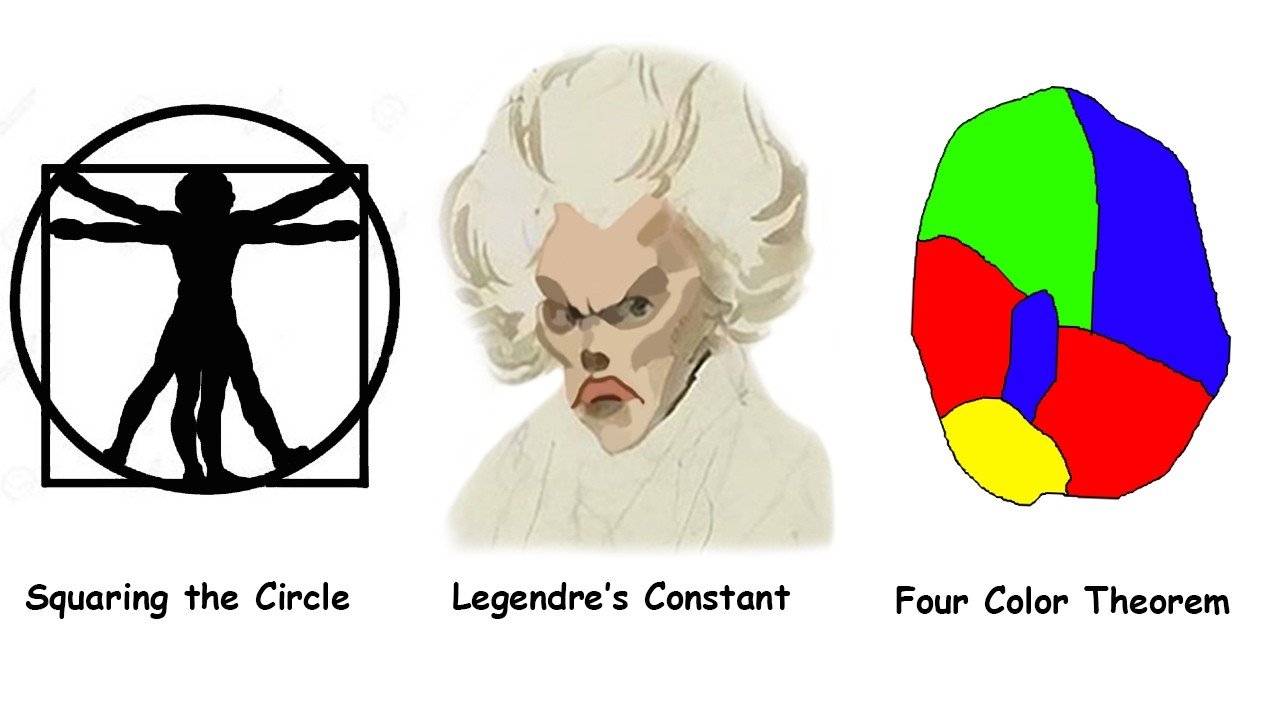
Famous Math Problems That Took Centuries to Solve
Squaring the Circle
We begin with a sheet of paper, a pencil, and only two other tools. The first is a straight edge, a ruler with no markings that you can lay on the paper and draw lines and line segments against. The second is a compass, a tool with two adjustable arms that can be used to draw circles and circular arcs.
Given any set of points already drawn on the paper to begin with, you can connect two points with a line, draw a circle centered at one point and passing through the other, and mark the points where paths you draw intersect. That’s it. This is known as a straight edge and compass construction, first considered by the ancient Greeks.
Now suppose that you already have a circle drawn on the paper. With only straight edge and compass, can you draw a square enclosing the same area as the circle? Constructing such a square is called squaring the circle, first considered by Greek philosopher Anaxagoras, who lived in the 5th century BC. Solutions evaded mathematicians for 2,300 years.
To begin considering this problem, let’s start by declaring that the radius of the circle is one unit, whatever that unit is. The formula for circular area is A = πr². A radius of one gives us an area of π. To square the circle, we need to draw a square with an area of π, therefore having a side length of √π, about 1.77. Can such a side be constructed? In other words, is √π a constructible number?
Using known compass and straight edge constructions, we can simplify this to asking whether π is a constructible number. In order to be constructible, one condition is that it must be an algebraic number, meaning that it is the root of a nonzero polynomial with integer coefficients, as opposed to a transcendental number, which is not. This condition was proven in 1837 by French mathematician Pierre Wantzel.
However, it would take until 1882 for German mathematician Ferdinand von Lindemann to prove that π is transcendental. The proof relied on the identity e^(iπ) = −1 and the fact that e is transcendental. The Lindemann-Weierstrass theorem shows that iπ must be transcendental, proving that π is transcendental, proving that √π is transcendental, proving that √π is not constructible, proving that a square with side length √π cannot be constructed from a unit length, proving that squaring the circle is impossible, and finally solving this millennia-old problem.
Euler’s Sum of Powers Conjecture
Integers are the set of numbers consisting of the whole numbers and their negative versions. Pick an integer greater than 1. We’ll call that integer k. For instance, suppose we choose k = 4. If you use k as an exponent on an integer base, then the resulting number is called a kth power. For instance, 2⁴ = 16 is a fourth power.
Now we have to choose a second integer n, which is greater than 1 and less than k. For instance, we may choose n = 3. Take n many kth powers of positive integers and add them together. In our case, we are adding together 3 fourth powers. We could have 5⁴ + 2⁴ + 3⁴, for instance. Now our goal is to make this sum equal to another kth power. We failed with our example, because 5⁴ + 2⁴ + 3⁴ = 722, which is not the fourth power of any integer. The question is: is this actually possible?
In 1769, Swiss mathematician Leonhard Euler conjectured (guessed) that it is not possible. So the conjecture was named in his honor.
Significant progress was made on Euler’s conjecture in a 1966 paper, 197 years later, by L.J. Lander and T.R. Parkin. The contents of this paper will now be recited in full:
“A direct search on the CDC 6600 yielded 27⁵ + 84⁵ + 110⁵ + 133⁵ = 144⁵ as the smallest instance in which 4 fifth powers sum to a fifth power. This is a counter example to a conjecture by Euler that at least n nth powers are required to sum to an nth power (n > 2).”
Yes, the paper was only two sentences long. By the way, the CDC 6600 was a supercomputer manufactured by Control Data Corporation.
Mathematicians would later search for cases where three 4th powers sum to a 4th power, culminating in a 1988 example by American mathematician Noam Elkies. Later the same year, Roger Frye found the smallest possible example: 2,682,440⁴ + 15,365,639⁴ + 18,796,760⁴ = 20,615,673⁴.
The Four Color Map Theorem
On October 23, 1852, British mathematician Francis Guthrie was coloring a map of the counties of England. He noticed that he only needed four colors so that no touching counties were the same color (here “touching” excludes boundaries of zero width). Guthrie soon wondered whether any map could be constructed requiring five or more colors, assuming that regions had to be contiguous, or all in one piece.
Francis Guthrie immediately brought this problem to his younger brother, the physicist, chemist, and academic author Frederick Guthrie. In turn, Frederick brought it to a professor of his, mathematician and logician Augustus de Morgan. The question was later published in the magazine The Athenaeum in 1854 and again in 1860. The four color conjecture would proceed to attract numerous false proofs, including one by de Morgan himself, and false disproofs too.
As for the proof itself, it appeared on June 21, 1976, about 124 years after the initial proposal of the problem. The proof cannot be explained in its entirety here, mainly because part of it was just a thousand hours of computer brute-forcing. But it essentially involved breaking every possible map down into 1,834 configurations and then plugging them all through a computer. This was one of the first mathematical problems solved using computers this way. When the proof was finally finished, news stations internationally covered it, and a postmark was created at the University of Illinois proudly proclaiming “Four Colors Suffice.”
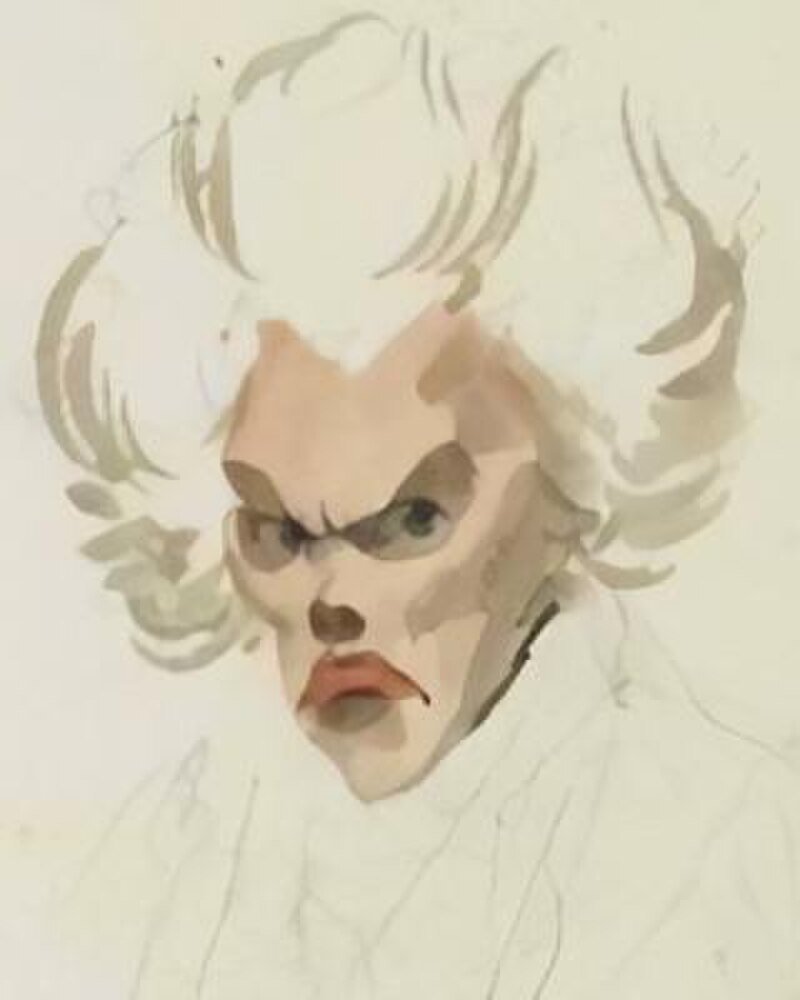
Legendre’s Constant
Pick any real number you like, say 12.5. Now list out all the prime numbers less than or equal to that number and count how many you have. In our case, those are 2, 3, 5, 7, and 11, so that’s five prime numbers.
The prime counting function, as the name suggests, counts how many prime numbers are less than or equal to a given number. For us, we started with 12.5 and got 5. The function is denoted by the Greek letter π (for “prime,” and no relation to the number π). So we would say, for example, that π(12.5) = 5.
In 1808, French mathematician Adrien-Marie Legendre found a good approximation for the function: π(x) ≈ x/(ln(x) − B), where B was defined as 1.08366. This value of B was only a guess on Legendre’s part for the optimal value, so later mathematicians sought to obtain the exact value of B that would give the best possible approximation.
Stated more precisely, they wanted to choose a value for B so that as x grows larger and larger, the ratio between the function and the approximation approaches 1.
Taking our approximate equality and treating the approximately-equals sign as an actual equals sign for a moment, we can manipulate the statement using algebra and solve for B. Multiply both sides by (ln(x) − B) and divide both sides by π(x). Now subtract ln(x) from both sides and negate. To make this an actual equality, we take the limit on the right as x approaches infinity, assuming the limit exists (which we don’t actually know is true yet).
In 1849, Pafnuty Chebyshev proved that if the limit exists, then it must be equal to 1. So while Legendre seemed to think that B was some number other than 1, this proof already showed that to be false: either it is 1, or it just doesn’t exist at all.
Due to a later proof by Belgian mathematician Charles de la Vallée Poussin in 1899, we now know that the limit does exist. So B is indeed equal to 1. It only took nearly a century for this proof to appear. Due to this result, the term “Legendre’s constant” can be used nowadays as an overly fancy way of saying the number 1, though doing this is not recommended.
Fermat’s Last Theorem
You can add two first powers of positive integers and get another first power. For example, 2¹ + 2¹ = 4¹. Similarly, you can add two second powers and get another second power. For example, 3² + 4² = 5². This will be familiar to those who know the Pythagorean theorem.
But what about adding two third powers and getting another third power? Or fourth powers? In general, is this at all possible for some power greater than 2?
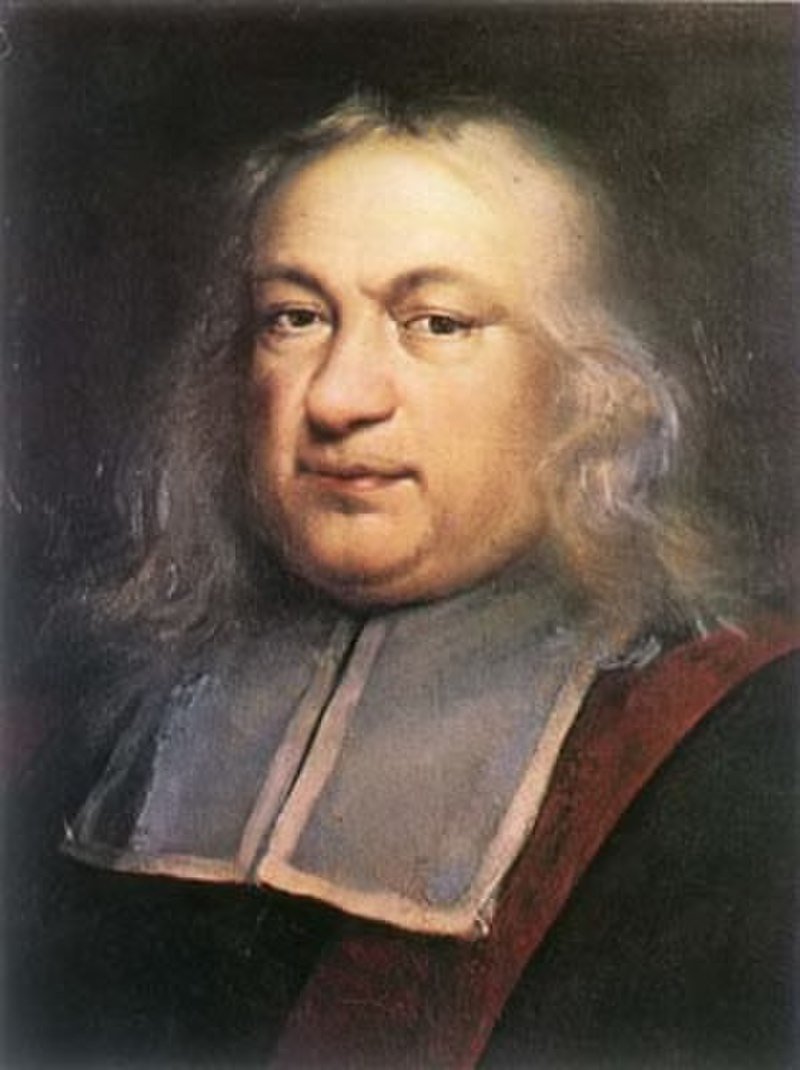
In 1637, French mathematician Pierre de Fermat said no. This fact is immortalized in the text he wrote in his copy of Arithmetica: “It is impossible to separate a cube into two cubes, or a fourth power into two fourth powers, or in general any power higher than the second into two like powers. I have discovered a truly marvelous proof of this, which this margin is too narrow to contain.”
In fact, Fermat actually had a bad habit of making claims without proving them, and mathematicians had to fill in the blanks of all of his statements. The preceding one was the last to go unproven, so it is known as Fermat’s Last Theorem. Although simple to state, the theorem resisted proof for a whopping 358 years.
The first correct proof was created by English mathematician Andrew Wiles in 1994, using the study of elliptic curves, for which he went on to win the prestigious Abel Prize in 2016. And no, Wiles did not write the proof in the margin of a math book.
Further Reading
- Squaring the Circle on MathWorld
- Lindemann-Weierstrass Theorem on MathWorld
- Euler’s Sum of Powers Conjecture on MathWorld
- Four Color Theorem on MathWorld
- Prime Counting Function on MathWorld
- Fermat’s Last Theorem on MathWorld
Leave a Reply