
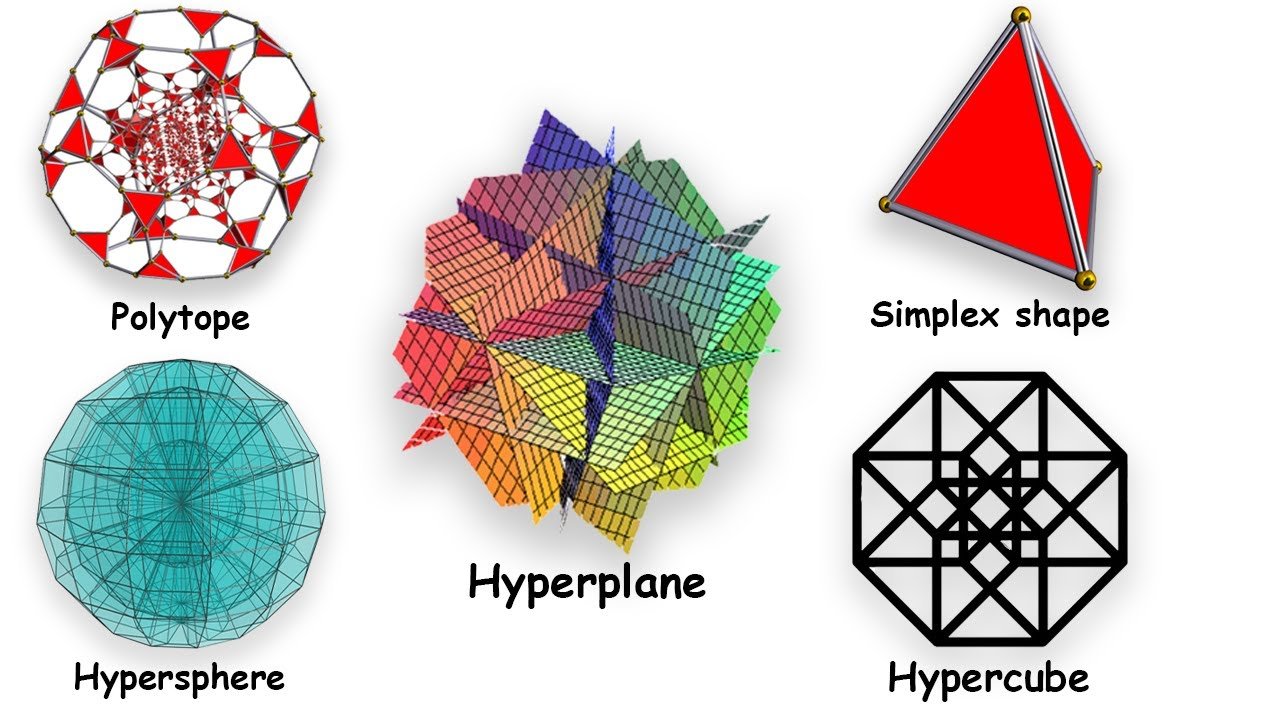
Hypercubes
In one-dimensional (1D) space, a line segment is bounded by two points. In 2D space, a square is bounded by four line segments (if we include the inside region as part of the square). In 3D space, a cube is bounded by six squares. All of these objects are known as hypercubes, the generalization of a cube to an arbitrary number of dimensions. The objects forming the boundary of each one are called the hypercube’s facets. Each next hypercube has copies of the previous hypercube as its facets.
After 3D, we can keep going into 4D space, though this is hard to visualize in a three-dimensional world. In 4D we have the tesseract, bounded by eight cubes. After that, the hypercubes stop having special names, so we resort to a numbering scheme. An n-dimensional hypercube is called an n-cube. So the cube is a 3-cube, the tesseract is a 4-cube, then we have the 5-cube, the 6-cube, and so on toward infinity. Hypercubes are a special case of polytopes, the generalization of polygons and polyhedra to any number of dimensions.
We can measure each hypercube by its hypervolume, the generalization of volume. Assuming an n-dimensional hypercube of side length s, its hypervolume is sⁿ. In 0D we have a point, which is a 0-cube. This gives us a hypervolume of s⁰, which is just 1, which makes sense because there’s one point there. Although that may seem like silly logic, this is actually the mathematical meaning of a zero-dimensional measure: just count the points.
As for 1D, a line segment has a hypervolume (that being length here) of s¹, or just s. This essentially means that a line segment of length s has a length of s. Continuing: the area of a square of side length s is s², the volume of a cube is s³, the 4D hypervolume of a tesseract is s⁴, and so on.
Hyperspheres and Hyperballs
In two-dimensional space, every point on a circle is the same distance away from the center. The distance is known as the circle’s radius. The same goes for the sphere and its radius in three-dimensional space. A hypersphere is the generalization of this concept to work in any number of dimensions.
For instance, the version in 1D space is simply the set of two points equidistant from a midpoint, with that distance being the radius. Versions of this concept also exist in 4D, 5D, 6D, and beyond, though these are hard to visualize.
The interior of a hypersphere is called a hyperball. For instance, a disc (the interior of a circle) is a hyperball, and a ball (the interior of a sphere) is a hyperball. A hyperball is closed if its bounding hypersphere is a part of it, and open otherwise.
An important clarification about dimension numbers: in mathematical terms, the dimension of an object is the number of degrees of freedom you have to move on it. A circle exists in two dimensions of space, but it is a one-dimensional object, as you only have one degree of freedom on it (along the circle). You can also think of an object’s dimension in terms of the measure you’d use for it: length, area, volume, and so on. The circle is a curve, so it is measured by its length (circumference), making it one-dimensional.
A hypersphere of dimension n can be called an n-sphere, and a hyperball of dimension n an n-ball. So a circle is a 1-sphere and a disc is a 2-ball.
A hypersphere can be described as the set of points satisfying a certain equation. In one-dimensional space, a pair of points of radius r is described by x² = r², giving both points on the x-axis that are a distance of r from the origin. A circle of radius r centered at the origin can be described by x² + y² = r². And a sphere of radius r is given by x² + y² + z² = r².
We can’t keep using new letters for higher-dimensional space because we’d run out, so let’s use numbered variables: x₁, x₂, and so on. The general equation in n-dimensional space can be written as x₁² + x₂² + … + xₙ² = r². The corresponding closed hyperball contains all the points whose distance from the center is at most r, so it is described by the inequality x₁² + x₂² + … + xₙ² ≤ r².
Polytopes
As previously mentioned, polytopes generalize polyhedra to any number of dimensions. These are not very interesting in 0D and 1D; they are just points and line segments, respectively.
In 2D we have the concept of a polygon, with line segments as edges. You are probably familiar with the usual polygons: triangles, quadrilaterals, pentagons, and so on. Jumping up to 3D, a polyhedron is an object that has polygons as its faces. The most famous of the polyhedra are the Platonic solids: the regular tetrahedron, cube, octahedron, dodecahedron, and icosahedron.
As you might have guessed, a 4D polytope, a polychoron, has 3D polyhedra as its facets. In fact, we have a special name for 3D facets: cells. So we would say, for instance, that the tesseract has eight cubic cells.
The concept of a face can also be generalized, which we call an m-face, where m is the dimension of the object in question. Take a cube, for instance. It has 8 vertices, 12 edges, 6 faces, and then there is the cube itself. Thus its 0-face number is 8, its 1-face number is 12, its 2-face number is 6, and its 3-face number is 1. A facet of an n-polytope is simply an (n − 1)-face of that polytope.
If, for all m, each of the m-faces of a given polytope can be moved to any other m-face while resulting in an identical shape, then the polytope is called a regular polytope. The point is the single 0D regular polytope, and the line segment the single 1D polytope. There are infinitely many regular polygons (2D polytopes). As for 3D, the convex regular polyhedra (those being regular polyhedra that don’t dent inward) are the five Platonic solids. There are six regular polychora in 4D. And in 5D and beyond, there are always exactly three regular polytopes.
Simplexes
What is the simplest possible polytope, the one with the fewest facets, in each number of dimensions? In 0D we have the point. In 1D, the line segment, bounded by two points. In 2D, the triangle, bounded by three line segments. And in 3D, the tetrahedron, bounded by four triangles.
In each case, the n-simplex can be formed by taking the (n − 1)-simplex, drawing a new point somewhere else, and connecting all the vertices of the (n − 1)-simplex to that new point. If all vertices are the same distance from each other, then the simplex will always be a regular simplex.
In 4D we have a simplex called the 5-cell (or the 4-simplex). A cell is a 3D facet of a polytope. The five cells of the 5-cell are tetrahedra. The regular 5-cell is one of the six regular polychora. Then in 5D is the 5-simplex with six facets, 6D has the 6-simplex with seven facets, and so on. In general, the n-simplex has n + 1 facets.
In fact, an even more interesting pattern emerges in relation to a concept called Pascal’s triangle. Pascal’s triangle is a pattern of numbers constructed as follows. Start with an infinite row of tiles, filling in one of the tiles with the number 1 and the rest with 0. Now draw the next row of tiles, with the tiles staggered so each new tile is right under two previous tiles. Fill in each tile with the sum of the numbers in the above two tiles. Keep drawing new rows with the same rules forever, and the non-zero tiles form Pascal’s triangle.
Let’s list out the number of m-faces of an n-simplex. These can be listed in a table, putting each value in the mth column and nth row. The values here may look familiar: they are the values from Pascal’s triangle, except without the infinite string of ones on the left. Due to the relation of Pascal’s triangle with binomial expansion and combinatorics, the number of m-faces of an n-simplex may be expressed as the binomial coefficient C(n + 1, m + 1), meaning the number of ways to choose m + 1 objects from a group of n + 1 objects.
Hyperplanes
A line is a flat object that can split a plane into two parts, called half-planes. A plane itself is a flat object that can split a 3D space into two parts, called half-spaces. If we’re a little generous with our use of the word “flat” to just mean non-curvy, then a point is a flat object that can split a line into two parts, called half-lines or rays.
The generalization of this concept to higher dimensions is known as a hyperplane. To be more specific, a hyperplane in an n-dimensional space is a subspace (meaning a space contained entirely within the original space) with dimension n − 1.
The concept of a subspace will be familiar to those who have taken a linear algebra course. In particular, linear algebra gives us vectors, objects with a direction and magnitude, representable by an arrow. Vectors are a very useful tool for describing lines, planes, and 3D spaces. Information about a point’s position in space can be encoded in a vector that points from the origin to that point.
Since a hyperplane is itself a space, if it includes the origin then it can be represented by a set of vectors called a vector space. A vector space must satisfy a certain set of rules: it must have the zero vector, the sum of two vectors must be in the space, and any scalar multiple of a vector must be in the space. A subspace that includes the origin is called a linear subspace.
However, if we do not want to restrict ourselves to subspaces passing through the origin, we can generalize to affine subspaces. These can be obtained by simply starting with a linear subspace and translating (or shifting) it through space. It is this process that can give us any desired hyperplane.
Further Reading
- Hypercube on MathWorld
- Hypersphere on MathWorld
- Platonic Solid on MathWorld
- Simplex on MathWorld
- Regular Polytope on MathWorld
Leave a Reply