
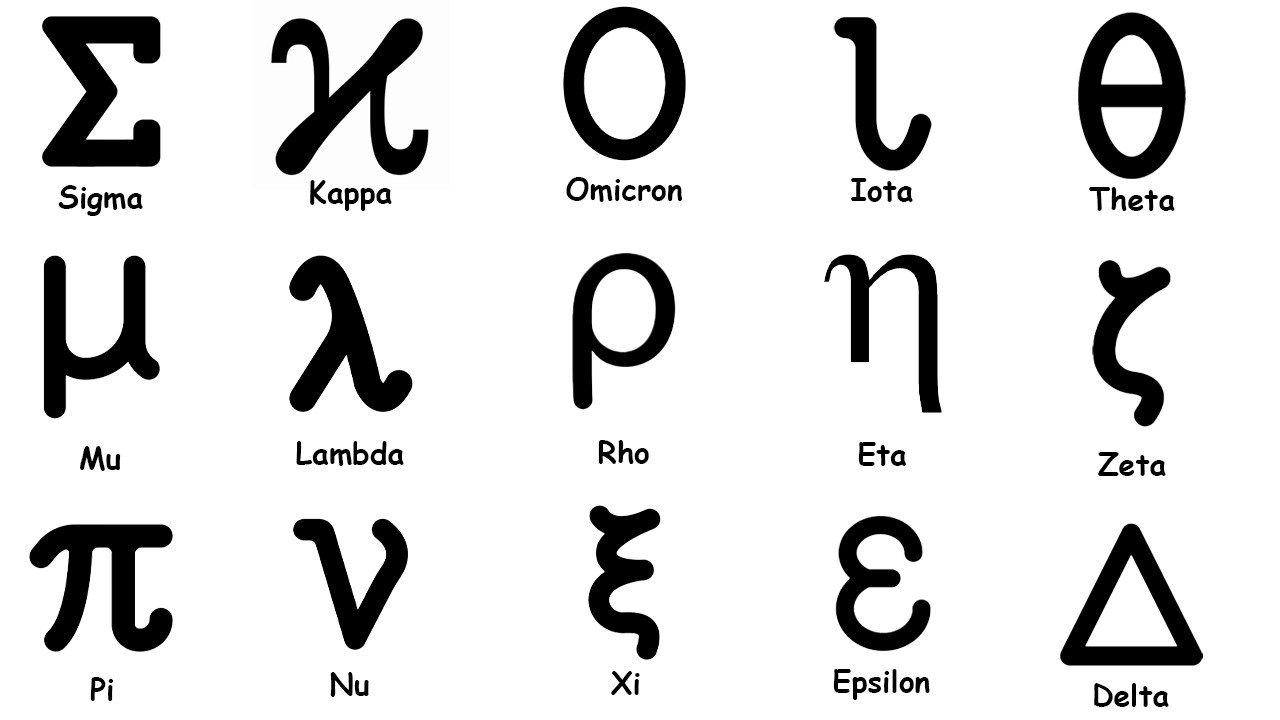
Every Greek Letter Used in Mathematics, Explained
α (Alpha)
In mathematics, the Greek letter alpha is most commonly used to denote an angle measure. For example, in the equation α = 90°, alpha is the measure of a right angle. In statistics, alpha is used for the significance level, which is the probability that a study rejects the null hypothesis (the hypothesis that whatever effect is being studied doesn’t exist) given that the null hypothesis is true. One commonly used value for alpha is 5%. Alpha is also used in set theory for an unspecified ordinal number. Ordinal numbers extend the concept of first, second, and so on to infinite sets.
β (Beta)
The letter beta, like alpha, can be used for angle measures. It’s usually used when alpha is already taken. For example, the trigonometric identity sin(α + β) = sin α · cos β + cos α · sin β uses both letters. This is also true of ordinal numbers in set theory.
Γ/γ (Gamma)
Gamma, along with alpha and beta, is often used to label the three angles of a triangle. Aside from that, an uppercase Γ is used for the gamma function, defined by an integral. This extends the factorial function to the complex numbers, where Γ(z) = (z − 1)!.
Gamma is also used for the Euler-Mascheroni constant, which is the limit of the difference between the natural logarithm of n and the nth harmonic number as n approaches infinity. It is about 0.5772. This number is suspected, but not proven, to be irrational.
Δ/δ (Delta)
Uppercase Δ often denotes a change in a variable. For example, Δx represents some difference in x. It bears some resemblance to the use of the lowercase letter d in calculus for differentials like dx, which can be loosely thought of as infinitely small changes. Uppercase Δ is also used for the Laplacian operator in multivariable calculus, denoting the divergence of the gradient of a function, which can be thought of as a second derivative that works for multivariable functions.
Speaking of calculus, lowercase δ, along with ε, is used in the epsilon-delta definition of limits. This is essentially used to formalize the idea of “closing in on a value” that limits are meant to convey.
ε (Epsilon)
Epsilon is used in calculus in the epsilon-delta definition of limits, as previously discussed. Prior to the formalization of calculus with limits, it was also used to denote a so-called infinitely small positive value, though this usage has returned in non-standard analysis, where infinitely small quantities are a legitimate thing.
Epsilon is also used for ordinal numbers. An epsilon number must satisfy the equation ε = ω^ε, where ω is the smallest infinite ordinal.
ζ (Zeta)
Zeta denotes the Riemann zeta function. It arises from an infinite sum where s is a complex number. This sum converges (reaches a finite value) if the real part of s (the a in a + bi) is greater than 1. Elsewhere, the zeta function is defined by analytic continuation, extending the piece we have so that the function has a complex derivative everywhere it’s defined.
η (Eta)
Eta is used for the Dirichlet eta function, defined similarly to the zeta function. It is also known as the alternating zeta function, since this sum is just the zeta function sum but with alternating signs. This sum converges only for s > 0, but Abel summation can be used to produce values elsewhere to define the eta function on the rest of the complex plane. Other functions named eta include the Dedekind eta function and the Weierstrass eta function.
θ (Theta)
Theta is commonly used as a variable for angle measure. In fact, it’s the most common such variable. The parameter of a trigonometric function is usually written using theta: sin θ, cos θ, and so on. It is also used for the theta functions, which are special functions involving several complex variables. There are several closely related functions known as the Jacobi theta functions.
ι (Iota)
Iota is sometimes used for the imaginary unit, the number defined by the equation ι² = −1. However, the usual standard is to use i instead (or j in electrical engineering, where i denotes electric current). The imaginary unit gives rise to the imaginary numbers, numbers of the form bi for some real value b. In turn, this yields the complex numbers a + bi for real values a and b. However, the term “imaginary” is deceptive, and some prefer the term “lateral numbers,” as mathematicians consider these numbers no less real than the so-called real numbers.
κ (Kappa)
In differential geometry, kappa is used for the curvature of a curve. To understand this, imagine some arbitrary curve in a plane. For some point on the curve, you can draw the circle which hugs the curve most closely at that point and call its radius R. The exception is if the curve is completely straight, in which case no such circle exists, though you can imagine a circle of infinite radius.
R is called the curve’s radius of curvature at that point, and curvature is defined as the reciprocal of R: κ = 1/R. The curvier the curve, the greater κ is.
λ (Lambda)
Lambda is the namesake of lambda calculus (no relation to calculus), a formal system for expressing mathematical functions. For example, λx. 2x + 3 abstractly represents a function f defined by f(x) = 2x + 3.
In linear algebra, λ represents an eigenvalue, a scale factor satisfying the equation Mv = λv, where M is a linear transformation and v is an eigenvector. The eigenvector points in the same direction after being transformed, and the eigenvalue tells you how much it got scaled.
μ (Mu)
Mu denotes the population mean, or average, in statistics. It is also used for a measure in measure theory. Measure theory essentially takes the everyday definition of measure (like length or area) and adds a bunch of math to it. For example, take the set S = {2, 3, 5}. The counting measure of S is the number of elements in S, which is 3.
ν (Nu)
Nu is used for the number of degrees of freedom, which is how many freely varying quantities you end up with after your calculations are done. For example, if your expression has two variables that can be tweaked, then ν = 2. It is also used for the greatest fixed point of a function, the greatest number for which f(ν) = ν. For example, the greatest fixed point of f(x) = x² is 1, since f(1) = 1² = 1, so ν = 1.
ξ (Xi)
Xi is used for random variables in statistics, which are exactly what they sound like. It is also used for the Riemann xi function, which is defined in terms of both the gamma function and the Riemann zeta function. Riemann’s original definition used lowercase xi. German mathematician Edmund Landau changed this to uppercase.
ο (Omicron)
Omicron looks just like the more familiar Latin letter O, so mathematicians usually find no real reason to use it. It shows up in technical notation sometimes, and it denoted Big O notation in a paper by American mathematician Donald Knuth. Otherwise, it never really appears.
π/Π (Pi)
Pi is the ratio of a circle’s circumference to its diameter, about 3.14159. It’s irrational, so it isn’t the ratio of two integers, and it’s transcendental, so it’s not the root of a polynomial with rational coefficients. It appears often in math formulas.
Pi is also used for the prime-counting function, which returns the number of primes less than or equal to the input. Uppercase Π denotes a product of a sequence, similar to how Σ denotes a sum.
ρ (Rho)
Rho denotes the plastic ratio, the real number satisfying the equation ρ³ = ρ + 1, about 1.3247. It can be used to form a spiral of triangles where each consecutive pair of triangles has side-length ratios of ρ. It is also used for a length coordinate in polar, cylindrical, and spherical coordinate systems, similar to r.
Rho also denotes the prime constant, whose decimal expansion’s nth digit is 1 if n is prime and 0 otherwise.
Σ/σ (Sigma)
Uppercase Sigma denotes summation. The index of summation k takes on all the integer values from the lower bound to the upper bound. The summand is a function of k, and all the terms in the resulting sequence are added together for the final result. For example, ∑(k=2 to 4) k² = 2² + 3² + 4² = 4 + 9 + 16 = 29.
Lowercase σ in statistics denotes standard deviation. This value measures how spread out a data set is.
τ (Tau)
Tau is the ratio of a circle’s circumference to its radius, about 6.2832, and equal to 2π. Some argue that τ is a clearer, more natural circle constant than π. This primarily applies to radian angle measurements: one quarter turn is τ/4 radians, one sixth of a turn is τ/6 radians, and so on. This also relates to complex exponentiation. In particular, e^(iτ) = 1, representing a full turn.
As for the formula for circular area, it can be derived by integrating rings of circumference τr and width dr. The letter τ is also used in number theory for the divisor function, which counts how many divisors a number has. For instance, 6 has four divisors (1, 2, 3, 6), so τ(6) = 4.
υ (Upsilon)
Upsilon is sometimes used instead of ν for degrees of freedom in statistics. It has no other significant uses in mathematics.
φ (Phi)
Phi denotes the golden ratio, a mathematical constant equaling (1 + √5)/2, about 1.618. If something has two parts and the ratio of the larger part to the smaller part equals the ratio of the whole to the larger part, that’s the golden ratio.
Phi also denotes the standard normal distribution in statistics.
χ (Chi)
The chi-squared distribution is a distribution in statistics. It comes from squaring a bunch of random variables and adding them all up. This is often used in statistically testing hypotheses.
ψ (Psi)
Psi is used for the polygamma function, defined by taking derivatives of the logarithmic derivative of the gamma function. The first of these is the digamma function, followed by the trigamma function. The digamma function has a close relationship to the harmonic numbers, as seen in the equation ψ(n) = −γ + ∑(k=1 to n−1) 1/k, where γ is the Euler-Mascheroni constant.
Ω/ω (Omega)
The Omega constant is the real number Ω satisfying Ω · e^Ω = 1. It can be expressed as W(1) using the Lambert W function, which is defined by W(x) · e^(W(x)) = x.
Omega is also used for the smallest infinite ordinal in set theory, the first ordinal that comes after all the natural number ordinals. And Ω can denote a 2D region in multivariable calculus, usually the domain of a double integral, which computes the volume under the graph of a two-variable function.
Leave a Reply