
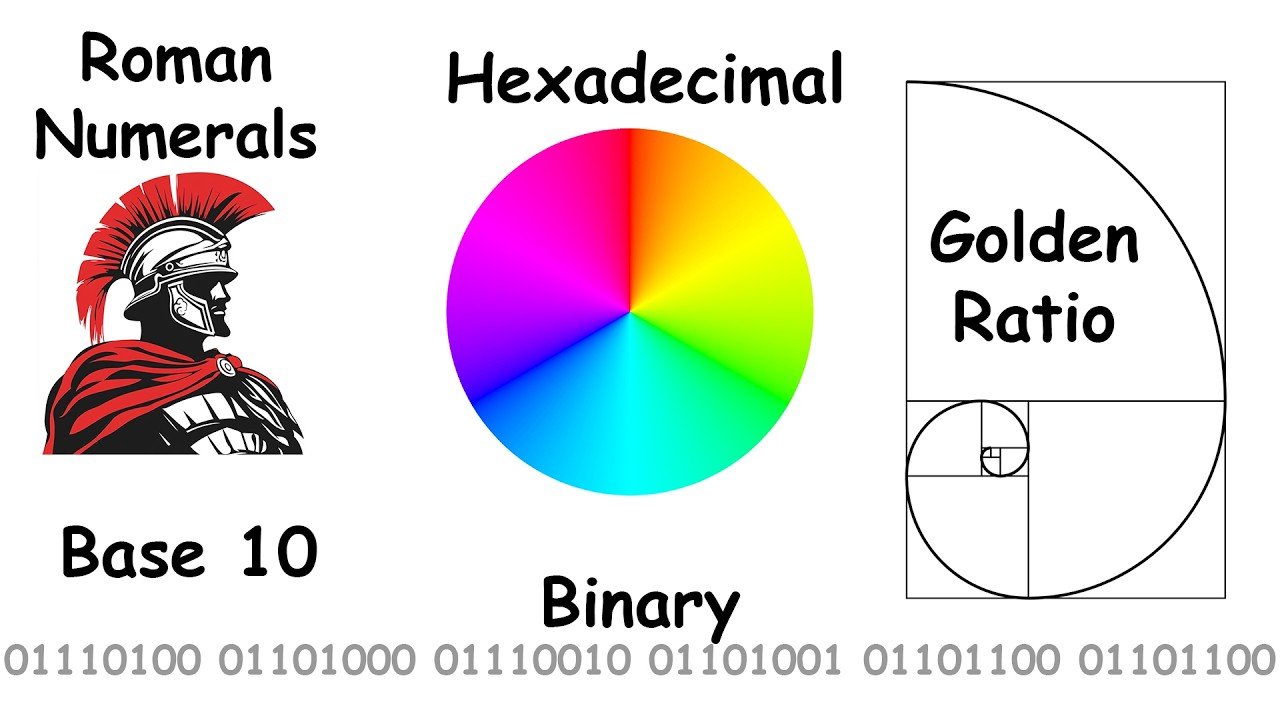
Decimal (Base 10)
Assuming you’ve heard of numbers before, you probably know about the decimal system, also known as base 10. It involves 10 digits that can be put together to represent a number. For example, consider the number 243. That’s 2 groups of 100, 4 groups of 10, and 3 groups of 1. So the total is 2 × 100 + 4 × 10 + 3 × 1 = 243.
Each place value is based on a certain power of 10. For instance, 100 is 10², which is the result of multiplying two 10s together. Similarly, 10 is 10¹, and 1 is 10⁰. That last one is the result of multiplying no tens together, which is called the empty product, equal to 1 (since multiplying something by 1 is the same as not multiplying at all).
The decimal system can also represent non-whole amounts using a decimal point. For example, 2.5 is 2 × 1 + 5 × 0.1, or 2 × 10⁰ + 5 × 10⁻¹.
The decimal system with the digits we have today is called the Hindu-Arabic numeral system. It originates from Indian mathematicians sometime between the 1st and 4th centuries, though not including fractions, which were a later extension by 9th-century Arabian mathematicians. In modern times, the system is the standard worldwide system of number representation. The choice of 10 as a base is rather arbitrary, primarily occurring because most humans have 10 digits on their hands. Though many other bases exist, base 10 remains the dominant one.
Roman Numerals
If you want to represent numbers in a fancy way, Roman numerals are one way to do it. The system uses letters to represent numbers with these values: I = 1, V = 5, X = 10, L = 50, C = 100, D = 500, and M = 1,000.
However, while you might think you can just keep adding together these letters until you get the value you want, the reality is a bit more complicated. This is true for a number like 355, which is just CCCLV. But let’s say we want to represent the number 49. This can be broken up as 40 + 9, and each part will be considered separately.
We could represent 40 with a chain of four X’s, but the standard is to use an alternative notation that saves on symbol usage. This is known as subtractive notation, where a smaller numeral is placed before a larger one to indicate subtracting the first from the second. In our case, we would write XL. X is 10 and L is 50, so this means 10 less than 50, or 40. Similarly, 9 is 1 less than 10, so it’s represented by IX. Putting it together, we can write 49 as XLIX. Note that we wouldn’t write 49 as IL; with subtractive notation we have to break it up as 40 + 9 first.
The largest number representable by the standard system is 3,999, written as MMMCMXCIX: 3,000 is MMM, 900 is CM, 90 is XC, and 9 is IX.
Roman numerals were used in ancient Rome, but there are many mysteries regarding the nature of their origin, particularly because very few examples from that time have been found. They may have originated from a similar number system called Etruscan numerals, named after the Etruscans who lived in the same area. As Roman numerals developed, there were many conflicting conventions regarding their usage. For example, 4 could be IIII or IV. The version described here is the standardized version used today.
Binary (Base 2)
Binary will be familiar to fans of computer science, since it’s what computers use to represent numbers. It’s also called base 2, due to having just two digits: 0 and 1. Like decimal, binary is a positional numeral system where each digit’s value depends on its position. However, binary uses powers of 2, not 10.
For example, consider the binary number 1110₂ (we write a subscript 2 to remind us of the base). The first digit is three places left from the ones place, so that’s 1 × 2³ = 8. Then the next one is two places left, so that’s 1 × 2² = 4. Repeating for the next two digits, the values are 2 and 0. So 8 + 4 + 2 = 14, meaning the binary number 1110₂ is the decimal number 14.
Binary is particularly useful for computer representations since computers store information using bits. A bit is the most basic unit of information, having only one of two possible values. These values can be represented by 1 and 0, on and off, true and false, and so on. The name “bit” itself is short for “binary digit.”
Bits are the basic building block of computer data. Everything stored in a computer’s memory can basically be boiled down to zeros and ones. A related unit is a byte, which consists of 8 bits. It can store any whole number from 0 to 255, so it has 256 possible states altogether.
Hexadecimal (Base 16)
Another base common in computer science is hexadecimal, which is base 16. This system uses our usual digits 0 through 9 along with the alphabetical letters A through F. Since 16 is a power of 2 (namely 2⁴), hexadecimal relates nicely with binary, with the added benefit of faster writing.
One common use of hexadecimal is representing colors with a color code. You’ve probably seen this if you’ve ever used a color picker.
Golden Ratio Base
So far we’ve only looked at integer bases. However, in the spirit of mathematics, we can try seeing what happens when we generalize our bases to other numbers. One option is to try using irrational numbers like π, e, γ, and so on. Unfortunately, these number systems tend to be very chaotic and strange, making it difficult to use them to represent numbers. However, one special exception is the golden ratio.
To obtain it, imagine having two amounts a and b, where a is larger than b. These are two parts of a whole, where the whole is a + b. If the ratio of the whole to the larger part equals the ratio of the larger part to the smaller part, that is, if (a + b)/a = a/b, then that ratio is called the golden ratio.
This is a number denoted by the Greek letter φ (phi), equal to (1 + √5)/2, approximately 1.618.
So what does it mean to have a number in base φ? Phi is not the number of digits in our system, since you can’t have φ digits. However, a positional numeral system can be defined by the specific number which is raised to a given power for each position and multiplied by the digit at that position. For example, this number is 10 for base 10 and 2 for base 2. Applying that same logic here, the number that will be exponentiated will be φ.
Our system will use two digits, 0 and 1. However, whenever we get a digit sequence of “11,” we will try to rewrite the number to eliminate it.
Let’s try to represent some numbers in this system. The numbers 0 and 1 are easy enough; they still look like 0 and 1. However, the number 2 is where difficulty begins. Luckily, we can make use of some of the algebraic properties of the golden ratio to solve this.
We know that the golden ratio is defined by the equality φ² = φ + 1. Through some algebra, we can rearrange this and use it to express 2 in base φ. The result is that 2 in standard base-φ form is 10.01_φ, with a digit 1 in positions 1 and −2.
In a similar way, every non-negative integer has a unique base-φ expansion that doesn’t go on forever (that is, it terminates).
But what if we allow for non-terminating expansions? For instance, consider the base-φ number 0.10101… (repeating). This can be represented with an infinite sum, or series. The value of a series is the limit of its partial sums, which in this case is 1. Therefore both this representation and 1_φ are valid ways to represent the number 1.
It’s similar to how 0.333… repeating represents 1/3. Although the partial sums of the corresponding series will never be exactly equal to 1/3, they get closer and closer to within an arbitrarily small distance of the target number. Therefore the limit of the partial sums is 1/3, which is the value that 0.333… represents. Similar logic can be used to show that 0.999… equals 1, as long as you know how an infinite sum works.
Further Reading
- Positional Numeral Systems on Wikipedia
- Golden Ratio Base on Wikipedia
- Binary Number on MathWorld
- Roman Numerals on MathWorld
- Hexadecimal on MathWorld
Leave a Reply