
Set theory is the fundamental language of mathematics, describing and organizing collections of objects called sets. A set is usually denoted with braces. For example:
A = {1, 2, 3}
Its elements can be numbers, points, objects, functions, or even other sets.
Basic Operations
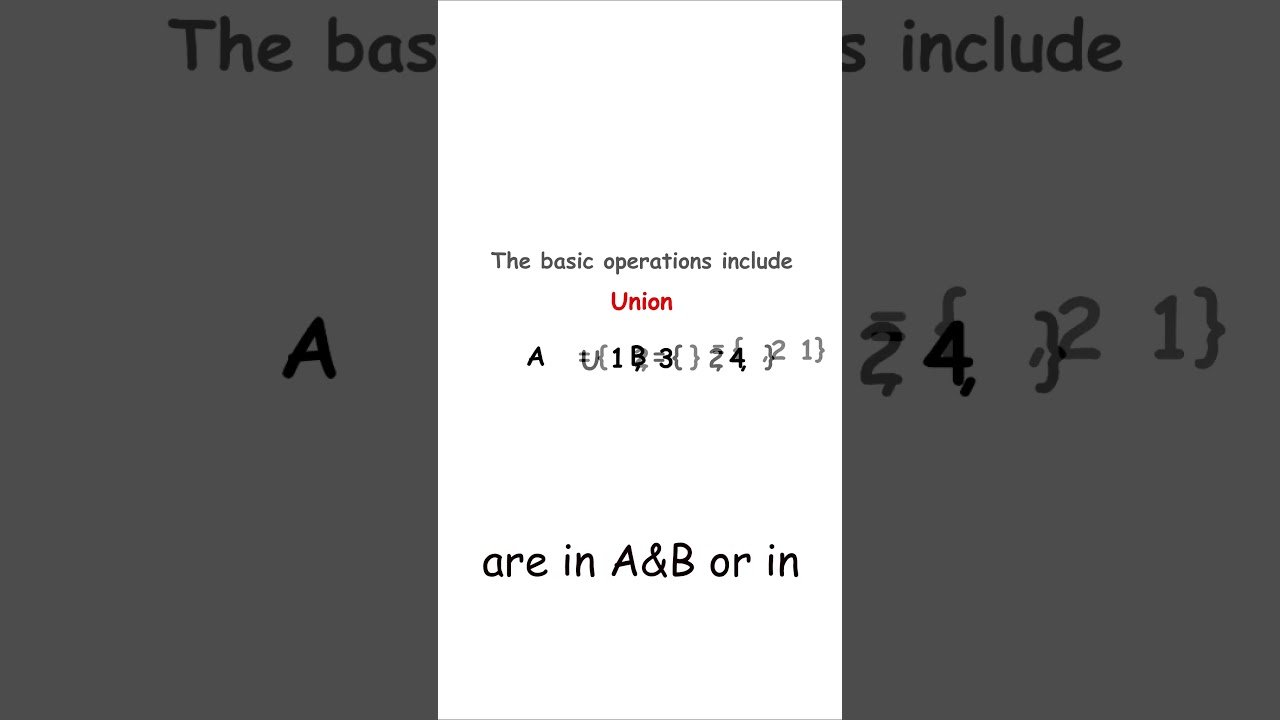
The basic operations of set theory include:
Union (A ∪ B): The elements that are in A, in B, or in both.
Intersection (A ∩ B): The elements that are common to both A and B.
Difference (A \ B): The elements that are in A but not in B.
Complement (Aᶜ): The elements outside a given set with respect to a defined universe.
Why Is Set Theory So Important?
Set theory is the foundation on which virtually all of modern mathematics is built. Numbers, functions, sequences, geometric spaces, and probability measures are all formally defined in terms of sets. In the late 19th century, Georg Cantor developed set theory and revealed that infinity itself comes in different sizes, a discovery that transformed mathematics forever. The Zermelo-Fraenkel axioms, together with the axiom of choice (collectively known as ZFC), provide the standard axiomatic framework that underpins nearly every mathematical discipline today. From algebra to topology to analysis, the language of sets is what holds it all together.
Leave a Reply