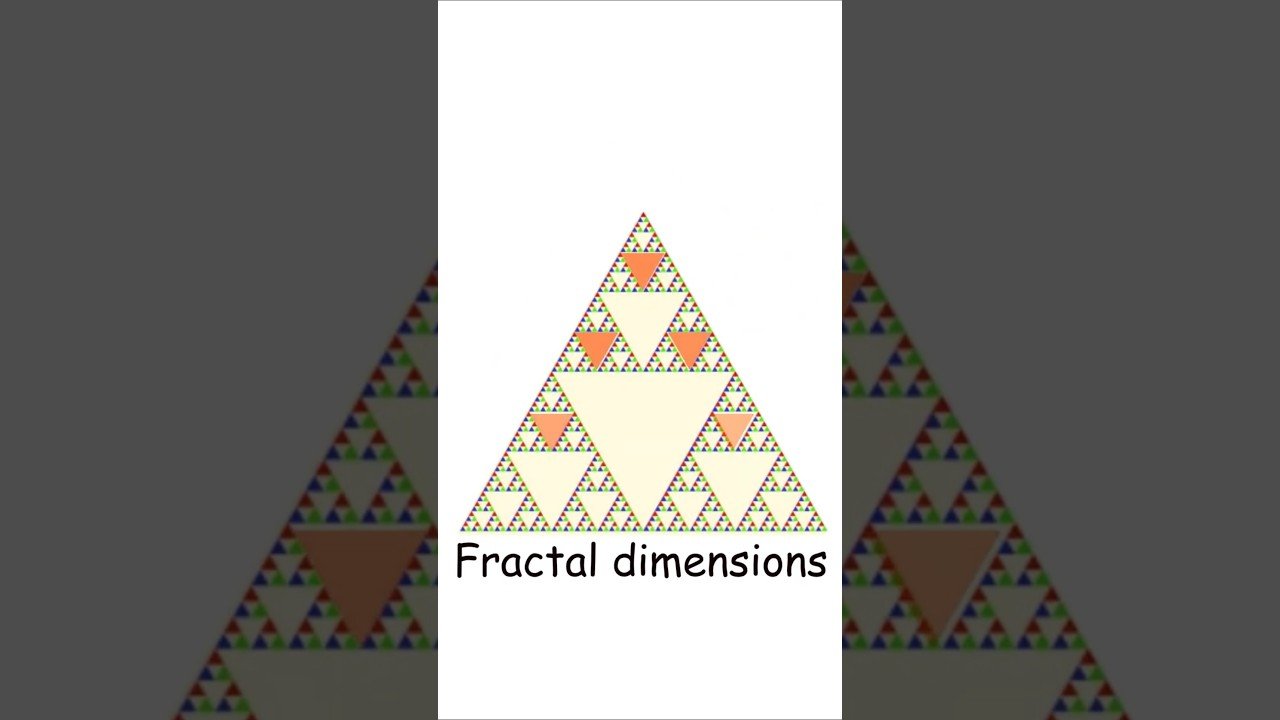
Fractals introduced the idea of non-integer dimensions, also called fractional dimensions. These are used to measure the complexity of objects that display self-similarity, meaning patterns that repeat at different scales.
The Koch Snowflake
A famous example is the Koch snowflake, where each line segment is replaced by four smaller ones at each iteration. The length grows indefinitely, but the enclosed area remains finite. The Koch snowflake has a fractal dimension of approximately 1.2619, meaning it is more complex than a one-dimensional line but does not quite fill a two-dimensional plane.
Mandelbrot and Fractal Geometry
Benoît Mandelbrot popularized fractal geometry in the 20th century by showing that seemingly chaotic phenomena could be characterized with fractional dimensions. In this way, the notion of dimension expands beyond integers, offering a quantitative framework for studying the inherent complexity of the natural world.
Where Do Fractional Dimensions Appear?
Fractional dimensions are not just abstract mathematical curiosities. They show up throughout nature and science. Coastlines, mountain ranges, blood vessel networks, and cloud boundaries all exhibit fractal-like properties that are best described using non-integer dimensions. Mandelbrot famously posed the question “How long is the coast of Britain?” to illustrate that the measured length of a coastline depends on the scale of measurement, a direct consequence of its fractal nature. Fractional dimensions are also used in signal processing, financial modeling, and medical imaging, where they help quantify irregular structures that traditional geometry cannot adequately describe.
Leave a Reply