
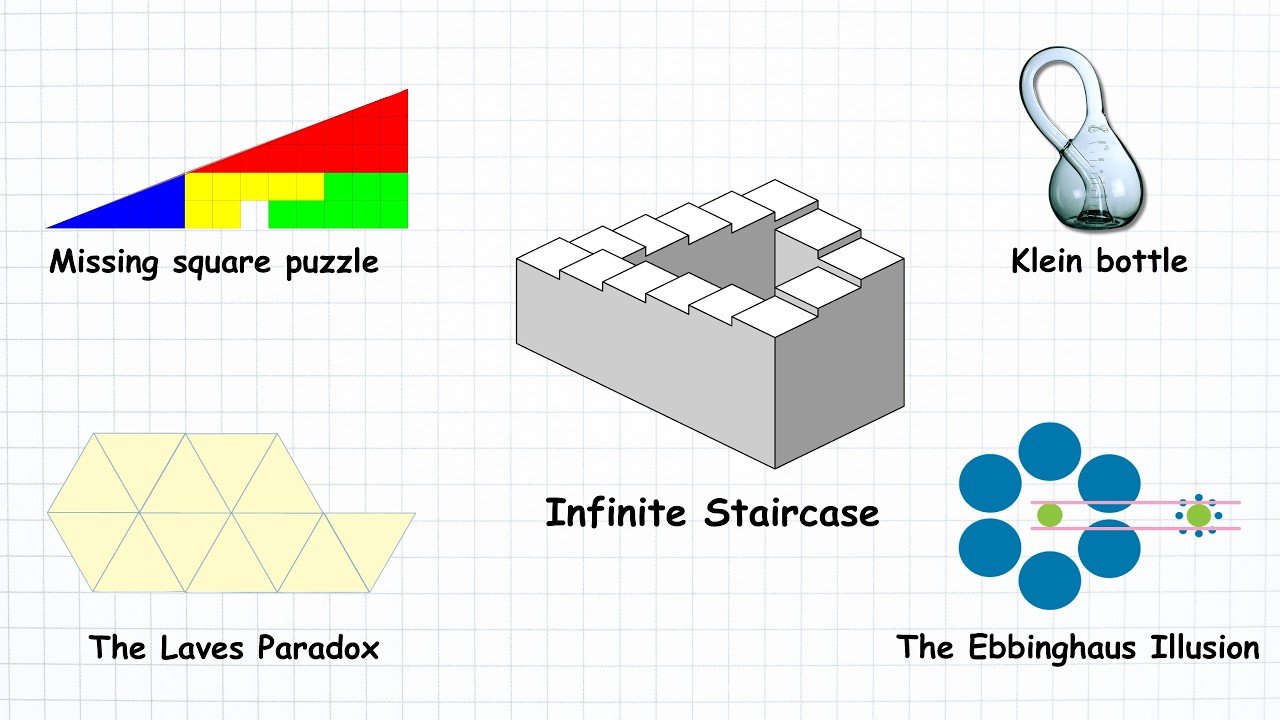
The Missing Square Puzzle
The triangle puzzle with the missing square is one of the most well-known examples where geometric intuition fails. At first glance, the problem seems simple. Two triangular figures are composed of the same four geometric pieces: two right triangles (red and blue) of different sizes, and two irregular parallelograms (green and yellow), which are rearranged. In the first arrangement, they appear to occupy a total area without gaps. In the second rearrangement, a small empty square appears.
The key to the puzzle lies in the illusion that both configurations form a single right triangle. Visually, the outlines appear to match. The base, height, and hypotenuse seem to be aligned. However, upon precise analysis, it becomes clear that the hypotenuses are not straight segments but compositions of two segments with different slopes. In the first figure, the top line has a slightly convex curvature. In the second figure, a concave curvature. This curvature, imperceptible to the naked eye, is enough to create or eliminate a small portion of area.
From a mathematical point of view, this can be demonstrated by examining the slopes of the triangles that make up the figure. The red triangle has a slope of 3/8, while the blue one has a slope of 2/5. These different slopes imply that their hypotenuses are not parallel. Therefore, when placed next to each other on the supposed hypotenuse of the larger triangle, the line they form is not straight. The entire figure is not a true triangle.
Even when the triangles are superimposed, it is evident that their hypotenuses do not match. This difference, although visually subtle, prevents the segments from aligning along a continuous straight line. They’re not proportional and therefore cannot together form a true hypotenuse. The discrepancy creates an accumulated space, seemingly lost or gained, that gives rise to the illusion of the missing square.
The paradox is in fact a consequence of elementary geometry being visually misinterpreted. There’s no paradox or actual loss of area. There is an illusion caused by non-uniform geometry and visual trust in falsely rectilinear outlines. This puzzle highlights how perception can be deceived even with simple flat figures, and how basic concepts such as area and shape depend critically on mathematical precision rather than visual intuition.
The Laves Paradox
This paradox arises from the study of tessellations. A tessellation is a pattern that completely covers a surface using repeated geometric shapes without gaps or overlaps. The most well-known tessellations are periodic: they repeat the same module regularly across the plane. Classic examples include the repetition of equilateral triangles or the hexagonal structure of a beehive or a floor design. In any case, an evident symmetry is observed. Each shape is translated, rotated, or reflected to cover the space uniformly and predictably.
Traditionally, it is assumed that symmetry implies periodic repetition. That is, if a pattern has symmetry, whether by translation, rotation, or reflection, we expect it to repeat regularly in all directions. However, there are tessellations that break this rule, displaying order without periodicity, which deeply challenges classical geometric intuition.
Penrose tilings radically defy this visual and geometric assumption. In these configurations, there is local symmetry but no global repetition. No fragment of the pattern repeats infinitely across the plane as in a classical periodic tessellation. Despite maintaining a form of order, the tiling creates the illusion of broken or incomplete symmetry, challenging geometric intuition.
This type of tessellation, initially inspired by the studies of the German architect, civil engineer, and urban planner Georg Ludwig Friedrich Laves and later more thoroughly developed by the British physicist and mathematician Sir Roger Penrose, is described mathematically using local matching rules that prevent total repetition. It is worth noting that these structures are not fractals, as they do not repeat at different scales. By definition, non-periodic tessellations are unique patterns that are never fully replicated, balancing local order with apparent global chaos.
This paradox does not represent a mathematical contradiction but rather a visual and conceptual challenge. It forces us to distinguish between order and periodicity, between structure and repetition. This phenomenon has transformed not only geometry but also crystallography, visual art, and the way we understand space, regularity, and apparent chaos.
The Ebbinghaus Illusion
The Ebbinghaus illusion is one of the most emblematic examples of how visual perception can distort the geometric interpretation of figures. Discovered by German psychologist Hermann Ebbinghaus in the 19th century, this illusion consists of presenting two central circles that are exactly the same size but surrounded by other circles that vary in size. The circle surrounded by larger figures appears smaller, while the one surrounded by smaller circles appears larger, even though both are identical.
This illusion illustrates a key discrepancy between subjective perception and mathematical reality. From a geometric standpoint, the size of the circles can be measured precisely through area, diameter, and circumference, and their equivalence can be determined objectively. However, the human visual system does not process these measurements consciously. Instead, it compares spatial relationships and relative proportions within an immediate visual context.
The mechanism behind the Ebbinghaus illusion is based on contextual contrast. The brain interprets the size of an object not in absolute terms but in relation to the surrounding objects.
The Klein Bottle
The Klein bottle is a fascinating mathematical object that challenges classical notions of interior and exterior. It was proposed by the German mathematician Felix Klein in 1882 as a non-orientable surface, meaning a figure that has no distinguishable inside or outside. Geometrically, it is a closed surface that cannot be represented in three-dimensional space without its surface intersecting itself.
Topologically, the Klein bottle is a compact, closed, non-orientable surface with no boundary. Unlike a sphere or a torus, it cannot be divided into two distinct sides. It is impossible to construct a true Klein bottle in three-dimensional Euclidean space without the surface intersecting itself.
The significance of the Klein bottle goes beyond the visual. It is a key tool in topology, especially in the study of surfaces, classification of manifolds, and group theory. It represents how three-dimensional geometric intuition can fail and is one of the most iconic examples of geometry breaking conventional spatial limitations.
The Penrose Stairs
The infinite staircase, known as the Penrose stairs, is an impossible geometric figure that illustrates how perception can construct realities that do not exist in physical space. It was conceived by psychiatrist and geneticist Lionel Penrose together with his son, mathematician Roger Penrose, who also developed the famous non-periodic tessellations discussed earlier. It was later popularized by the lithographs of artist M.C. Escher, particularly in his work “Ascending and Descending.”
The figure represents a staircase built in a closed loop where each section appears to constantly ascend or descend, yet returns to the starting point. This structure defies the fundamental laws of Euclidean geometry, since if one were to ascend it indefinitely, they would end up where they began, something physically impossible in three-dimensional space. It is a clear manifestation of how perspective can deceive spatial intuition and generate an illusion of continuity.
The trick lies in the use of projective geometry. Each stair segment is coherent on its own, but the combination in a closed cycle creates a visual contradiction. Mathematically, this type of figure cannot exist in three-dimensional space without distorting its components. But it can be represented in two dimensions through a precise visual construction, based on a carefully designed perceptual illusion optimized to maintain coherence from a single perspectival viewpoint.
Further Reading
- Missing Square Puzzle on Wikipedia
- Penrose Tiling on MathWorld
- Klein Bottle on MathWorld
- Penrose Stairs on Wikipedia
- Ebbinghaus Illusion on Wikipedia
Leave a Reply