
From Squaring to Square Roots
To start, consider multiplying a number by itself. For example, 4 × 4 = 16. This can be done with negative numbers as well: (−3) × (−3) = 9. Remember, a negative times a negative is a positive. Multiplying a number by itself is called squaring, which is a special case of exponentiation, multiplying a number with copies of itself some number of times. We can write 4 × 4 as 4², where the superscript 2 just means “multiply two copies of 4 together.”
We can also consider the inverse of squaring. For example, what number squared is 25? There are actually two possible answers: 5 and −5. These are called the square roots of 25. However, we’re often just interested in the non-negative solution, which is 5 in this case. Five is called the principal square root of 25, or simply “the square root.” This is indicated with a radical symbol: √25 = 5.
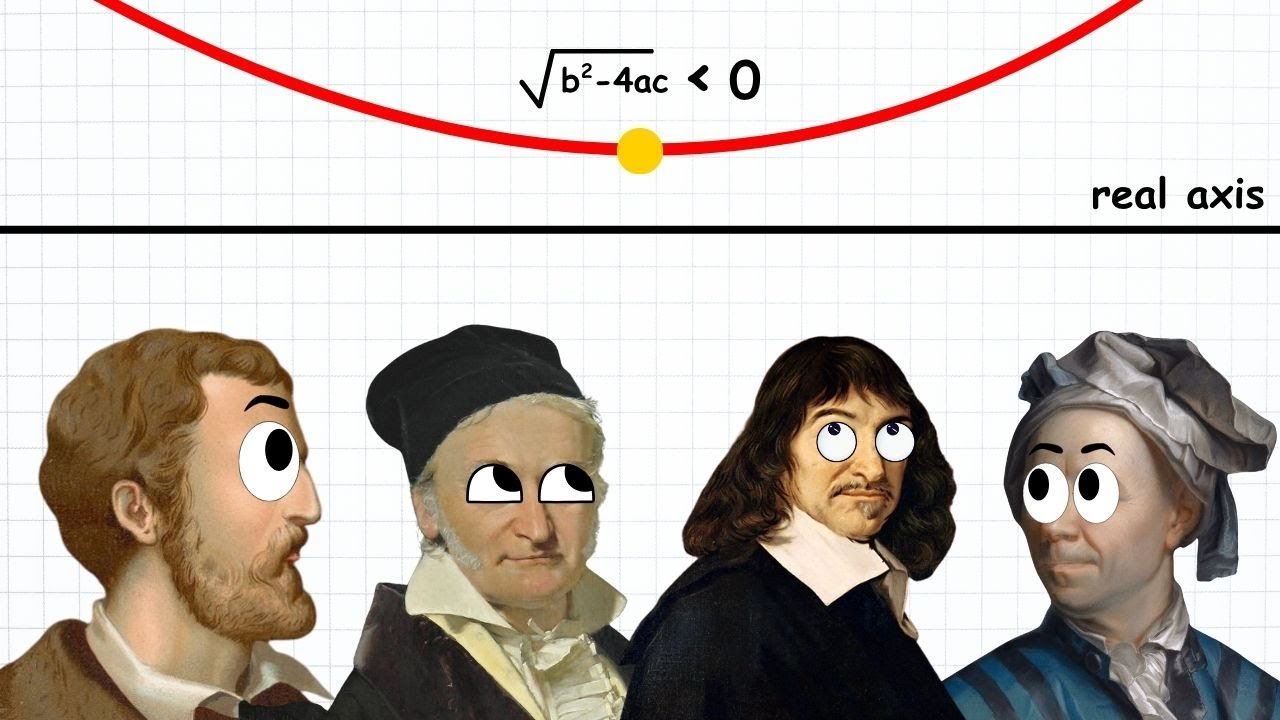
With this idea in mind, you may consider taking the square root of a negative number like −1. Can we find any number on the entire real number line so that squaring it gives us −1? The answer is no. If we choose any real number, we’ll find that the square of that number must be at least zero. This can be visualized using a graph. If we define a real function f(x) = x², then graphing y = f(x) gives us a shape called a parabola, and this parabola never goes below y = 0.
The Imaginary Unit
That may seem like the end of our journey, but let’s not give up just yet. Why don’t we simply declare the existence of some new type of number to solve this problem? Let’s call this number the imaginary unit, written with the letter i, and define it using the equality i² = −1.
This may feel like cheating, but mathematics is about rules, and making up new rules to see where they lead us is a major part of the process.
So let’s think about what we can do with the number i. We can multiply i by a real number to get some product. For example, we can have 7 × i, or simply 7i. Since i is the imaginary unit, let’s call i times a real number an imaginary number. We’ll explore this naming choice in more depth later.
What other operations can we do with real and imaginary numbers? Let’s try adding a real number to an imaginary number, an example being 3 + 4i. This number consists of multiple parts: a real part and an imaginary part. Since the word “complex” can mean “having multiple parts,” let’s call this type of number a complex number.
The Complex Plane
Let’s think of a way to visualize these new concepts. First, we already know that we can visualize the set of real numbers as a line. So let’s draw the real number line. Next, you might notice that it’s possible to visualize the set of imaginary numbers as a line as well. Just take the real number line and multiply each number by i. But notice that anything times 0 is zero, so the imaginary number 0i is really equal to the real number zero. This suggests drawing both the real and imaginary lines in the same place, intersecting where both of them contain the number zero.
We will draw the lines perpendicular to each other, with the number 1 and the number i being the same distance from zero, which will be useful later. Now let’s think about how we can represent adding a real number and an imaginary number to get a complex number. If you’re familiar with Cartesian coordinates, one solution that may jump out at you is to use the real and imaginary parts of a complex number as coordinates. The real and imaginary lines can serve as the axes of our coordinate system.
Indeed, this system works well, allowing us to represent complex numbers as points within a two-dimensional plane. This plane is known as the complex plane. Each complex number can also be represented as an arrow pointing from the origin (zero) to a given point in the complex plane. If you have some experience with vectors, this will likely look familiar.
Operations on Complex Numbers
Operations on complex numbers are similar to those on real numbers. Adding complex numbers is the same as adding the real and imaginary components separately. For example, (2 + 3i) + (4 − i) = (2 + 4) + (3i − i) = 6 + 2i. Subtraction works in a similar way.
As for multiplication, you can simply distribute the multiplication to each term. (2 + 3i)(4 − i) = 2(4 − i) + 3i(4 − i) = 8 − 2i + 12i − 3i². Now remember that we defined i so that i² = −1. So this becomes 8 − 2i + 12i − 3(−1), which can be simplified and rearranged to 8 + 3 − 2i + 12i, or just 11 + 10i.
Polynomial Equations and Complex Roots
With the basics covered, let’s move on to applications. You will usually first encounter complex numbers in the context of solutions to polynomial equations. A polynomial is an expression created from variables and constants where the only operations allowed are addition and multiplication (which can include raising a variable to the power of a positive integer). Although a polynomial can have multiple variables, we’ll just focus on single-variable polynomials for now.
An example of a polynomial is x² − 6x + 25. The quantities being added together are called terms, and the word “polynomial” itself means “many-termed.” The constants multiplying the variables are called the coefficients. Here the coefficients are 1, −6, and 25. (Note that x² is the same as 1 · x², which is where the coefficient of 1 comes from.)
Each polynomial has a degree, which is the highest exponent on the variable among all terms. In x² − 6x + 25, the highest exponent on x is 2, so the polynomial is degree 2. Such a polynomial is also called a quadratic polynomial (the Latin word “quadratus” means “made square”). The names for polynomial degrees from 0 to 5 are constant, linear, quadratic, cubic, quartic, and quintic.
We can write an equation where a polynomial is equal to zero and solve for the values of the variable that satisfy the equation. An example is x² − 6x + 25 = 0. Since the solutions are the values of x where the polynomial has a value of zero, they are called the zeros of the polynomial. This is where complex numbers come in. For any degree of at least 2, it’s possible to write a polynomial with that degree that has real coefficients but non-real zeros. The specific equation above has solutions x = 3 + 4i and x = 3 − 4i.
A Brief History of Complex Numbers
Polynomial equations are the main reason that complex numbers were first considered. However, perhaps surprisingly, quadratic equations were not the biggest motivator. Instead, cubic polynomials were. Back in the day, mathematicians only cared about real solutions of polynomial equations. Quadratic equations with non-real solutions were basically just tossed in the garbage. But even when considering only real solutions, problems arose.
You may have heard of the quadratic formula for solving quadratic equations. But there is a cubic formula, often unmentioned due to its complexity. Even when the solutions themselves are real numbers, the cubic formula doesn’t actually work if you completely stay in the real numbers, because you end up having to take the square root of a negative number.
To fix this, Italian mathematician Gerolamo Cardano came up with the idea of using complex numbers in 1545. However, he apparently wasn’t a big fan of his own creation, repeatedly calling complex numbers “useless” and referring to using them as “mental torture.” This was before the geometric representation of the complex plane was used. In fact, Cardano outright refused to accept complex numbers as valid solutions to polynomial equations in their own right.
The term “imaginary number” was coined by a separate figure, French mathematician René Descartes. You may have heard part of his name in the term “Cartesian.” Descartes used the term in an insulting fashion in order to contrast these numbers with so-called “real” numbers, which were the only types of numbers he recognized as legitimate. Mathematicians of the time simply didn’t understand exactly how useful these types of numbers would turn out to be. Couple that with the word “complex” in “complex number” often being misunderstood to mean “complicated,” and you get what is famously one of the most confusing sets of terminology in mathematics.
A later proposal by German mathematician Carl Friedrich Gauss was to replace the term “imaginary number” with “lateral number,” because these numbers extend laterally from the real number line in the complex plane. But this never really caught on.
Despite their rocky start, complex numbers ended up being widely accepted as extremely useful by the mathematical community.
Modeling Rotations
To demonstrate this usefulness, let’s look at one of the most powerful things you can do with complex numbers: modeling rotations.
We’ll start by observing what happens to a complex number when you multiply it by 1. For example, what is 1 × (3 + 4i)? The answer should be obvious. Anything times 1 is itself, so we just get 3 + 4i. This makes the number 1 special, and in the context of complex numbers it is often called unity.
Next, we’ll try multiplying a complex number by i. What is i × (3 + 4i)? Algebraically: i(3 + 4i) = 3i + 4i², and since i² = −1 by definition, this becomes 3i − 4, which can be rearranged to −4 + 3i.
Now for a geometric view. Recall that we can represent complex numbers using vector arrows. Drawing both 3 + 4i and −4 + 3i as arrows reveals that the angle between them is a right angle. This is not a coincidence. If you take some complex number a + bi (for real a and b), then i(a + bi) = ai + bi² = −b + ai. Drawing them both as arrows will result in a right angle between them, with −b + ai always being a quarter turn (90°) counterclockwise from a + bi.
So multiplying a complex number by i results in a counterclockwise rotation by a quarter turn. Notice that i itself is a quarter turn counterclockwise from 1. Multiplying i by itself rotates it to −1, and indeed we know this is correct from the definition of i. Multiplying a complex number by −1 is the same as multiplying it by i twice, which is the same as applying two quarter turns, adding up to a half turn (180°). Indeed, you can calculate that −1 × (a + bi) = −a − bi, and the result is a 180° rotation of what you started with. Multiplying by −1 twice takes you back to where you started, which makes sense since (−1)² = 1. This is one way to see that a negative times a negative is a positive.
To model a rotation by any angle, we can make use of a handy tool called Euler’s formula, one of the many things named after Swiss mathematician Leonhard Euler. Fully explaining what Euler’s formula is and why it works requires a bit of trigonometry and calculus, so we’ll just focus on some basic geometric intuition for now.
We can begin by drawing a circle with a radius of 1 centered at the origin of the complex plane. This is called the unit circle. Next, choose a complex number on the unit circle with a certain angle θ from the positive real axis. We’ve already looked at the special cases of 1 and i, but you can choose any complex number on the unit circle that you want. Whichever complex number you choose can be written as e^(iθ). And multiplying any other complex number z by e^(iθ) will rotate z by the angle θ.
This is simply a generalization of the previous cases we’ve looked at, and it is one of the ways that complex numbers help translate geometric problems into algebraic ones.
Further Reading
- Complex Number on MathWorld
- Euler’s Formula on MathWorld
- Visual Complex Analysis by Tristan Needham (Oxford University Press)
- An Interactive Guide to the Fourier Transform on BetterExplained (uses complex number intuitions)
Leave a Reply