
What Are Complex Numbers?
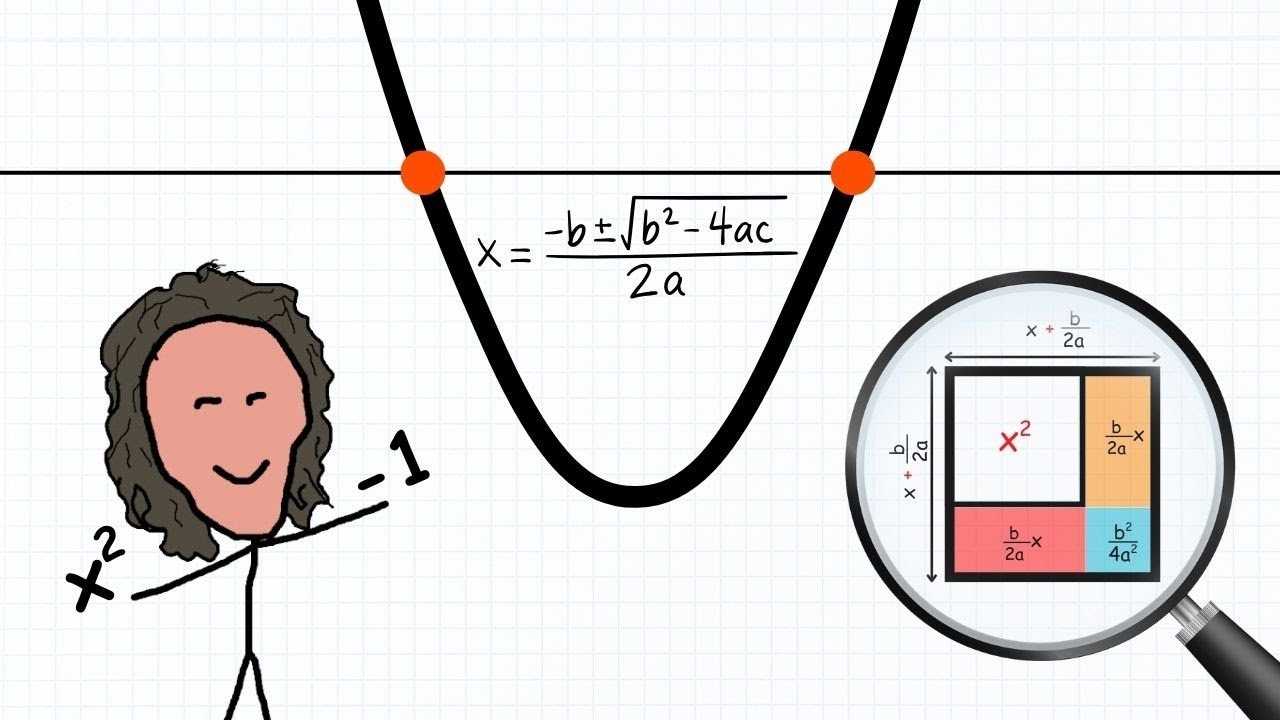
Complex numbers often arise when we are solving quadratic equations. We’ll begin with a simple equation: x² = −1. No real number satisfies this equation, so we extend our number system with a new number that does. This number is called i, also known as the imaginary unit, defined by the equality i² = −1.
If you multiply i by a real number, you get an imaginary number, such as 3i or 5i. From there, we can add together a real number and an imaginary number to get a complex number, such as 4 + 3i. Here, 4 is called the real part of this complex number and 3 is called the imaginary part. Note that every purely real number is considered a complex number. For example, the real number 6 can be expressed as 6 + 0i in complex number form. Similar logic applies to imaginary numbers.
We can visualize complex numbers in a two-dimensional plane where the horizontal axis represents the real part and the vertical axis represents the imaginary part. This is called the complex plane.
A Note on the Names
The names here are rather poorly fitting. Despite the terms “real number” and “imaginary number,” mathematicians don’t actually consider either one to be more or less real than the other. In fact, the names were invented by French mathematician René Descartes, who genuinely disliked the concept of imaginary numbers and didn’t understand how or why they would be useful (which they did turn out to be). Other names have been proposed, like “lateral number” by German mathematician Carl Friedrich Gauss, but “imaginary number” remains standard.
As for “complex number,” the word “complex” just means “having several parts” in this context, namely a real part and an imaginary part. However, it may give the false impression of meaning “complicated” instead, which is not a useful idea to express in a name.
Solving Quadratic Equations with Complex Numbers
Using complex numbers, we can now solve many quadratic equations that real numbers alone didn’t allow us to solve. In fact, every solution to every quadratic equation is a complex number (possibly a real or imaginary number).
Let’s look at an example: 3x² + 18x + 75 = 0. First, notice the coefficient of 3 in the 3x² term. Often it is more convenient to work with a coefficient of 1 on the x² term instead. To do this, we can divide both sides of the equation by 3, distributing the division to each term. The result is x² + 6x + 25 = 0.
Now let’s complete the square. If we subtract 25 from both sides, we get x² + 6x = −25. Draw a square with a side length of x. Then draw a rectangle with a width of 6 and a height of x. Cut the rectangle vertically in half and attach these two new rectangles to the sides of the square representing x². This forms a shape like a big square except for a missing gap. We fill in the gap with a plug that completes the square. The plug is a small square with side lengths of 3 and an area of 9.
So we add 9 to both sides of x² + 6x = −25, giving us x² + 6x + 9 = −16. The big square has side lengths of x + 3, so we can rewrite this as (x + 3)² = −16.
Working with Imaginary Solutions
From this point, we can’t use the same absolute value trick that works when staying in the real numbers. The absolute value of a complex number is its distance from zero in the complex plane, just like the absolute value of a real number is its distance from zero on the real number line. This can be calculated using the Pythagorean theorem. The main point is that an actual geometric distance only makes sense as a non-negative real number, so that is what the absolute value of a complex number must be. In our equation, we can’t just take the square root of both sides and get a non-negative real number on the right.
Still, we can split the equation into two cases based on the available possibilities. We know that the square root of 16 is 4. So what happens if we take the square of 4i? That’s 4i × 4i, which can be rearranged to 4² × i² = 16 × (−1) = −16. We can also take the square of −4i, giving us (−4i)(−4i) = (−4)² × i² = 16 × (−1) = −16.
So we split our equation into two cases: x + 3 = 4i and x + 3 = −4i, which can also be written as x + 3 = ±4i for shorthand. To solve for x, we subtract 3 from both sides. This gives us our final answer: x = −3 ± 4i. In other words, x = −3 + 4i or x = −3 − 4i. These are the solutions of 3x² + 18x + 75 = 0.
A Quick Aside on the Definition of i
At this point you might have noticed that while x = i is a solution to the equation x² = −1, so is x = −i. This may raise the question: if we define i to be a number whose square is −1, but −i is also a number whose square is −1, does that mean the definition doesn’t actually work?
The answer is that we arbitrarily select the number i as a particular solution to x² = −1. It turns out that we could just as well have called the other one i, and we wouldn’t be able to tell the difference when doing math.
Deriving the Quadratic Formula
To close things out, let’s derive the quadratic formula. This formula is usually presented without explanation to algebra beginners, and it probably just looks incredibly confusing and random. However, figuring out why something is true in math goes a long way toward understanding it. We can derive this formula by simply using completing the square in the general case.
We have a general quadratic equation ax² + bx + c = 0, assuming that a ≠ 0. We want the coefficient of x² to be 1, so we start by dividing everything by a. This gives us x² + (b/a)x + c/a = 0. Now we subtract the constant term c/a from both sides: x² + (b/a)x = −c/a.
Now we represent the left-hand side as an area. For x² we draw a square with side length x. For (b/a)x we draw a rectangle with height x and width b/a. We vertically cut the rectangle in half. Each resulting rectangle still has a height of x, and since the original width is b/a, dividing by 2 gives us b/(2a). We attach one rectangle to the right of the square and rotate the other a quarter turn to attach it to the bottom.
This shape almost looks like a square, but there is a missing gap in the bottom right. We fill it with a smaller square of side length b/(2a). Its area is [b/(2a)]² = b²/(4a²). We add this to both sides of our equation, giving x² + (b/a)x + b²/(4a²) = b²/(4a²) − c/a.
Now the left-hand side represents the area of the completed square. Its side length is x + b/(2a), so we can rewrite the left side as (x + b/(2a))².
Since we have something squared on the left, we take the plus-or-minus square root of the right-hand side to get rid of the squaring: x + b/(2a) = ±√(b²/(4a²) − c/a).
To isolate x, we subtract b/(2a) from both sides. Now let’s simplify the expression under the square root. We want to combine the two fractions, so they need a common denominator. We take c/a and multiply top and bottom by 4a, giving 4ac/(4a²). Now we can combine: (b² − 4ac)/(4a²).
We distribute the square root to the top and bottom. The square root of 4a² is 2a (choosing the positive value for convenience, since the ± already accounts for both signs). Finally, since both fractions share the common denominator 2a, we combine them to get the familiar form:
x = (−b ± √(b² − 4ac)) / (2a)
And that is the quadratic formula, derived from first principles.
Further Reading
- Complex Numbers on MathWorld
- Completing the Square on MathWorld
- Quadratic Formula on MathWorld
- The Complex Plane on MathWorld
Leave a Reply