
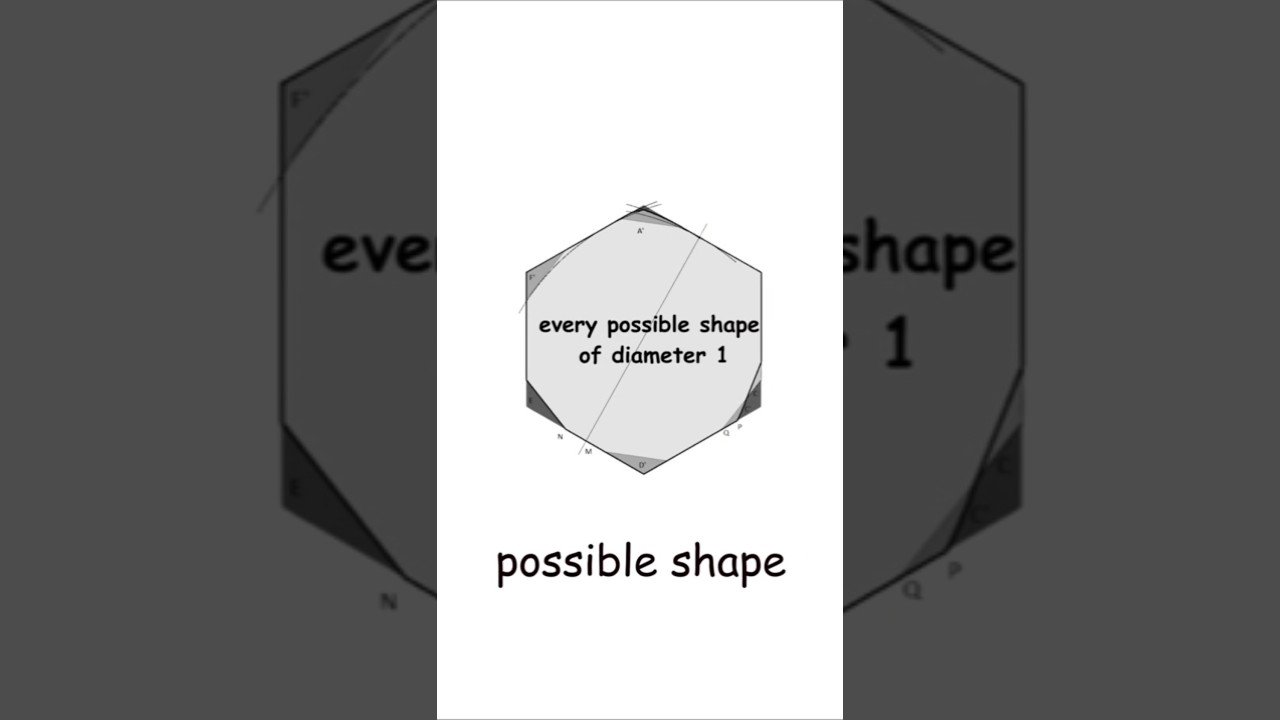
Imagine you are working in 2D and you have some kind of convex shape that can contain any shape with a diameter of one. Let’s call this shape the cover, since it can be used to cover up any of the diameter-1 shapes. The diameter-1 shapes can be translated (slid), rotated (spun around), and reflected (flipped) to fit inside the cover.
Lebesgue’s universal covering problem asks: what is the smallest area that this cover can have?
Curves of Constant Width
A key insight, shown by Gyula Pál, is that if you simply find a cover for all curves of constant width with a diameter of one, then it will also cover every possible shape of diameter 1. This dramatically narrows the problem.
The Best Known Solution
Pál also showed his best solution for such a cover: a regular hexagon with two corners snipped off. Its area is 2 − 2/√3, which is approximately 0.845.
Why Is This Problem Still Unsolved?
Lebesgue first posed this problem in a letter to Pál in 1914, and over a century later it remains open. While Pál’s hexagonal solution provided an early upper bound, mathematicians have been slowly chipping away at it ever since, shaving off tiny slivers of area through increasingly clever constructions. The difficulty is twofold: proving that a proposed cover actually contains every possible diameter-1 shape is extremely hard, and proving that no smaller cover exists is even harder. The problem sits at the intersection of geometry and optimization, and its deceptive simplicity has attracted both professional mathematicians and amateur problem solvers for over a hundred years. Despite steady incremental progress, no one has yet determined the exact minimum area.
Leave a Reply