
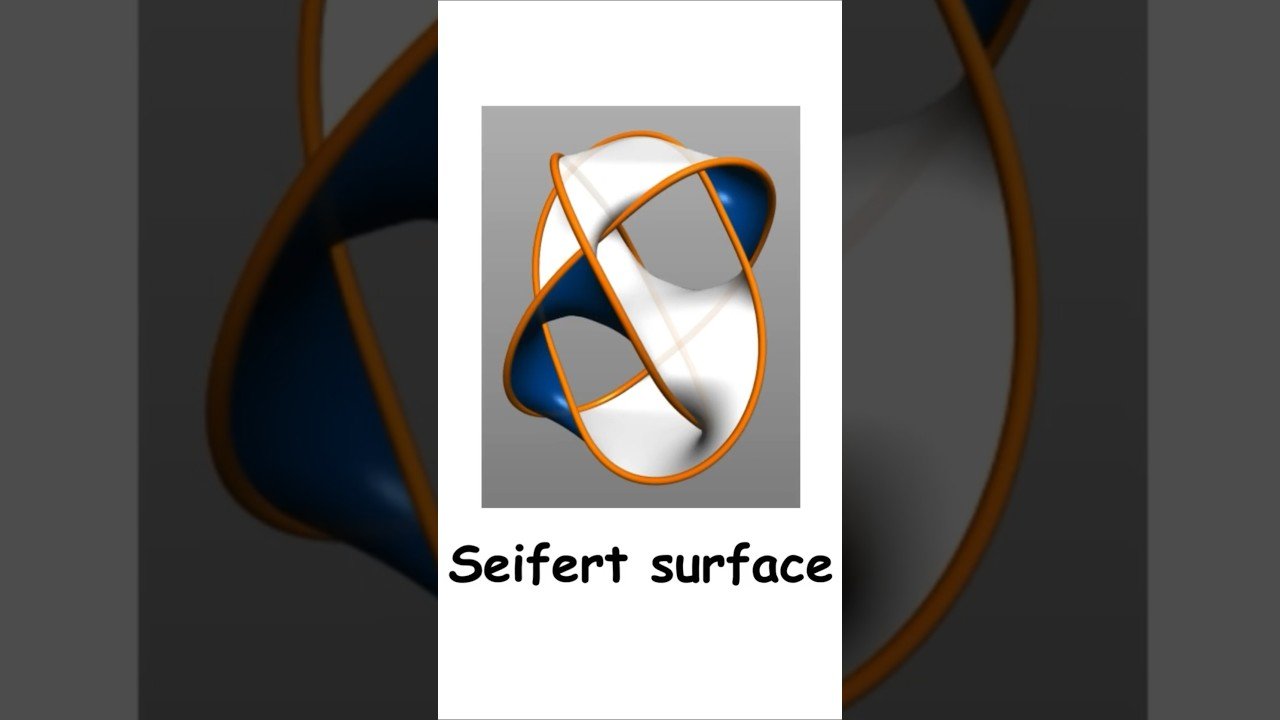
A Seifert surface, named after German mathematician Herbert Seifert, is an orientable surface whose boundary is a knot or link.
The Simplest Example
The simplest example is a disc, which is a surface whose boundary is a circle, and a circle is just an unknot. Note the requirement of orientability in the definition. A Möbius strip is not a Seifert surface even though its boundary is an unknot, because a Möbius strip is non-orientable.
Seifert Surfaces of Links
A Seifert surface formed by a Hopf link may look reminiscent of a Möbius strip, but it is actually topologically equivalent to an annulus, the plane region bounded by two concentric circles, and is thus orientable. A Seifert surface formed by the Borromean rings produces a more complex orientable surface bounded by all three interlocking loops.
Why Are Seifert Surfaces Important?
Seifert surfaces are a fundamental tool in knot theory, a branch of topology concerned with the mathematical study of knots and links. Seifert proved in 1934 that every knot and link in three-dimensional space has at least one orientable surface spanning it, a result that was far from obvious. These surfaces allow mathematicians to extract algebraic invariants from knots, such as the Seifert matrix and the Alexander polynomial, which help distinguish one knot from another. Knot theory itself has applications well beyond pure mathematics, appearing in molecular biology (where DNA strands form knots), chemistry (in the study of molecular topology), and theoretical physics (particularly in quantum field theory and string theory).
Leave a Reply