
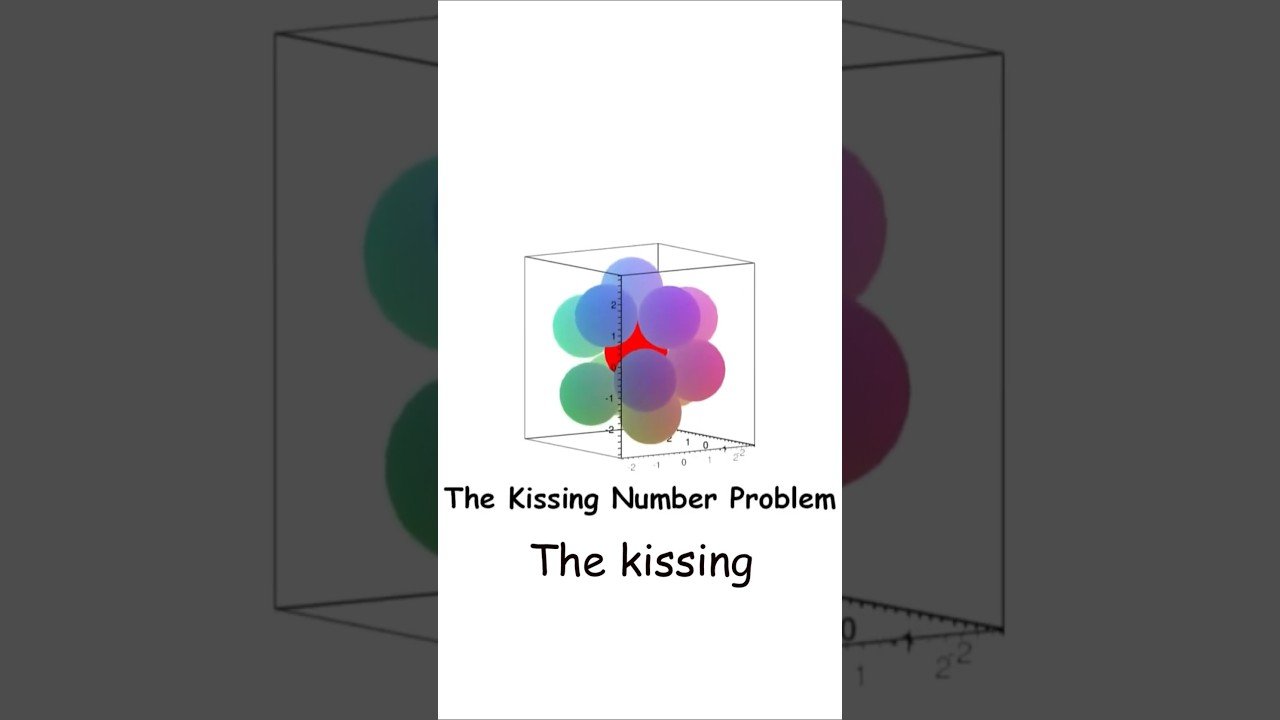
A broad category of problems in math are called sphere packing problems. They range from pure math to practical questions like figuring out how to stack fruit at the grocery store. Some of these problems have solutions, but others, like the kissing number problem, are still tricky.
What Is a Kissing Number?
When a bunch of spheres are packed in some region, each sphere has a kissing number, which is the number of other spheres it is touching. If you are touching five neighboring spheres, then your kissing number is five. A packed bunch of spheres will have an average kissing number, which helps mathematically describe the situation.
What Do We Know?
A basic question about the kissing number stands unanswered. A one-dimensional thing is a line, and a two-dimensional thing is a plane. For these low dimensions, mathematicians have proven the maximum possible kissing number. It is 2 when you are on a 1D line: one sphere to your left and the other to your right. There is proof of an exact number for three dimensions as well, although that took until the 1950s.
Beyond three dimensions, the kissing problem is mostly unsolved. Mathematicians have slowly whittled the possibilities to fairly narrow ranges for up to 24 dimensions, with a few exactly known. For larger numbers or a general form, the problem is wide open.
Why Is It Still Open?
The difficulty comes down to the geometry of high-dimensional space, which behaves in ways that defy our three-dimensional intuition. As dimensions increase, the number of possible sphere arrangements grows enormously, and ruling out configurations that might allow one extra touching sphere becomes extremely hard. There are several hurdles to a full solution, including computational limitations. Expect incremental progress on this problem for years to come.
Leave a Reply