
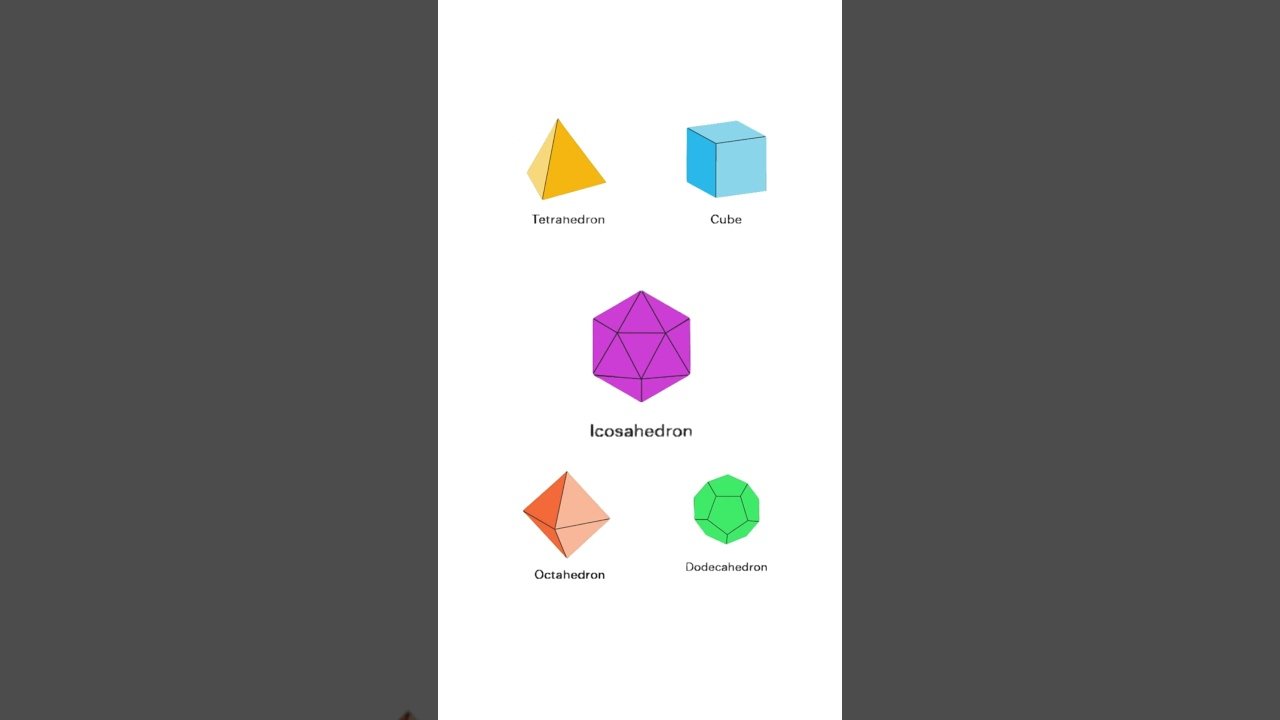
Advanced geometry includes the study of geometric bodies. The five Platonic solids are convex polyhedra such that all their faces are regular polygons equal to each other and in which all the solid angles are equal.
Why Only Five?
Here are the reasons why there are only five shapes and not more. For each of the five shapes, at least three faces meet at each vertex. The internal angles that meet at a vertex are less than 360°.
They are identified as:
The tetrahedron with four faces. The cube with six. The octahedron with eight. The dodecahedron with 12. And finally, the icosahedron with 20 faces.
The Vertex Angle Constraint
The restriction to exactly five solids comes from a simple geometric fact. At any vertex, you need at least three polygons to create a three-dimensional corner. But the sum of angles at that vertex must be less than 360°, otherwise the polygons would lie flat or overlap.
With equilateral triangles (60° each), you can fit three (tetrahedron), four (octahedron), or five (icosahedron) around a vertex. Six triangles would give exactly 360°, forming a flat plane. With squares (90° each), only three fit (cube). With regular pentagons (108° each), three also work (dodecahedron). But three hexagons already total 360°, so no Platonic solid exists with hexagonal faces.
This elegant constraint is why the Platonic solids have fascinated mathematicians and philosophers since ancient Greece.
Leave a Reply