
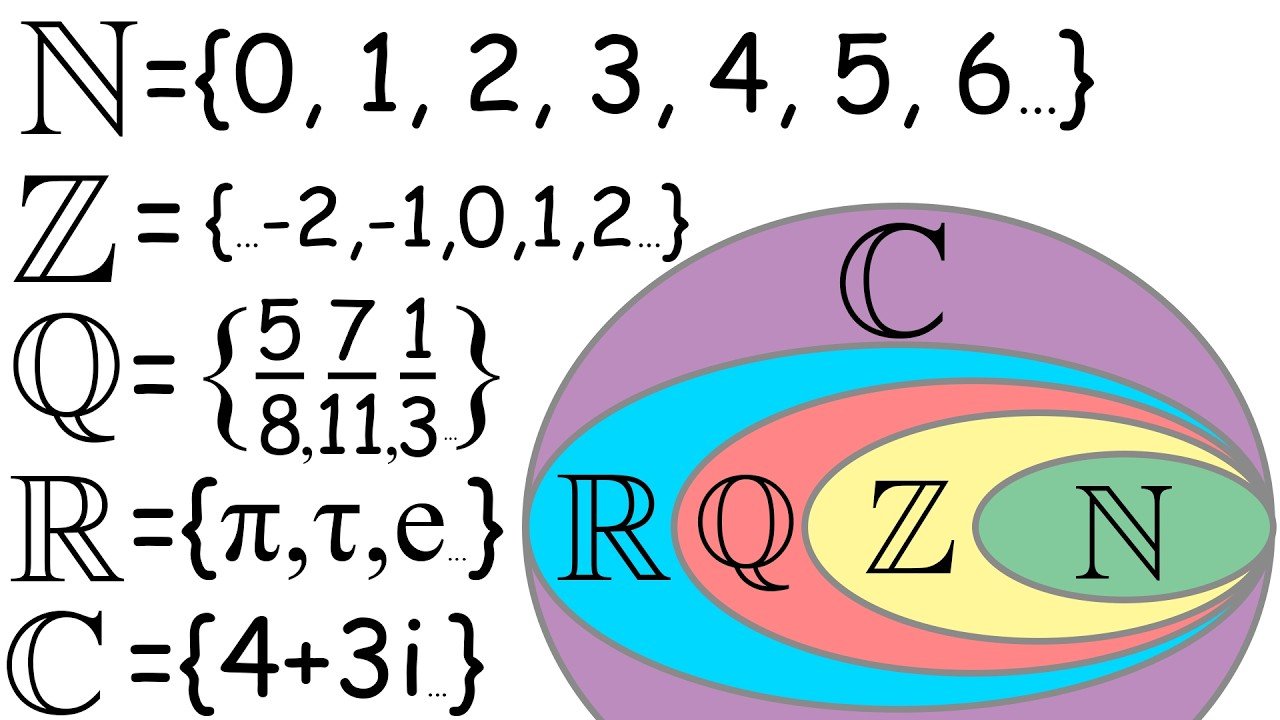
Natural Numbers
The story starts at the beginning of mathematics itself. Evidence of humans counting things goes back to the Paleolithic era, tens of thousands of years ago, with tally marks etched on various surfaces. Early humans could have been counting fruits, animals, or days. Whatever the case, it helped to keep track. With that, the counting numbers were invented. They’re more often called the natural numbers, which is not as helpful of a name, but it’s the mathematical standard. Based on this name, the set of natural numbers is written as ℕ in blackboard bold font.
When it comes to natural numbers, we must also discuss the number zero, representing the concept of nothing. Even though zero is a very basic number, it’s also very strange, so humanity struggled to accept its existence as a number for a long time. Just like any counting number, zero can represent a count of things: zero rocks, for example. Today, mathematicians accept the validity and usefulness of the number zero.
As for whether zero is considered a natural number, this varies based on the definition of the term. A set theorist would likely say that it is, while a number theorist might tell you that it isn’t. One might call the natural numbers including zero the “whole numbers” instead. This variance in definition is mainly just a matter of convenience, but it is also really confusing and tends to fuel arguments. From here on, we’ll refer to the natural numbers with zero included, in agreement with the set theory definition.
The set of natural numbers has certain special properties. Adding two natural numbers always gives you a natural number, and it’s the same for multiplying. Formally, the natural numbers are said to be closed under addition and multiplication. Another property is the identity elements. Zero is called the additive identity because adding zero leaves a number identical. Similarly, one is called the multiplicative identity. Finally, there are the commutative and associative properties of addition, the associative property of multiplication, and the distributive property. Since the set of natural numbers with these operations satisfies these properties, they form a structure called a semiring. In particular, multiplication is also commutative, so it is a commutative semiring.
Integers
You can use subtraction to represent spending money. If you start with $7 and you buy something for $3, then you end up with $4. But what if you had started with $2 instead? Well, maybe the seller is generous and lets you get the item anyway, but you have to pay $2 now and $1 later. In other words, you owe a debt of $1 to the seller.
Historians believe that this is the context in which negative numbers were first considered, as it features in the earliest known record of negative numbers: the Chinese work “Nine Chapters on the Mathematical Art” from around 200 BC. For now, we’ll focus on a specific subset of these negative numbers, the negative versions of the natural numbers. Taking the natural numbers and combining them with their negative versions, we have the integers.
The word “integer” comes from Latin meaning “intact” or “whole.” The symbol for the integers is ℤ (blackboard bold Z), from the German word “Zahlen” meaning “numbers.”
The integers with addition and multiplication satisfy the same properties that were satisfied by the natural numbers. In addition, now we can include subtraction as well. An integer minus an integer will always be an integer. This is because for each integer we can find an integer so that the sum of the two is zero. The two integers are called the additive inverses of each other because they cancel out when added together. Thus, subtracting a number is the same as adding its additive inverse. For instance, 2 − 3 is the same as 2 + (−3).
With the additional property of an additive inverse, the set of integers with addition and multiplication is known as a ring. In particular, it is a commutative ring since multiplication is still commutative.
Rational Numbers
Chances are that you’ve heard of fractions before, dividing one number by another. Humans have likely had an intuitive understanding of fractions for a very long time, but the earliest widely accepted written records of fractions come from the ancient Egyptians, from around 1800 BC.
A rational number is defined as the ratio of two integers, a numerator and a denominator. Notice the “ratio” in “rational.” This set of numbers is denoted using ℚ (for “quotient,” meaning the number you get from a division).
There is one important restriction: you are not allowed to divide by zero. It is common math knowledge that division by zero causes a lot of problems.
The rational numbers with addition and multiplication satisfy all of the properties from the previous structures. However, we’re now able to include division as well. For almost every rational number, we can find a rational number where multiplying the two together gives you 1. These two numbers are called the multiplicative inverses of each other, also known as reciprocals, which can be obtained by swapping the numerator and denominator. The only exception is zero, which has no multiplicative inverse since anything times 0 is 0.
Just like how subtracting is the same as adding the additive inverse, dividing is the same as multiplying by the multiplicative inverse. For example, 2/4 is the same as 2 × (1/4). Starting from addition and multiplication, we now have all four basic operations. Thus the rational numbers with addition and multiplication form a structure called a field.
However, this number system still has some gaps. Consider a number that, when multiplied by itself, gives you 2. This number is called √2, which was discovered not to be a rational number by the Pythagoreans of ancient Greece. Such numbers are called irrational numbers, and there are infinitely many of them. In order to complete our number line, we will have to fill in the gaps.
Real Numbers
When we remove the holes in the rational numbers, we get a set of numbers called the real numbers, symbolized by ℝ. To obtain the real numbers, we can choose any of various different constructions. In these constructions, it is possible to take advantage of the properties of the rational numbers.
For example, even though √2 is not a rational number, you can still find rational numbers that are as close to √2 as you want: 14/10, 141/100, 1414/1000, and so on. If you partition the rational numbers into those that are less than √2 and those that are greater than √2, it is possible to uniquely define the value of √2.
In general, each real number x cuts the set of rational numbers into one set containing all the rational numbers less than or equal to x, and another set containing all the rational numbers greater than x. Thus such a pair of sets can be used to determine the value of x. This kind of cut is called a Dedekind cut, named after German mathematician Julius Wilhelm Richard Dedekind.
Like the rational numbers, the real numbers with addition and multiplication form a field. However, because the real numbers have no holes, they are called continuous. Due to this, they can be used to represent continuous quantities, for example length. In addition, they are used as a basis for calculus, the study of continuous change.
Complex Numbers
There is still one remaining issue. What if you want to take the square root of a negative number? Does that concept even make sense?
Consider the equation x² = −1. In the real numbers, there is no solution for x. You cannot multiply a real number by itself to get a negative number. However, just like before, we can solve this by inventing a new number system. In this case, we define a new number i using the equality i² = −1. This is called the imaginary unit, and by multiplying it with any real number, we get a new system of numbers called the imaginary numbers.
In fact, this reveals how the real numbers got their name: to contrast them with the imaginary numbers. This naming scheme was established by French mathematician René Descartes in the 17th century, which he did solely to mock the concept of so-called imaginary numbers, which he thought were ridiculous. Of course, numbers are just invented constructs used to model reality, and these particular numbers turned out to be extremely useful. However, mathematicians still adopted these names and never got around to changing them.
If you add a real number and an imaginary number, what you get is called a complex number. Here “complex” is in the sense of containing several parts: a real part and an imaginary part. The set of complex numbers is denoted ℂ.
This can be visualized using a plane in Cartesian coordinates (ironically also named after Descartes) with a horizontal coordinate and a vertical coordinate. The horizontal axis is the real line, whereas the vertical axis is the imaginary line. Complex numbers can be represented within this plane, known as the complex plane.
Complex numbers are useful for modeling a wide array of phenomena, particularly rotations, which can be modeled by complex number multiplication. And yes, every complex number has a square root that is also a complex number. So our journey through the number sets is finally complete.
Further Reading
- Natural Numbers on MathWorld
- Integer on MathWorld
- Rational Numbers on MathWorld
- Dedekind Cut on MathWorld
- Complex Numbers on MathWorld
Leave a Reply